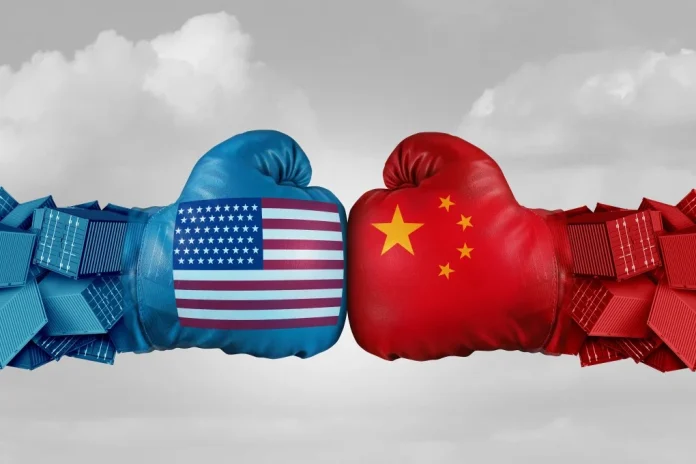


In a major geopolitical milestone that reshapes the future of global technology and industry, China has officially overtaken the United States as the world’s largest investor in Research and Development (R&D).
According to consolidated data released by the Organisation for Economic Co-operation and Development (OECD), China’s Gross Domestic Expenditure on R&D has crossed the historic threshold to reach parity with—and structurally surpass—American spending when measured on an internationally comparable Purchasing Power Parity (PPP) basis.
The report marks the first time since the United States displaced the United Kingdom in 1948 that a foreign rival has held the top spot in global innovation funding.
The Trillion-Dollar Crossing: Breaking Down the Numbers
The macroeconomic realignment is the result of two opposing funding velocities. While China has maintained a multi-decade, double-digit acceleration in its scientific budgets, federal and public R&D growth in the United States has steadily cooled.
The newly updated figures show both superpowers officially operating in the trillion-dollar research bracket:
| Country / Region | Gross Annual R&D Expenditure (PPP) | Global Output Share (1960 vs. Present) | Core Funding Anchor |
| China | $1.03 Trillion (3.92T Yuan equivalent) | From near-zero to Global Leader | State-directed enterprise & basic science hubs |
| United States | $1.01 Trillion | Fell from 69% (1960) to under 30% | Commercial development & corporate software |
While the nominal gap stands at a relatively narrow $20 billion, the underlying trajectories tell a deeper story. Since 2004, China’s inflation-adjusted R&D allocation has scaled at an average clip of more than 12% annually—more than triple the sluggish U.S. baseline expansion rate over that same span.
The Metric Shift: Output, Citations, and Patents
The spending milestone serves as the ultimate financial validation for a series of rapid structural takeovers in academic and scientific output that have materialized over the last several years:
- The Nobel-Class Papers (2019): China pulled past the United States in its net volume share of the top 1% most highly-cited, groundbreaking scientific publications.
- The Nature Index (2024): Chinese research institutes claimed first place in the selective Nature Index, tracking papers published in the world’s most elite, gold-standard peer-reviewed journals.
- The Patent Avalanche (2024–2025): According to the World Intellectual Property Organization (WIPO), China’s intellectual property offices processed 1.8 million patent applications in a single year—nearly triple the 603,191 filings managed by the U.S. Patent and Trademark Office (USPTO).
The Structural Divide: Where the Money Goes
Crucially, the two superpowers deploy their trillion-dollar war chests in fundamentally different ways. For economists, the core concern for the United States is not a lack of private cash, but a structural shift in the nature of the investment.
1. The U.S. Commercial Focus
American R&D is heavily dominated by the private sector, which funds and executes roughly 77% of all domestic research. However, Wall Street incentives prioritize late-stage commercial development over basic scientific discovery. Trillions of private dollars are channeled into localized SaaS platforms, consumer apps, biotechnology productization, and semiconductor circuit layouts. Conversely, long-term federal funding for pure, open-ended basic science has shriveled from a mid-century peak of 1.86% of GDP down to a modern low of roughly 0.66%.
2. China’s Hard-Tech Priorities
Backed by the State Council’s sweeping development targets, China has directed its capital engine into tangible, heavy-tech engineering verticals. The Ministry of Science and Technology confirmed that funding for basic research hit a historic high of 7.08% of its total footprint, fueling massive, state-backed breakthroughs in humanoid robotics, advanced solid-state battery technology, deep-tier gene editing, and foundational open-source AI frameworks like DeepSeek.
Policy Pressures and the Global Talent War
The funding crossover has ignited immediate alarm bells across Washington, prompting immediate pushback from think tanks like the Information Technology and Innovation Foundation (ITIF) and Brookings.
Compounding the funding pinch, U.S. academic institutions are dealing with severe geopolitical headwind strains. The federal freezing and increased security scrutiny of key university grants, paired with tightening international immigration and visa restrictions, have heavily disrupted the global talent pipeline.
Given that foreign-born immigrants have historically contributed to nearly 40% of all American Nobel Prizes since 2000, policy-driven limits on scientific openness risk triggering a permanent talent drain back toward expanding research complexes in Shanghai, Beijing, and Singapore.
With China leveraging its spending dominance to establish three dedicated international centers for sci-tech innovation, Western policymakers are faced with a starkly rewritten playing field. Moving forward, the strategic challenge for Washington is no longer figuring out how to maintain an uncontested lead, but mapping out how to prevent its critical economic and defense infrastructure from permanently falling behind a well-funded peer competitor.