Key takeaways
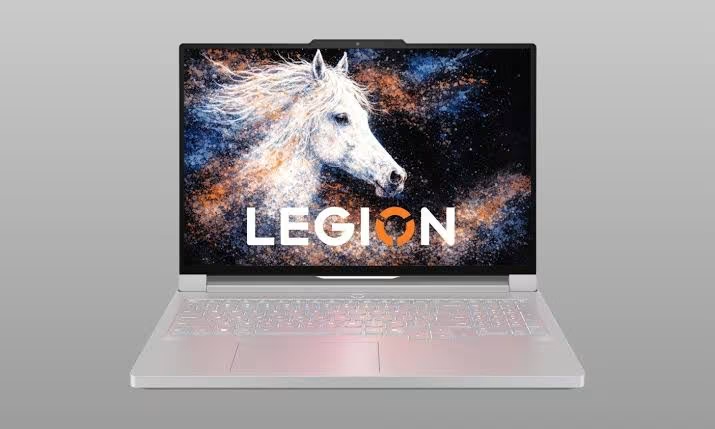
- Lenovo says its new Legion R9000P is the first inkjet OLED laptop.
- Inkjet printing could make OLED screens cheaper to build, so prices may fall over time.
- OLED means each pixel lights itself, which helps with deep blacks and strong contrast.
- This does not mean every budget laptop gets OLED soon, but it could push the market that way.
Lenovo has launched an inkjet OLED laptop in its Legion R9000P line. An inkjet OLED laptop is a notebook whose OLED screen is made with a print-like process, instead of older display methods. That matters because printing the screen may waste less material. So the big promise is lower cost with the same rich OLED look.
What did Lenovo announce?
Lenovo introduced the Legion R9000P as what it calls the world’s first inkjet OLED laptop. The news matters because OLED screens usually cost more than standard LCD screens. LCD means liquid crystal display. It uses a backlight behind the panel.
OLED is different because each pixel makes its own light. That means darker blacks, punchier color, and better contrast. Contrast is the gap between bright whites and deep blacks. In games and films, that can make scenes look more real.
The Legion brand is known for gaming laptops, not cheap school notebooks. But this launch still matters for budget buyers, because new factory methods often start in premium devices and then move down. That’s how many features spread in tech. First expensive, then more normal.
How does an inkjet OLED laptop screen work?
An inkjet OLED laptop screen uses a process a bit like very precise printing. Tiny drops of OLED material get placed where the screen needs them. Because the material goes only in selected spots, makers may waste less of it.
That is different from vacuum deposition, the older common method for OLED. Vacuum deposition is a factory process that lays material across a surface in a sealed chamber. It can work well, but it may waste more material, especially on larger panels.
Think of it like frosting a cake. The old way can spread frosting everywhere and scrape some off. The print-like way tries to place each bit where it belongs from the start. So, in theory, the printed method can cut waste and lower manufacturing cost.
TechRadar reported that this laptop uses inkjet-printed OLED from TCL CSOT, a large display maker. You can read Lenovo’s product page here and learn more about OLED basics from OLED-Info.
Why could an inkjet OLED laptop be cheaper?
The key reason is waste. Display materials can be expensive, so every bit saved matters. If a factory wastes less organic material, its cost per panel can fall. Organic here means carbon-based light-making material inside the screen.
Factories also care about yield. Yield is the share of good panels that come out ready to sell. If a new process gives high yield and low waste, prices can improve fast. But if yield is weak, savings can disappear.
That’s why this story is interesting but not magic. A single inkjet OLED laptop does not prove all future OLED laptops will get cheap. It shows the idea is moving from demos into a real shipping product. That’s the first step that counts.
For buyers, even small cost changes matter. If a panel cost drops by 10% or 15%, a brand might use that saving to lower price or add better parts. For example, it could include more storage, faster memory, or a larger battery at the same price.
What numbers matter here?
One number stands out: 1. Lenovo is pitching this as the first inkjet OLED laptop on sale. Another useful number is 2, because two big things shape success: cost and yield.
Then there is the screen market itself. OLED laptops have grown in recent years, but they still sit above many LCD models on price. In many stores, OLED versions can cost hundreds of dollars more than similar LCD notebooks. That gap is why cheaper production matters.
Gaming laptops also sit in a busy price band. A mid-range gaming model often lands around $1,000 to $1,500, while premium machines run much higher. If printing helps narrow display costs, that could reshape value in this segment.
Why the new method mattersOlder OLEDInkjet OLEDHigher wasteLower wasteRelative material waste
Should buyers care right now?
Yes, but with calm expectations. This inkjet OLED laptop is not a sign that every cheap laptop will suddenly get a stunning OLED panel this month. Supply chains move slowly, and factories need time to prove they can make lots of panels well.
Still, this launch is a real signal. It says display makers think the process is ready for more than lab talk. If more brands adopt it, competition could rise. And when competition rises, prices often soften.
That could matter beyond gaming laptops. Students, remote workers, and creators all like better screens. A screen is the part you stare at for hours. So even a modest price drop can make nicer displays reach many more people.
If you are shopping now, don’t buy on the buzzword alone. Check brightness, battery life, burn-in protection, and warranty terms too. Burn-in is a faint image that can stay on a screen after heavy use. Newer OLED panels are better at handling it, but the risk is not zero.
How does this fit the wider laptop market?
Laptop makers are under pressure to add features without pushing prices too high. That is hard because chips, memory, cooling, and screens all cost money. A cheaper OLED path could help brands balance that puzzle.
We’ve seen similar trade-offs in other tech areas. In India, for example, companies keep chasing better value in hiring and devices, as seen in our report on IT hiring stabilisation. Hardware firms face that same math every day.
The move also fits a broader trend in electronics manufacturing. Companies want more efficient production, less waste, and faster scale. You can see that push in other supply-chain stories too, such as our coverage of the CXMT Shanghai IPO, where factory economics matter a lot.
| Feature | Older OLED making method | Inkjet OLED method |
|---|---|---|
| Material use | More waste likely | Less waste likely |
| Main promise | Great picture quality | Great picture plus lower cost |
| Market stage | Established | Early commercial use |
| Buyer impact | Often pricey | Could become more affordable |
What’s the big takeaway on inkjet OLED laptop tech?
Here’s the plain answer: an inkjet OLED laptop could make premium-looking screens less expensive to build, but only if factories can make them reliably at scale. That is why Lenovo’s launch matters. It turns a promising idea into a product people can actually buy.
For now, think of this as an early clue, not the final result. If this first model performs well and more brands follow, OLED could move closer to the mainstream. And that would be very good news for laptop buyers who want a better screen without paying a painful premium.
FAQs
What is an inkjet OLED laptop?
An inkjet OLED laptop uses an OLED display made with a print-like process. The goal is to waste less material and lower screen cost.
Why is Lenovo’s launch a big deal?
It may be the first real shipping laptop to use this method. That makes the tech feel practical, not just experimental.
Will this make all OLED laptops cheap soon?
Probably not right away. Factories need time to improve output, test quality, and scale production before prices fall across the market.
How is OLED better than LCD?
OLED pixels light up on their own, so blacks look deeper and contrast looks stronger. LCD uses a backlight, which usually cannot match that effect as well.
Get the day’s top stories in your inbox
One concise email. No spam, unsubscribe anytime.