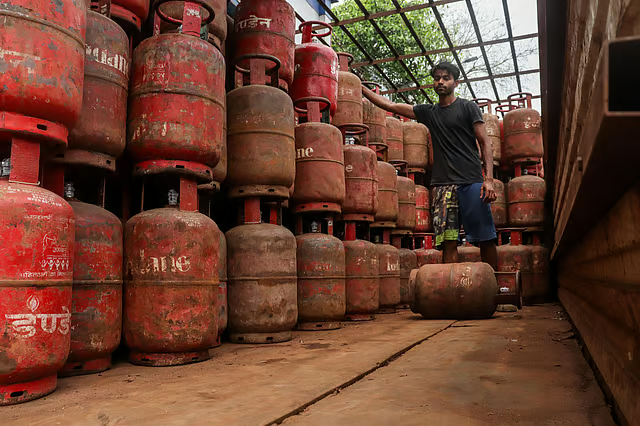
India’s imports of liquefied petroleum gas (LPG)—the vital cooking fuel used across millions of Indian households—are on track to cross a record 1 million metric tons from the United States in June 2026.
This unprecedented surge marks a massive geopolitical rebalancing of India’s energy basket, forced by recent maritime blockades and conflicts in West Asia that severely choked off traditional trade corridors.
1. Grounding the Sourcing Pivot
Historically, India has been intensely reliant on the Gulf region for its cooking gas infrastructure. The recent maritime disruptions completely transformed that dynamic:
- The Pre-War Baseline: Before the conflict and the subsequent closure of the Strait of Hormuz, India sourced roughly 90% of its imported LPG from West Asian producers, bringing in roughly 2 million tons per month.
- The Supply Crash: Following the blockade, India’s total LPG imports plummeted to a low of 696,000 tons in April.
- The American Rescue Line: To protect households from severe shortages, Indian state-owned refiners pivoted aggressively to the West. The U.S. share of India’s LPG import basket skyrocketed from just 8% in February to nearly one-third by April, culminating in the projected 1.07 million to 1.2 million tons scheduled to arrive from the U.S. this June.
2. The Microeconomic Strain: Paying the “Spot Premium”
While the pivot successfully kept Indian kitchens running, it came at a staggering financial cost to the country’s energy infrastructure.
February 2026 ──► US Share of India LPG Imports: 8%
April 2026    ──► US Share of India LPG Imports: ~33%
June 2026     ──► US Total Volume: >1 Million Metric Tons (Historic Peak)
Sourcing gas from the U.S. Gulf Coast requires much longer shipping transit times and dramatically higher freight expenses. Because New Delhi had to aggressively buy up uncontracted cargoes on the spot market, Indian refiners paid hefty spot market premiums. This premium was further exacerbated by a 46% spike in the global Saudi Aramco Contract Price benchmark between February and June.
3. The ₹22,000 Crore Under-Recovery Cushion
To prevent catastrophic food inflation and public backlash, the Government of India opted to shield domestic retail consumers from the worst of the global price surge:
- Commercial vs. Household Split: Between February and June, the price of a 19-kg commercial LPG cylinder was allowed to surge by more than 79% to reflect market realities. However, the price of a standard 14-kg household cylinder in Delhi was capped, rising only about 10% (to around ₹942).
- The Deficit Burden: Because the actual procurement cost of a household cylinder ballooned past ₹1,600, state-owned Oil Marketing Companies (OMCs) like IOCL, BPCL, and HPCL absorbed massive losses. The under-recovery rose to ₹651 per domestic cylinder in May, resulting in an estimated ₹22,000 crore in cumulative OMC losses between March and May.
4. The Path to De-escalation
The extreme reliance on high-cost American spot cargoes is expected to ease into the third quarter. Following the signing of an interim memorandum of understanding between the U.S. and Iran, the partial reopening of the Strait of Hormuz has allowed traditional Middle Eastern flows to gradually recover.
The UAE has already begun ramping up shipments back toward 300,000 to 400,000 tons for June—utilizing alternative routing mechanisms like deploying dedicated vessels to load free-on-board cargoes from Oman’s Sohar port. While a long-term 2.2 million-tonne-per-annum supply contract signed with the U.S. in late 2025 will ensure American gas remains a permanent 10% anchor of India’s energy portfolio, the normalization of the Gulf shipping lanes will allow New Delhi to steadily bleed off its reliance on hyper-expensive spot market alternatives.