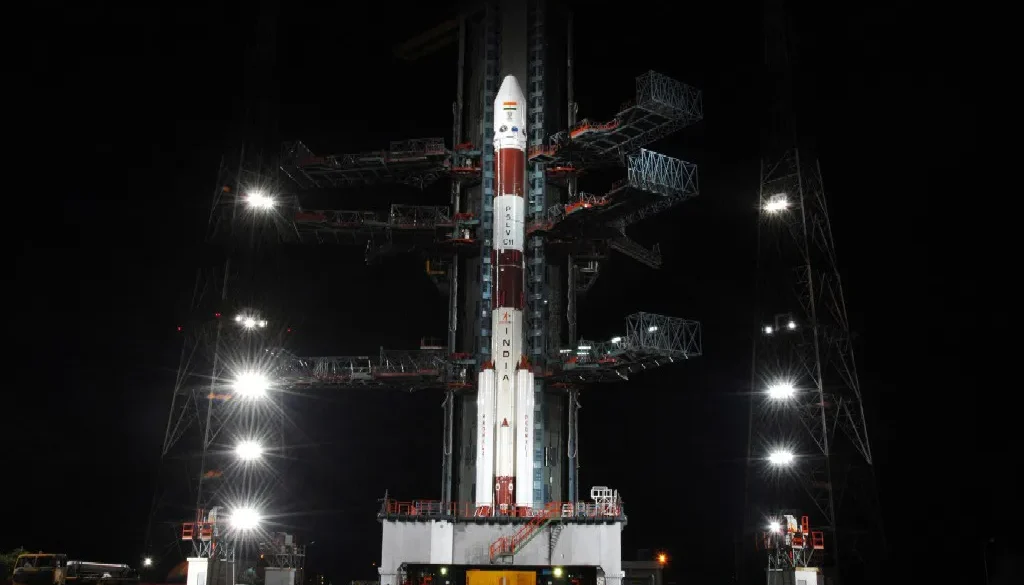
India’s space regulator, IN-SPACe (Indian National Space Promotion and Authorisation Centre), has officially released an Expression of Interest (EoI) to fully share and transfer the technology of the Polar Satellite Launch Vehicle (PSLV) to local private firms.
The strategic move aims to aggressively commercialize India’s space ecosystem, transforming the country into a global, high-volume hub for small and medium satellite launches by shifting the burden of rocket manufacturing onto the private sector.
1. The Crown Jewel: Why the PSLV?
The PSLV is widely regarded as the workhorse of the Indian Space Research Organisation (ISRO). With a stellar legacy spanning over 60 launches, the medium-lift rocket is globally famous for its reliability, having successfully sent India’s historic missions to the Moon (Chandrayaan-1) and Mars (Mangalyaan).
By handing over the complete technology stack of a proven, operational launch vehicle, the government is bypassing years of expensive, trial-and-error R&D for local aerospace firms.
2. Strict Qualification Hurdles
The government is not handing out this tech loosely. To prevent sensitive ballistic and structural engineering from falling into the wrong hands, IN-SPACe has set an incredibly high bar for applicants:
- Sovereign Control: The opportunity is strictly limited to companies that are majority-owned and controlled by Indian citizens.
- Domain Maturity: The bidding entity (or at least one member of a bidding consortium) must possess a minimum of five years of active experience in the space or aerospace domain.
- Financial Muscle: To ensure the firm can actually handle heavy industrial scale, the company must have an annual turnover exceeding ₹400 crore in three of the last five years, or carry an independent corporate valuation of at least ₹1,000 crore.
3. The 30-Month Transition Cushion
To make sure the private sector successfully absorbs the complex manufacturing pipelines—covering everything from solid rocket boosters to liquid propulsion and avionics staging—ISRO will act as a close partner.
The space agency will provide intensive, hands-on infrastructural support and technical guidance for a defined period of 30 months, or until the selected private player builds and successfully launches its first two private PSLV vehicles, whichever comes earlier.
[Tech Transfer Finalized] ──► 30-Month ISRO Hand-holding ──► Target: 2 Private PSLV Launches
4. Bolstering Capacity Amid Recent Setbacks
The aggressive push for privatization comes at a critical time for India’s upstream space economy. While the space startup ecosystem has exploded from a single player in 2014 to over 400 firms, the public sector launch pipeline has hit a temporary bottleneck, with two consecutive PSLV missions encountering failures over the past year.
Pawan Goenka, Chairman of IN-SPACe, dismissed concerns over the recent setbacks, calling them transient anomalies in an otherwise world-class track record. The move to offload PSLV production frees up ISRO’s core scientists to focus on deep-space exploration—like the upcoming Venus orbiter (Shukrayaan) and the uncrewed phases of the Gaganyaan human spaceflight program—while local conglomerates and heavy-industry consortiums step in to monetize the booming global commercial launch market.