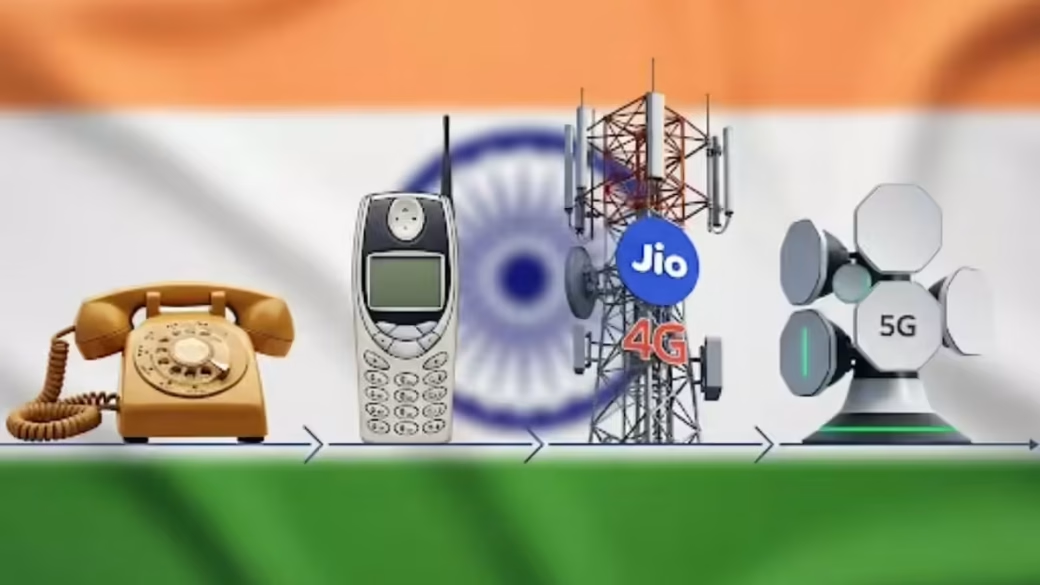
The Department of Telecommunications (DoT) has officially dismantled India’s decades-old telecom licensing regime, notifying the new Telecommunications (Authorisation for Provision of Telecommunication Services) Rules, 2026.
This shift moves the entire telecom sector from an antiquated, contract-based licensing framework over to a modern, statutory authorization model under the historic Telecommunications Act, 2023. Along with the rules, the government launched the unified “Telecom eServices Portal” to accept fresh applications and manage transitions completely digitally.
1. The Core Paradigm Shift: Contract vs. Statute
The move from a “License” to an “Authorization” is not just a cosmetic name change—it radically alters the legal relationship between the Indian Government and telecom operators (like Jio, Airtel, Vodafone Idea, and upcoming satellite players):
- The Legacy Bilateral Model: Previously, a telco signed a formal, bilateral contract (Unified License) with the DoT. If the government wanted to change a rule midway, telcos could challenge it in courts or tribunals as a contractual breach.
- The New Unilateral Model: Under the 2026 framework, the government unilaterally issues an Authorization to an eligible entity once they meet predefined statutory parameters. Future rules, security guidelines, or operational directives issued by the Centre automatically become part of the authorization conditions—effectively eliminating the concept of a “contractual breach of agreement.”
  [ Old Framework ]  Bilateral Contract (Unified License) ──► Modifications could be challenged as a Contract Dispute

  [ New Framework ]  Statutory Authorization            ──► Unilateral Government Grant; Violations = Lawbreaking
2. Structural Categories & Private Network Rules
The rules split telecommunication capabilities into specific network layers, making it significantly easier to deploy targeted enterprise networks:
- Network & Virtual Operators: Any eligible company can apply to become a Network Service Operator (NSO), a Virtual Network Operator (VNO), or both, spanning National Unified, Regional Access, Wireline Access, or Internet Service portfolios.
- Captive Networks (CNPN) Eased: The rules establish a frictionless path for private enterprises to set up Captive Non-Public Networks (CNPN) inside factories, ports, industrial campuses, and data centers with zero authorization fees.
- The Subsea Cable Loophole Lifted: Under the 2026 captive rules, a “telecommunication network” explicitly encompasses subsea infrastructure. Large enterprises or hyperscalers can land their own private subsea cables and route dark fiber straight to their facility PoPs (Points of Presence), entirely bypassing the premium “backhaul” fees historically charged by major licensed telecom cartels.
3. The Major Financial Win: Clean AGR Definitions
To the massive relief of the industry, the 2026 framework codifies a permanent resolution to the multi-decade legal wars surrounding Adjusted Gross Revenue (AGR):
Excluding Non-Telecom Cash: The new authorization rules explicitly clarify that non-telecom revenues are completely excluded from the baseline AGR calculations used to determine license/spectrum fees. Telcos will no longer be financially penalized or taxed on revenues generated from dividend income, handset sales, property rent, or unrelated digital enterprise services.
4. Operational Transition & Enforcement Matrix
For companies currently running active services across India, the DoT has laid down clear continuity parameters to prevent disruption:
| Operational Vertical | Legacy Framework Rulebook | New 2026 Authorization Paradigm |
| Active License Status | Allowed to run unhindered until the original validity period of the legacy Unified License expires. | Operators can voluntarily migrate to the authorization platform early, or will be forced onto it at renewal time. |
| Dispute Resolution | Handled through general commercial arbitration, civil courts, or contract tribunals. | Managed internally by a state-appointed Adjudicating Officer and an Appeals Committee, with escalation rights to the TDSAT. |
| Data Sovereignty Guardrails | Varied routing allowances with offshore storage parameters. | Absolute Data Localization: Mandates that all data, system logs, and user traffic must remain strictly inside India with no foreign routing allowed. |
The notification officially ends an eight-month stasis in the telecom sector, during which the DoT had completely frozen the processing of new carrier and internet service provider licenses. By lifting the freeze and taking the process “digital by design,” the government aims to drastically lower entry friction for specialized enterprise networks and low-earth orbit satcom operators while simultaneously establishing absolute statutory sovereignty over national communication networks.