Following the successful nationwide rollout of E20 petrol, the Government of India is officially extending its biofuel playbook to diesel.
A high-powered, government-backed task force has launched validation trials of a 2% isobutanol-diesel fuel blend. The initiative is a highly strategic pivot aimed at cutting crude oil imports and lowering commercial transport emissions after earlier, multi-year attempts to blend ethanol into diesel completely failed.
1. The Pilot Phase Setup
The validation program operates under a structured public-private partnership format designed to test the fuel’s viability before introducing a nationwide mandate later this year:
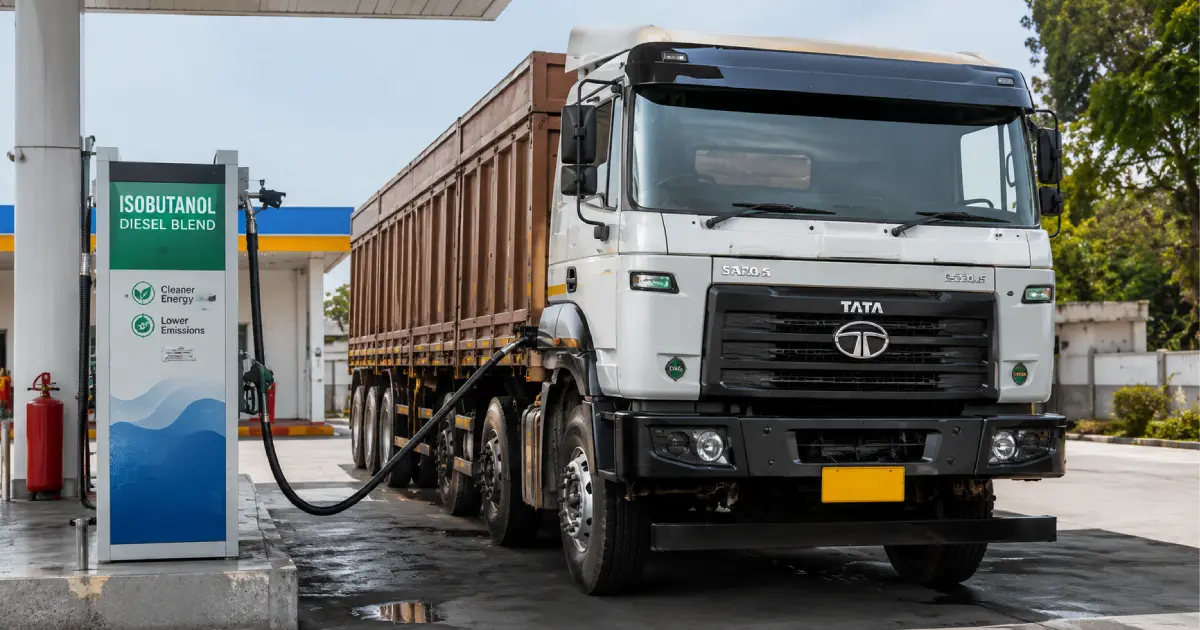
- The Fleet Leaders: Heavy commercial vehicle giant Tata Motors is spearheading the vehicle trials. The automaker is finalizing logistics with state-run oil marketing giants HPCL and BPCL to secure fuel supplies, with active on-road pilot testing scheduled to kick off next quarter (Q2 FY27).
- The Technical Screen: The Automotive Research Association of India (ARAI), in tandem with bioenergy technology major Praj Industries, has initiated a rigorous 10-month technical assessment. They will test the fuel across 33 distinct vehicle types, focusing on combustion efficiency, fuel-system compatibility, and engine durability.
- Performance Trade-offs: Isobutanol carries a slightly lower calorific value (energy content) than traditional diesel. However, Tata Motors Managing Director Girish Wagh noted that at the current 2% testing threshold, the performance drop is negligible. “Because the calorific value is lower, there would be some impact, but 2% is hardly anything,” Wagh stated.
[Sugarcane / Biomass Fermentation] ──► [Advanced Isobutanol Alcohol] ──► [2% Diesel Blend] ──► [ARAI 10-Month Durability Trial]
2. Why Ethanol Failed, But Isobutanol Wins
The shift to isobutanol comes after Union Road Transport Minister Nitin Gadkari confirmed that past experiments trying to mandate a 10% ethanol-diesel blend were a chemical failure. Isobutanol is structurally and chemically much better suited for heavy transport infrastructure:
| Chemical & Logistical Vector | Legacy Ethanol-Diesel Attempts | New Isobutanol-Diesel Architecture |
| Chemical Mixing & Stability | Polar structure: Refuses to mix naturally with oily diesel. Separates in the fuel tank unless expensive chemical binders are continuously added. | Non-polar structure: Readily dissolves and remains consistently stable inside diesel mixtures without settling. |
| The Flashpoint Hazard | Highly Volatile: Flashpoint drops to 12°C–13°C, turning diesel tanks into immediate fire hazards and complicating shared petroleum logistics. | Stable & Safe: Features combustion characteristics closer to standard hydrocarbons, requiring minimal changes to existing pipelines. |
| Corrosion Risk | Highly hygroscopic (absorbs moisture), which over time corrodes delicate fuel lines and storage tanks. | Markedly less corrosive and less prone to water absorption, preserving long-term engine durability. |
3. The Macro Stakes: Why This Matters More Than Petrol
While the E20 petrol transition was a major achievement, diesel remains India’s most consumed petroleum product, tracking at roughly 91.4 million tonnes annually—nearly double the national consumption of petrol.
Because the heavy transport sector (trucks, buses, and tractors) runs almost exclusively on diesel, even a conservative 2% blending program creates an immediate, massive domestic market for agricultural biomass and sugarcane distilleries. If the current validation tests run smoothly, MoRTH Secretary V. Umashankar indicated that the government is prepared to formalize a baseline mandate by the end of 2026, eventually evaluating long-term roadmaps to allow up to a 15% isobutanol blend using standard BS-VI engines.