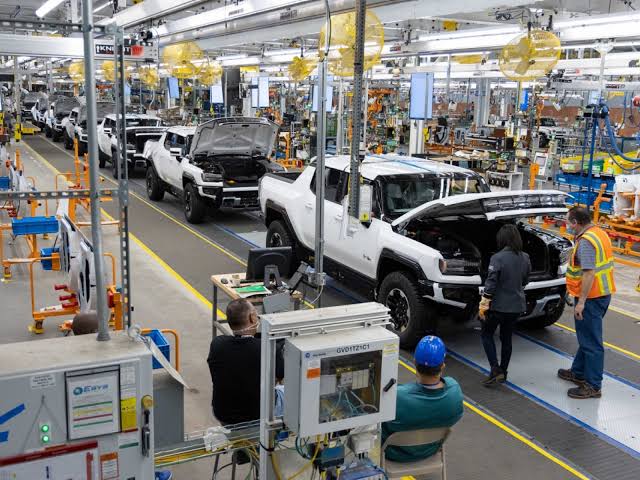
General Motors has triggered a major standoff with labor unions by introducing 50 collaborative robots (or “cobots”) at its flagship Factory Zero EV assembly plant in Detroit, Michigan—just months after shedding more than 1,000 human jobs at the exact same facility.
The rapid automation push highlights how major automakers are aggressively turning to robotics to stabilize margins, cut structural overhead, and offset the rising labor costs stemming from recent union contract negotiations.
1. The Core Standoff: Jobs vs. Automation
The move at Factory Zero has drawn sharp criticism from the United Auto Workers (UAW), who view the deployment as a direct mechanism for labor displacement rather than workplace enhancement.
- The Union Backlash: James Cotton, president of UAW Local 22, stated that members are “disgusted” by the introduction of the machines, noting that the union has lost roughly half of its localized membership due to these ongoing job cuts. The UAW has officially filed structural grievances over the installation.
- The Corporate Defense: GM spokesperson Kevin Kelly stated that the cobots are intended to work alongside the remaining human workforce to “improve safety and ergonomics” on tasks like lifting and attaching heavy vehicle body panels. While GM termed the human job cuts “temporary layoffs,” the company has notably refused to provide a firm timeline for when—or if—those workers will be called back.
2. The Economic Equation: Curbing Rising Labor Costs
The financial math driving this automation is tied directly to the rising operational costs of traditional vehicle assembly.
Following the historic 2023 UAW contract, GM estimated that its long-term domestic labor costs would climb by roughly $500 per vehicle.
Unlike human workers, robotic equipment does not require healthcare packages, pension contributions, or contract renegotiations every four years. Industry analysts point out that vehicle assembly now requires 50% to 70% fewer labor hours than it did in the 1980s, a structural downward curve that major manufacturers are determined to accelerate.
3. Slowing EV Demand Meets Record Profits
The restructuring at Factory Zero reflects a broader tactical pivot as GM navigates a turbulent electric vehicle market:
- Production Pauses: Factory Zero—the primary hub for high-profile electric vehicles like the GMC Hummer EV—has seen its production schedules paused multiple times over the past year due to softer-than-expected consumer appetite for premium EVs.
- The Profit Paradox: Despite scaling back its EV commitments and paying massive restructuring charges, the automation and cost-cutting push has kept GM highly profitable. The automaker reported a 22% jump in Q1 profits, hitting $4.25 billion.
4. Part of a Sweeping “Skills Swap”
The deployment of Fanuc-made cobots on the assembly line is part of a larger corporate blueprint to aggressively downsize traditional staff in favor of automated systems and advanced tech. Just prior to this factory overhaul, GM executed significant layoffs elsewhere, cutting more than 600 engineers from its IT division and over 200 Computer-Aided Design (CAD) engineers.
With GM’s executive leadership previously formalizing deep partnerships with companies like Nvidia to develop end-to-end factory AI architectures, the events at Factory Zero are being watched as an early blueprint for the future of highly automated, low-headcount American industrial manufacturing.