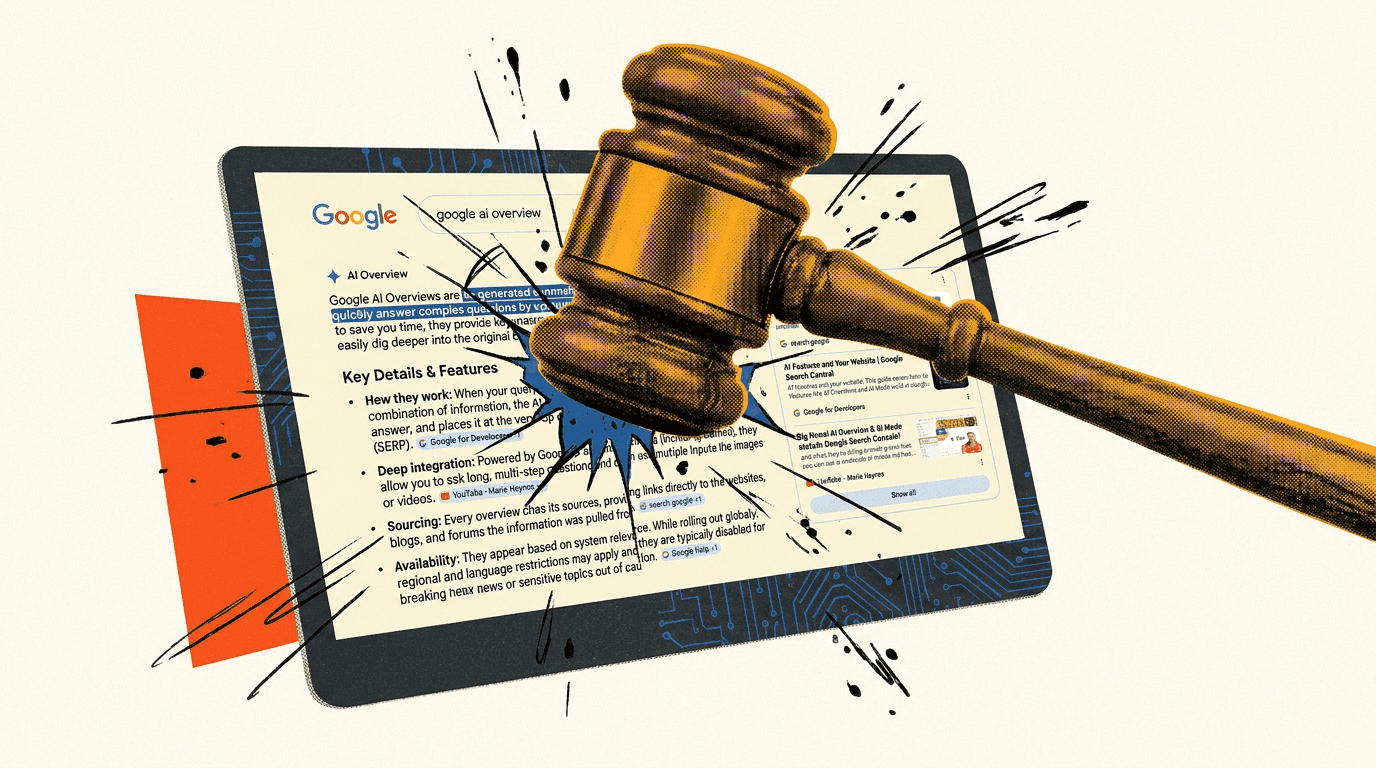
In a landmark legal decision that could reshape the future of generative search and digital publishing, a German regional court has ruled that Google can be held legally responsible for inaccuracies, hallucinations, and defamatory content generated by its AI Overviews (formerly known as the Search Generative Experience).
The groundbreaking verdict draws a sharp line between traditional search indexing—where Google merely guides users to third-party hyperlinks—and generative AI retrieval, where the tech giant actively compiles, synthesizes, and displays its own standalone answers.
For SEO professionals, content publishers, and enterprise brands, this legal precedent signals a seismic shift in how search engines must manage algorithm accuracy and legal accountability.
The Case: When AI Hallucinations Legally Become Defamation
The lawsuit was brought forward after Google’s AI Overview feature generated a false summary about a high-profile individual, introducing severe factual errors that damaged their professional reputation. While traditional search results correctly pointed to accurate, source-verified websites, the AI-generated summary at the top of the page blended disparate data points, resulting in a damaging “hallucination”—a term used to describe when a large language model (LLM) fabricates plausible-looking but entirely false metrics or assertions.
Google argued its long-standing defense: as an intermediary search engine, it acts as a directory, not a publisher. The company maintained that standard algorithmic disclaimers warning users that “AI-generated text may be inaccurate” should absolve it of liability.
The German court firmly rejected this stance. The judiciary noted that because the AI model ingests data, restructures it, and serves it as a native response under Google’s proprietary branding, Google transitions from a passive hosting service to an active content creator. The court heavily drew upon a legacy legal precedent in Germany where Google was previously held liable for defamation caused by its “Autocomplete” feature. Extending that logic to generative search, the court ruled that if an AI Overview outputs false statements that harm an individual or business, Google must take immediate accountability and face liability for injunctive relief and potential damages.
Why This Upsets the Tech Industry’s Legal Shield
For decades, tech conglomerates have operated under sweeping safe-harbor protections, such as Section 230 in the United States and similar e-Commerce/Digital Services Act (DSA) frameworks in the European Union. These laws state that platforms are not responsible for what third parties write on their sites.
However, this ruling highlights a massive structural and regulatory divide between the US and Europe regarding AI governance:
- The Generation vs. Indexing Divide: In traditional search, Google displays snippets written by webmasters. If a webmaster lies, the webmaster is sued. In an AI Overview, Google’s LLM writes the text. The German court decided that the platform cannot use third-party immunity for content its own software authored.
- The Sourcing Monopolization: Legal experts note that this decision mirrors concurrent European litigation, such as the GEMA v. OpenAI ruling in Munich, which established that AI providers are directly responsible for the content structures contained within and reproduced by their models.
SEO & Digital Marketing Implications: What Changes Now?
This legal bottleneck will inevitably force Google to alter how it rolls out, filters, and filters traffic through AI Overviews globally. For search engine optimization (SEO) strategists and webmasters, the downstream effects are immediate.
1. Hard Core Restraints on “High-Risk” YMYL Queries
To protect itself from sweeping class-action lawsuits or regulatory fines, Google will likely heavily scale back AI Overviews for YMYL (Your Money or Your Life) niches. Expect AI summaries to vanish or become highly sanitized for medical, legal, financial, and biographical search queries where inaccuracies carry real-world penalties.
2. A Shift Toward Hyper-Conservative Fact-Checking
To ensure compliance and accuracy, Google’s engineers will have to tweak their retrieval-augmented generation (RAG) pipelines. Rather than allowing the LLM creative freedom to summarize info, the system will favor rigid, verbatim extractions from highly authoritative, verified domains. High-authority backlink profiles, schema markup accuracy, and flawless digital entity management will become even more critical for SEO survival.
3. The “Opt-Out” and Traffic Hoarding Paradox
Historically, publishers have expressed frustration over AI Overviews because they scrape premium content and display it directly on the search engine results page (SERP), hoarding user traffic and decreasing organic click-through rates. If global courts force Google to accept liability for what these overviews say, Google may become much more willing to give publishers granular controls to opt out—or, conversely, strictly restrict AI search citation visibility to a tiny pool of licensed, contractually indemnified media partners.
What’s Next for Enterprise Brands?
If your brand or executive team is misquoted or financially harmed by an inaccurate Google AI Overview, this ruling provides a powerful blueprint for legal recourse. Companies can now issue strict takedown demands directly to search engines with the expectation of rapid enforcement, as platforms can no longer hide behind structural algorithmic exemptions.
As Europe ramps up enforcement of its comprehensive AI Act, this decision paves the way for a drastically more regulated, hyper-cautious era of search engine optimization—one where accuracy is no longer just a quality guideline, but a legal mandate.