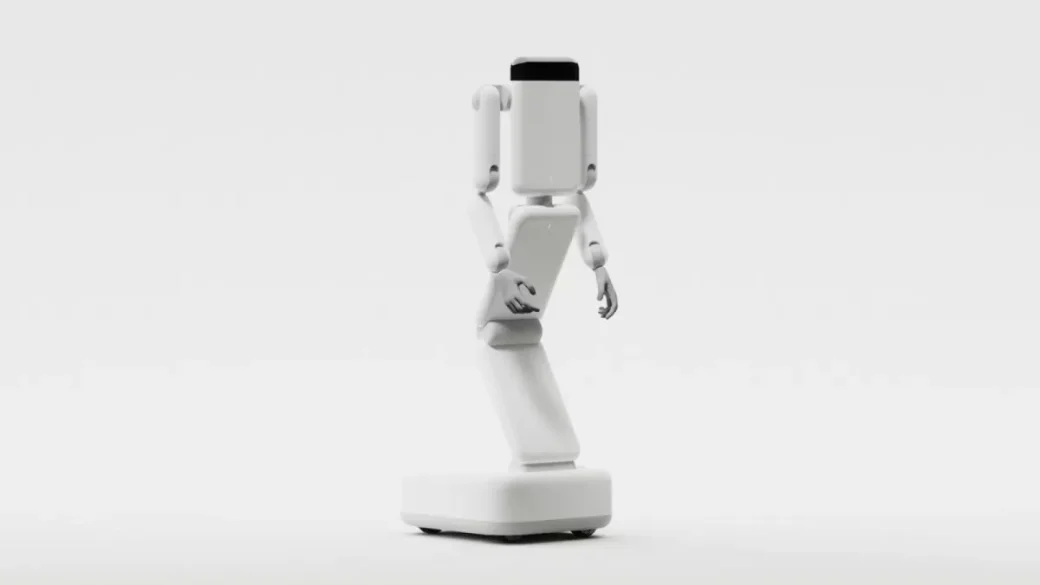
The robotics startup Genesis AI—backed by former Google CEO Eric Schmidt and a heavy $105 million seed funding round—has officially unveiled Eno, its first general-purpose robot.
In a sector heavily saturated with two-legged bipedal machines mimicking the human form (like Tesla Optimus or Figure 02), Genesis AI is taking a sharp “anti-humanoid” design path. Eno prioritizes human capability over human appearance, ditching legs and a traditional head to focus entirely on on-the-job utility.
1. The Design: Form Follows Human Capability
Eno trades the traditional dystopian metallic mannequin look for a sleek, minimalist silhouette that moves like a piece of high-end, functional furniture.
- The Wheeled Base: Rather than risking the instability, heavy battery drain, and spatial limitations of two legs, Eno navigates tightly packed environments via a narrow, highly agile wheeled base.
- The Articulated Spine: Emerging from the base is a tower of three articulated panels. These panels fold and flex dynamically, allowing Eno to expand its height and reach when working, or collapse completely down into a compact footprint the size of a checked suitcase for easy storage and transit.
- Human-Scale Hands: While the body looks entirely non-human, the upper appendages explicitly mirror human spatial proportions. Eno is equipped with proprietary, five-fingered hands featuring 20 active, back-drivable degrees of freedom. Because the arms and hands match human geometry one-to-one, the robot can interact with tools, objects, and environments designed for people without requiring expensive retrofits.
       [Optional Screen Interface]  <── (Displays intent & reasoning in real time)
                    │
            [Articulated Spine]     <── (Folds flat to the size of a suitcase)
                    │
        [20-DoF Bi-Dexterous Hands] <── (Matches human geometry 1:1 to handle tools)
                    │
             [Wheeled Base]         <── (Houses the AI brain & drives mobility)
2. The Core Brain: Driven by GENE
The physical hardware is co-optimized to run natively alongside GENE, Genesis AI’s foundation model and robotics-native AI brain.
Instead of relying on rigid, pre-programmed script loops, GENE turns Eno into an autonomous physical agent. Given a broad, high-level goal, the robot can independently process visual context, retain a persistent memory of the workspace, adapt to sudden structural anomalies, and execute complex, multi-step actions with millimeter precision.
3. Trust Through Transparency
Addressing the common public anxiety surrounding highly capable, faceless industrial machinery, Genesis AI is introducing a dedicated “cognitive interface” screen version. Instead of giving the robot an artificial human face, this modular display shows Eno’s internal thought processing, intent checklists, and current operational states in real time, making its micro-decisions completely transparent to nearby human coworkers.
4. Operational Deployment Timeline
Genesis AI is moving quickly from simulation into the physical world, leveraging its unified hardware and software ecosystem:
- H2 2026 (Current Year): The company has already manufactured dozens of physical prototypes and will deploy the first wave of test units to select enterprise clients before winter.
- Targeted Rollout Phase 1: Initial deployments will systematically focus on closed industrial environments, prioritizing high-volume logistics warehouses, manufacturing assembly floors, and commercial research laboratories.
- Targeted Rollout Phase 2: Future expansions are slated to transition Eno into public-facing service sectors—including hospitality staffing and hospital facility management—before ultimately developing consumer-facing domestic and outdoor home models.