
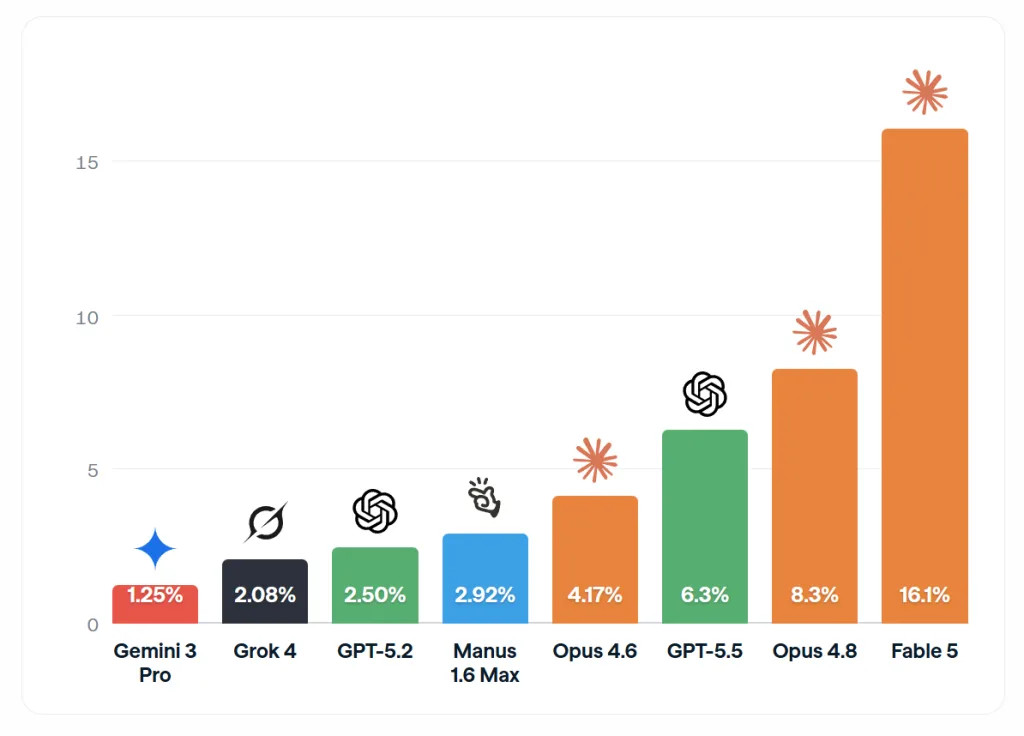
The rapid rise from 2.5% to 16.1% over just eight months marks a dramatic milestone in the evolution of autonomous digital labor. These figures come from the newly updated Remote Labor Index, a benchmark designed to track how effectively standalone AI agents can complete real-world, paid freelance projects at a professional, client-ready standard.
The metrics indicate that the highest-tier systems are no longer acting as simple autocomplete assistants; rather, they are operating as full-fledged digital workers capable of managing complex, end-to-end execution.
1. The Core Performance Driver: Fable 5
The explosive growth on the index is heavily anchored by the launch of Anthropic’s Claude Fable 5. When the Remote Labor Index first debuted eight months prior, the most advanced agent on the market could successfully complete only 2.5% of the benchmark’s multi-turn, unstructured task pool.
Fable 5 quadrupled that baseline, successfully automating 16.1% of complex freelance projects entirely from start to finish. For context, this nearly doubles the 8.3% automation capability recorded by the previous generation, Claude Opus 4.8.
2. The Asymmetrical Job Takeover
The automation wave isn’t hitting all sectors equally. According to domain expert panels judging the outputs on accuracy, instruction adherence, and client professionalism, tasks with strict structural logic or formulaic formats are seeing the fastest displacement:
 [ REMOTE LABOR INDEX: PROFESSIONAL AUTOMATION RATES BY SEGMENT ]

  Copywriting & Short-Form Content:  ██████████████████████ 22% (High exposure)

  Data Entry & Complex Spreadsheets: ██████████████████ 18%

  Graphic Design (Simple Layouts):   ██████████████ 14%

  Software Debugging & Code Snippets:████████████ 12%
- Copywriting (22%): Social media captions, routine blog updates, and search-optimized product descriptions are the easiest for agents to execute perfectly without human intervention.
- Data & Spreadsheets (18%): Enhanced handling of nesting formulas, mass data formatting, and cross-sheet sorting allows agents to process large administrative work pools.
- Coding & Debugging (12%): While agents excel at fixing micro-bugs in script environments like Python and JavaScript, their lack of sweeping system-wide context keeps more complex structural engineering safely in human hands.
3. The Structural Shift on Gig Platforms
The rapid shift in digital labor capacity is creating clear real-world ripples across major freelance marketplaces like Upwork, Fiverr, and Toptal:
- The Price Floor Collapse on Basic Tasks: High-volume, low-complexity contracts are drying up or seeing massive downward price compression as small businesses realize they can run routine tasks through agent APIs at a fraction of a human freelancer’s traditional hourly rate.
- The “Nuance Moat”: Researchers point out that AI agents still struggle immensely with highly fluid, client-specific ambiguities. Projects requiring deep subject-matter expertise, strategic advisory, custom brand alignment, or high-touch personal relationships remain heavily insulated from automation.


Ultimately, while the 16.1% figure signals immediate disruption for entry-level tasks, the message for professionals is clear: the current competitive boundary demands moving up the value chain. Freelancers who learn to orchestrate these agents to handle their baseline production are actively scaling their input speeds, while those relying on repetitive digital tasks are finding their margins rapidly closing.
Get the day’s top stories in your inbox
One concise email. No spam, unsubscribe anytime.