The “doomer vs. hype” debate over artificial intelligence just got a massive injection of real-world data. According to the newly released Anthropic Economic Index report (June 2026), the way people work has officially hit a major structural tipping point.
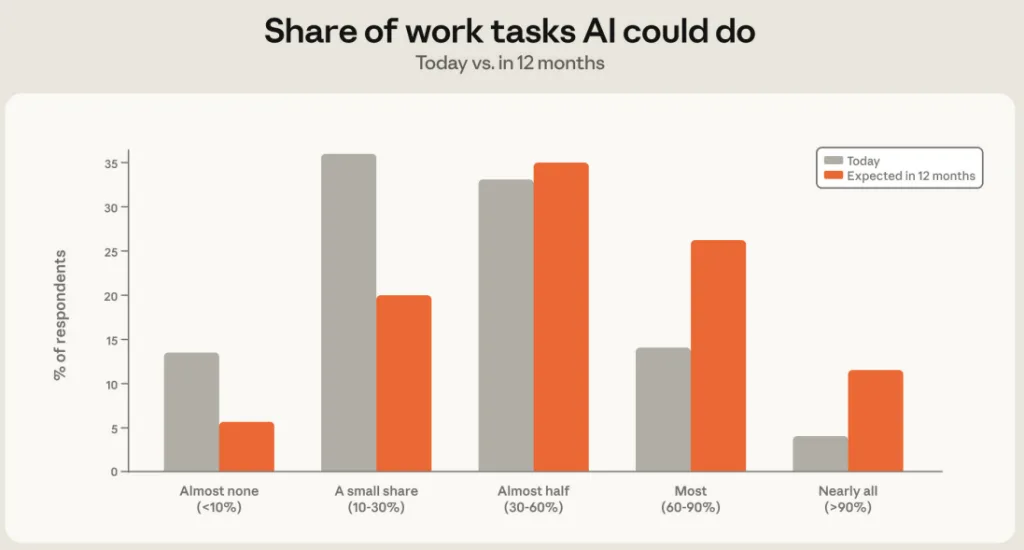
In a comprehensive global survey of roughly 9,700 active Claude users (spanning their Chat, Cowork, and Code products), about half of the respondents stated that AI can already handle 50% or more of their daily work tasks.
1. The Numbers: Breaking Down the Workplace Exposure
The data shifts the conversation from what AI might do in the future to what it is actively completing right now. When users were asked to evaluate how much of their current workload could be offloaded to Claude today versus a year from now, the responses painted a stark picture of rapid integration:
| Current Capability (Today) | Share of Claude Users | The 12-Month Outlook (Heading into 2027) |
| Handles 30% to 60% of tasks | 33% | The vast majority of users expect their baseline to shift radically higher. |
| Handles 60% to 90% of tasks | 14% | A massive wave of users expect AI to swallow this upper tier. |
| Handles 100% of my job today | ~4% | 26% of users expect AI to take over almost all of their work within a year. |
2. The Artifacts Index: What is AI Actually Doing?
The highest rates of automation aren’t happening in casual chat windows, but within structured workspaces like Claude’s Artifacts feature—where the model outputs concrete, standalone deliverables like structured code, spreadsheets, or documents.
Anthropic’s telemetry data isolated the top work-driven categories where Claude is delivering the heaviest lifting:
 [ Database Queries & Analytics ] ──► 82% of all generated Artifacts are strictly work-related
                                                    │
                                                    ▼
 [ Blog & Article Copywriting   ] ──► 81% of output is used to anchor corporate/marketing content
                                                    │
                                                    ▼
 [ Marketing Assets & Strategy  ] ──► 80% of workflows focus on generating active business material
3. The “Glue” Paradox: Fear vs. Optimism
The study revealed a fascinating psychological split across different professional experience levels.
- The Early-Career Squeeze: Junior and entry-level employees reported the highest percentage of AI-capable tasks in their workflows and expressed the most severe anxiety about long-term job security. This lines up with warnings from Anthropic CEO Dario Amodei, who noted that entry-level office roles are highly vulnerable to automation.
- The Power-User Optimism: Conversely, the heaviest, most advanced Claude power-users expressed the highest level of optimism regarding their careers, noting that offloading routine labor has actually made their high-level strategy and oversight skills vastly more valuable.
Why 50% of Tasks ≠ 50% of Jobs
Economists reviewing the Anthropic index emphasize a crucial nuance: a real job is significantly more than a linear checklist of individual tasks. The hardest part of any profession is what experts call the “glue”—the human judgment, corporate context, relationship building, and knowledge transfer required to carry insights from one project to the next.
While Claude can draft an entire database query or marketing plan in seconds, it still lacks the structural capability to replicate that organizational “glue.” For now, the vast majority of workers report they aren’t looking to be replaced by the technology; they are actively using it to automate the dullest parts of their day so they can focus on the work that actually requires human intuition.