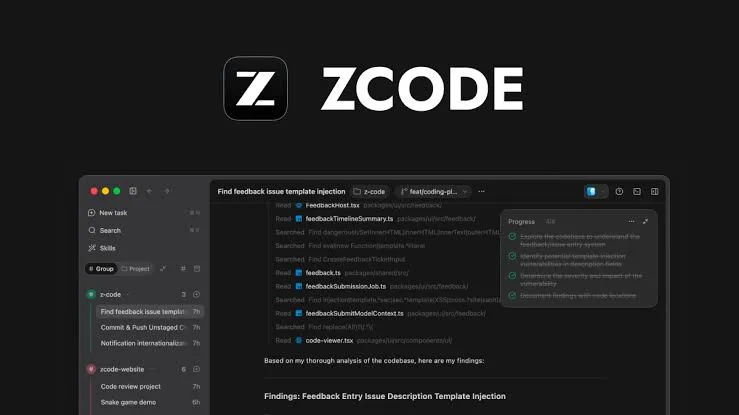
In an aggressive move to challenge Western AI dominance in the developer ecosystem, Z.ai (the international brand of Beijing-based Zhipu AI) has launched ZCode.
Billed as the “Official Harness for GLM-5.2,” ZCode is a native, standalone “Agentic Development Environment” available for macOS, Windows, and Linux. Rather than acting as a simple auto-complete plugin, the tool is a full-fledged agent built for long-horizon software tasks, deploying a multi-step workflow structure called “Goals” to plan, edit files, execute terminal commands, and run tests autonomously.
1. Under-Cutting the Market: The Pricing Matrix
The platform’s global launch strategy centers on massive pricing pressure aimed directly at established players like Cursor, Claude Code, and GitHub Copilot.
While the ZCode desktop agent itself is free to download, Z.ai has wrapped it in deeply discounted subscription tiers that significantly undercut US competitors:
| Subscription Tier | Promotional Monthly Price | Core Target & Feature Set |
| Lite Tier | $16.20 (List $18) | Built for lightweight iteration on smaller repositories; includes an estimated 23 million token allowance. |
| Pro Tier | $64.80 (List $72) | Designed for daily mid-sized repo development; features 5x the Lite quota and full Model Context Protocol (MCP) tool access. |
| Max Tier | $144.00 (List $160) | Built for advanced enterprise developers; offers 20x the Lite quota (~206 million tokens) and dedicated priority compute resources. |
To accelerate initial adoption, Z.ai is offering users a 50% extra usage credit bonus when running tasks directly inside the native ZCode app compared to routing the models through external third-party software harnesses.
2. Technical Edge: 1-Million Context & Remote Triggers
ZCode derives its mechanical advantage from being explicitly optimized for the recently released GLM-5.2 architecture, utilizing unique feature sets to stand out in a crowded market:
 [ THE ZCODE AGENTIC LOOP ]

  1M-Token Context Base ──► Ingests massive local codebases without context fragmentation
                                     │
                                     ▼ (The Remote Orchestration Edge)
  Chat App Triggers      ──► Ping a bot in WeChat, Feishu, or Telegram to kick off a run
                                     │
                                     ▼
  Autonomous Execution   ──► ZCode launches a background "Goal" to write, test, and verify code
- Massive Codebase Ingestion: Because GLM-5.2 supports a 1-million-token context window (paired with a massive 131,072 output token ceiling), ZCode can digest whole code repositories and complex dependency trees without needing aggressive, lossy text compaction.
- The Mobile Chat Trigger: In a unique workflow divergence from Western dev tools, developers can invoke and steer ZCode tasks completely remotely. By mentioning a dedicated bot inside mainstream communication apps like WeChat, Feishu, or Telegram, a developer can kick off or advance a heavy coding build on their remote machine without ever opening the desktop IDE.
- Bring Your Own Key (BYOK) Flexibility: To appease developers who aren’t ready to fully commit to the GLM ecosystem, ZCode includes native BYOK configuration panels. Teams can seamlessly connect the workspace to alternative endpoints, allowing them to route tasks to platforms like DeepSeek or OpenRouter.
3. The Data Governance Trade-Off
While the combination of an open-weight model framework, deep-discounted token pools, and cross-platform multi-agent orchestration makes ZCode an incredibly attractive option for “vibe coding,” enterprise adoption faces a stark geopolitical reality.
Adopting a specialized coding environment engineered by a prominent Beijing-based lab means that structural project data, task history, and remote chat-bot prompts are ultimately managed by an infrastructure operating under different data-governance standards. While the BYOK infrastructure allows teams to keep their actual model calls on localized, self-controlled servers, the core orchestration layer remains anchored to Z.ai’s systems. For global engineering leads, the choice to deploy ZCode will come down to a direct calculation: balancing unprecedented, low-cost agentic performance against their corporate data compliance boundaries.
Get the day’s top stories in your inbox
One concise email. No spam, unsubscribe anytime.