Continuing its hyper-aggressive release cadence to dominate the open-weight developer ecosystem, Z.ai (Zhipu AI) has officially launched GLM-5.2. Arriving just over two months after its predecessor, the new flagship coding model introduces a massive, usable 1-million-token context window paired with a heavily restructured reasoning architecture.
The model is immediately available to all active subscribers on the platform’s various developer and enterprise tiers, positioning the newly listed public firm to go toe-to-toe with Anthropic’s Claude Code and OpenAI’s GPT-5 frameworks.
Context Leap: Breaking the 1,000,000 Barrier
The clear headline specification for GLM-5.2—configured in developer workspaces as glm-5.2[1m]—is the fivefold expansion of its active context boundary. Moving from GLM-5.1’s 200,000-token limit to a full 1 million tokens fundamentally alters how autonomous agents manipulate codebases.
- Massive Code Ingestion: Rather than forcing agents to continuously summarize code histories or truncate file buffers, a 1-million-token window allows an engineering agent to hold an entire mid-sized software repository—including source code, system configurations, test suites, and terminal output history—directly in active working memory.
- Expanded Generation Output: To support deep refactoring pipelines, Z.ai has expanded the maximum output window to a massive 131,072 generation tokens per single request, preventing long-horizon scripts from cutting off mid-execution.
Architecture: Cost-Efficient MoE Infrastructure
While Z.ai did not release an exhaustive whitepaper alongside the sudden weekend drop, early community documentation and developer notes reveal that the architecture preserves the fundamental DNA of the GLM-5 series.
The model is built as a 744-billion-parameter Mixture-of-Experts (MoE) system that activates exactly 40 billion parameters per token. To prevent the massive 1-million-token context window from triggering an exponential spike in compute costs, Z.ai leverages DeepSeek Sparse Attention mechanics. This hardware optimization keeps inference fast and affordable during long agentic loop sessions.
“Max Effort” Reasoning and Tool Integration
To complement the massive context expansion, Z.ai has introduced a multi-tier reasoning framework that allows developers to trade compute latency for deeper logical accuracy. Accessible through standard agent command lines via the /effort toggle, GLM-5.2 introduces two new computing effort settings:
| Reasoning Mode | Recommended Workloads | Core System Behavior |
| High Effort | Fast debugging, test generation, API mapping | Multi-pass error verification with brief internal checking loops |
| Max Effort | Complex refactoring, architecture design, multi-file changes | Deep test-time scaling, long-horizon planning, continuous trial-and-error log parsing |
When running inside agent frameworks like Claude Code or OpenClaw, commands for extreme-reasoning options (xhigh, max, or ultracode) automatically map directly to GLM-5.2’s Max-effort tier. This allows the system to autonomously run local compilation tests, analyze error outputs, and modify its code-generation strategy across thousands of continuous tool calls before presenting a solution to the developer.
Market Roadmap: The Open-Weight Promise
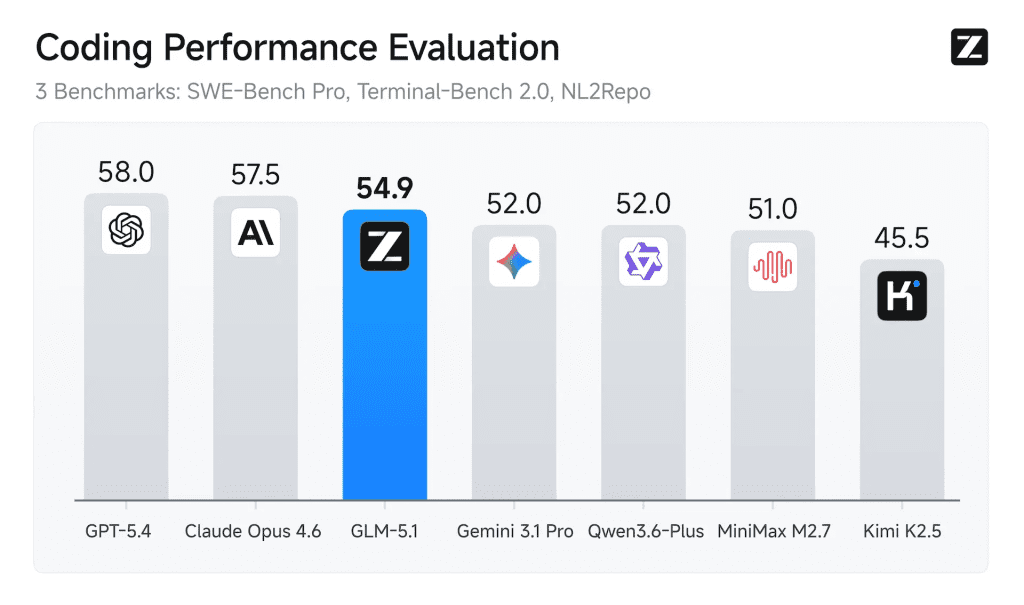
In an unusual move for a major frontier release, Z.ai launched GLM-5.2 without releasing independent benchmark evaluations. While internal evaluations from early testers place its raw coding capabilities within arm’s reach of top-tier American closed APIs, third-party validation is still pending.
However, the company’s roll-out roadmap indicates it is targeting a heavy market share capture across the global developer community:
- Immediate Availability: Live today across all paid developer subscription plan tiers (Lite, Pro, Max, and Team).
- Next Week’s Horizon: Z.ai has confirmed that official public API end-strings, consumer chatbot configurations, and fully open-source weights under a permissive MIT License are scheduled to drop within the upcoming days.
By committing to a highly permissive open-weight framework, Z.ai is providing enterprise engineering teams with a clear path to host a 1M-context, developer-centric model completely on-premise, bypassing the data privacy friction that typically limits closed-source API adoption in highly regulated industries.