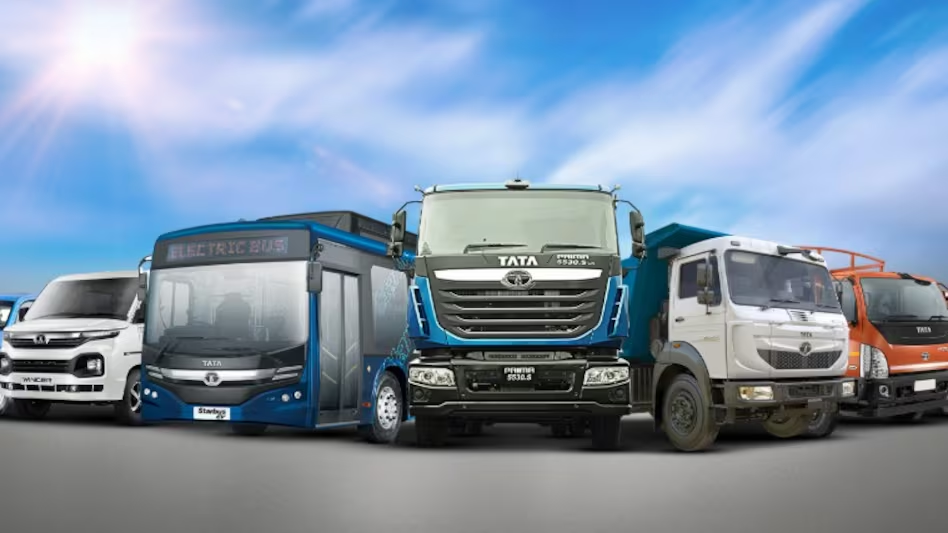
At its inaugural Investor Day as a separately listed entity, Tata Motors Commercial Vehicles (TMCV) unveiled an aggressive strategic roadmap targeting a 40% domestic market share by FY28.
Following the company’s demerger from its passenger vehicle arm, the newly independent CV business is pivoting hard toward margin-led growth and technology, triggering a nearly 4% surge in Tata Motors’ share price following the announcement.
1. Bridging the Market Share Gap
While TMCV recorded an exceptional financial performance for the fiscal year ended March 2026 (FY26)—generating ₹77,399 crore in revenue and a stellar 13.2% EBITDA margin—its overall domestic market share actually slipped to 35.7% (down from 37.1% the previous year).
To claw back and expand its slice of the market to 40% over the next two fiscal years, management has outlined targeted strategies across its distinct vehicle divisions:
- Defending Heavy Commercials (HCVs): Tata Motors remains the undisputed king of heavy duty trucking in India, commanding a rock-solid 55% market share. The company plans to sustain this through infrastructure-led macro demand and multi-axle freight efficiencies.
- The Small Commercial & Pickup Reset: The real battleground is the Small Commercial Vehicle and Pickup (SCV-PU) segment. Despite registering an 8.2% volume growth, Tata’s market share in this pocket dropped to 26.8%. To reverse this erosion, TMCV is launching a product offensive that includes nine brand-new models designed to directly challenge competitors like Mahindra’s Bolero Maxx range.
Current CV Market Share (FY26) ──► 35.7% (Strong in HCVs, under pressure in Small Pickups)
Target CV Market Share (FY28)  ──► 40.0% (Driven by 9 new pickup models + IVECO integration)
2. The International Catalyst: The €3.8B IVECO Acquisition
A major cornerstone of Tata’s FY28 ambition is its pending $4.4 billion (€3.8 billion) acquisition of Italian manufacturer IVECO Group.
Expected to officially close by Q2 FY27 (the September quarter), the blockbuster transaction will instantly elevate Tata Motors to the world’s fourth-largest commercial vehicle manufacturer. The deal creates powerful global synergies:
- Asset Harmonization: It marries Tata’s low-cost, hyper-efficient mass manufacturing base with IVECO’s high-end, low-emission, premium truck engineering.
- Geographic Expansion: The integration automatically hands Tata a mature, ready-to-use distribution footprint across premium markets in Europe, Latin America, and Australia/New Zealand—regions where the Indian major historically held virtually zero presence. Management expects the IVECO consolidation alone to account for a 4-percentage-point boost to its broader corporate baseline.
3. Digital Logistics via AIEQU Mobility
Beyond shipping physical steel and rubber, Tata Motors is heavily counting on recurring, non-cyclical digital revenue to cushion against traditional automotive downcycles.
The company has spun off its advanced telematics and freight matching networks—Fleet Edge and Freight Tiger—into a brand-new entity called AIEQU Mobility.
The AI Operating System: Fleet Edge has officially crossed the milestone of 1 million connected vehicles on Indian roads. TMCV’s five-year vision is to scale this ecosystem to 3 million vehicles, positioning AIEQU as the world’s first original equipment (OE)-agnostic, AI-native operating system for commercial logistics.
4. Operational Financial Targets (FY28)
Backed by strong structural tailwinds—including India’s steady 6-7% GDP growth and accelerating e-commerce logistics—TMCV has laid out firm financial commitments to investors for the FY28 horizon:
| Financial Metric | FY28 Institutional Target | Strategic Driver |
| EBITDA Margins | Double-digits through the cycle / High teens in upcycles | Shifting away from low-margin volume chasing toward premium, value-added connected vehicles. |
| Return on Capital (ROCE) | 30% to 35% | Maximizing asset utilization post-IVECO integration. |
| Free Cash Flow (FCF) | 7% to 9% of revenue | Maintaining disciplined capital expenditure (restricted to 2-4% of revenue). |
To manage near-term commodity price volatility and rising input costs, Tata Motors also announced a calculated price hike of up to 2.5% across its commercial vehicle portfolio, effective July 1, 2026. Brokerages like JM Financial have maintained a strong “Buy” rating on the stock, noting that the combination of disciplined pricing, downstream spare-parts expansion, and robust order books for electric buses and trucks positions the automaker beautifully for long-term value creation.