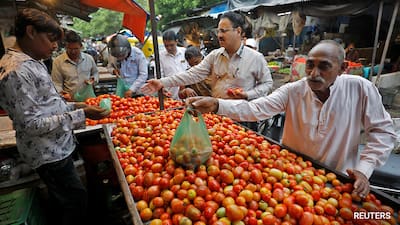
The Central Government is preparing a major market intervention to cool down a sharp, sudden spike in tomato prices, which have hit as high as ₹92 to ₹95 per kg in several elite localities of Delhi-NCR and on major quick-commerce apps like Blinkit and BigBasket.
The Ministry of Consumer Affairs has held high-level discussions to counter the price surge by rolling out subsidized tomato sales at ₹35 to ₹45 per kg through cooperative networks.
1. The Playbook: Re-activating the Subsidized Shield
To insulate household budgets from vegetable inflation, the government is leaning into a tested market stabilization strategy:
- The Price Target: The Centre plans to procure tomatoes directly from major producing regions and distribute them to consumers at a heavily subsidized rate of ₹35–45 per kg—effectively cutting local retail prices in half.
- The Distribution Network: The rollout will be executed by the National Cooperative Consumers’ Federation of India (NCCF) and other local cooperative networks using designated outlets and mobile vans.
- Phase 1 Footprint: The subsidized sales are slated to launch first in select high-pressure locations across Delhi-NCR and Mumbai, before expanding to other urban centers based on supply conditions.
2. Anatomy of the Price Surge
While the all-India average retail price sits closer to ₹44.36 per kg, localized supply disruptions have caused steep anomalies in metropolitan consumption hubs:
- The Local Reality: In standard local retail markets across North and West India, fresh tomatoes are currently holding at ₹60 to ₹70 per kg.
- The Transition Gap: India is currently in the middle of a delicate crop cycle transition. Extreme heat waves earlier in the summer, followed by unpredictable, localized weather disruptions in major producing belts, have delayed fresh crop arrivals and caused heavy transit losses for the highly perishable commodity.
- The Fast-Delivery Premium: Because physical supplies are constrained, online instant-delivery platforms and e-grocers are pricing their inventory anywhere between ₹79/kg and ₹95/kg to cover surge procurement and cold-chain logistics.
A History of Intervention: This isn’t the first time the Centre has stepped in to handle wild tomato volatility. The government initiated similar emergency subsidization programs in July 2023 (when supply bottlenecks sent prices screaming past ₹200/kg) and again in 2024 and 2025, where the state sold capped inventory at ₹60 and ₹48 per kg respectively in the capital region.
3. The Outlook: A Temporary Spurt
Agricultural economists and market experts view this current price shock as a temporary phenomenon. Unlike onions and potatoes—which have remained structurally stable due to extensive government buffer storage networks—tomatoes have an incredibly short shelf life and cannot be stored for long periods.
While wholesale rates at major agricultural mandis like Pimpalgaon and Nashik have doubled over the last two weeks as daily arrivals dropped by nearly 70%, supply metrics are projected to stabilize rapidly. As fresh, hybrid tomato yields from Southern states like Andhra Pradesh and Karnataka begin hitting national wholesale corridors in the coming weeks, market prices are expected to undergo a natural downward correction.