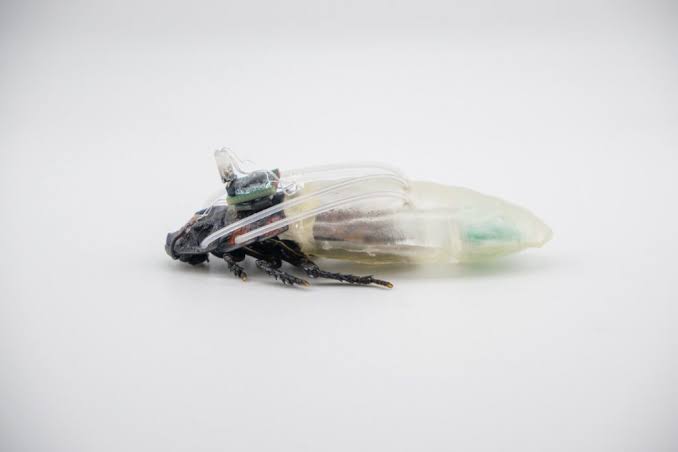
In a breakthrough that sounds like science fiction, researchers from Nanyang Technological University (NTU) in Singapore and Waseda University in Japan have successfully developed a 3D-printed “scuba suit” for cyborg cockroaches, allowing them to survive and walk underwater for up to three hours.
The study, published in Nature Communications, introduces a highly specialized, lightweight life-support backpack designed to transform land-based cyborg insects into amphibious rescue probes.
How the Tiny Scuba System Works
Because cockroaches breathe through small respiratory openings on their bodies called spiracles rather than lungs, dropping them into water normally cuts off their oxygen supply within minutes. The engineering team built a completely self-contained solution to bypass this biological limitation:
- The 3D-Printed Shell: A ultra-light, flexible, and waterproof 3D-printed shell (measuring just 10×10 mm) fits comfortably onto the insect’s back without inhibiting its natural movement.
- Chemical Tanks (No Heavy Cylinders): To avoid heavy, pressurized air tanks, the backpack features a miniature oxygen-generation tank. It holds a sponge soaked in manganese dioxide. When a small amount of diluted hydrogen peroxide is introduced, a controlled chemical reaction slowly and continuously releases oxygen.
- Direct Delivery Tubes: The generated oxygen is routed through four micro-silicone tubes directly attached to the cockroach’s thoracic spiracles, keeping water out while pumping fresh air straight into its respiratory tract.
Testing & High-Performance Mobility
The suits were tested on Madagascar hissing cockroaches—a robust, wingless species commonly chosen for biohybrid robotics due to their size and incredible resilience.
The results exceeded expectations. While unsuited cockroaches in the control group suffocated within two minutes, the suited cyborg roaches traveled through flooded, low-oxygen obstacle courses for up to three hours. Furthermore, the underwater environment barely slowed them down—submerged roaches paddled along at a speed of 78.4 mm per second, only slightly slower than their 87.5 mm per second sprint speed on dry land.
Plaintext
[ LAND VS. UNDERWATER SPEED ]

├── Dry Land Pace:  87.5 mm/sec
└── Submerged Pace: 78.4 mm/sec (90% mobility retained)
Why Use Real Bugs Instead of Robots?
Building mechanical, battery-powered micro-robots that can climb rubble, squeeze through microscopic structural cracks, and navigate water is an incredibly complex engineering challenge.
Cyborg insects solve this elegantly. By using the cockroach’s natural biology, the system uses very little battery power because the insect uses its own muscles to walk. Human handlers simply steer them wirelessly using a lightweight backpack that sends minor electrical impulses to electrodes on the insect’s sensory organs.
By turning these bugs into amphibious entities, search-and-rescue teams can eventually deploy swarms to scour heavily flooded disaster zones, collapsed buildings, and drainage pipes where humans and standard drones cannot reach. Future phases of the project will focus on adding onboard infrared cameras and navigating extreme environments—with researchers even noting the tech could eventually be scaled for outer-space or planetary exploration.
Get the day’s top stories in your inbox
One concise email. No spam, unsubscribe anytime.