ONDC’s DigiDukaan Wants to Digitise How Kirana Stores Buy Stock
India runs on kirana stores. These are the small shops near your home that sell things like rice, soap, biscuits and oil. A new system called ONDC DigiDukaan wants to change one hidden part of how these shops work. That part is the way they buy their stock. Right now they write orders on paper or wait for a salesman to visit. Soon they will be able to order on their phone.
According to Inc42, DigiDukaan is being built by ONDC. They are working with a government office called DPIIT (a part of the government that helps Indian businesses grow). The goal is simple. They want buying stock to be faster, clearer and cheaper for India’s tiny shops.
First, some simple words
ONDC stands for Open Network for Digital Commerce. Think of it as a shared set of digital roads. Any seller and any buyer can use these roads. The Indian government backs it. The idea is that no single big app should own the whole market.
A kirana store is a small, family-run grocery shop. You probably have one near your home. These shops are the heart of everyday shopping in India.
B2B procurement sounds fancy. It just means “one business buying from another business.” (B2B means business-to-business.) When a shop owner buys stock to sell later, that is B2B procurement.
A distributor is the middle person. Big brands make the products. Distributors buy in bulk (large amounts). Then they sell smaller amounts to many local shops. So your kirana store usually buys from a distributor, not straight from the brand.
The problem DigiDukaan is trying to fix
India has about 1.4 crore kirana stores. (One crore is ten million.) They handle about 75-80% of all FMCG sales. FMCG means fast-moving consumer goods. These are everyday items like packaged food, drinks and cleaning products. So these shops are a huge part of the economy.
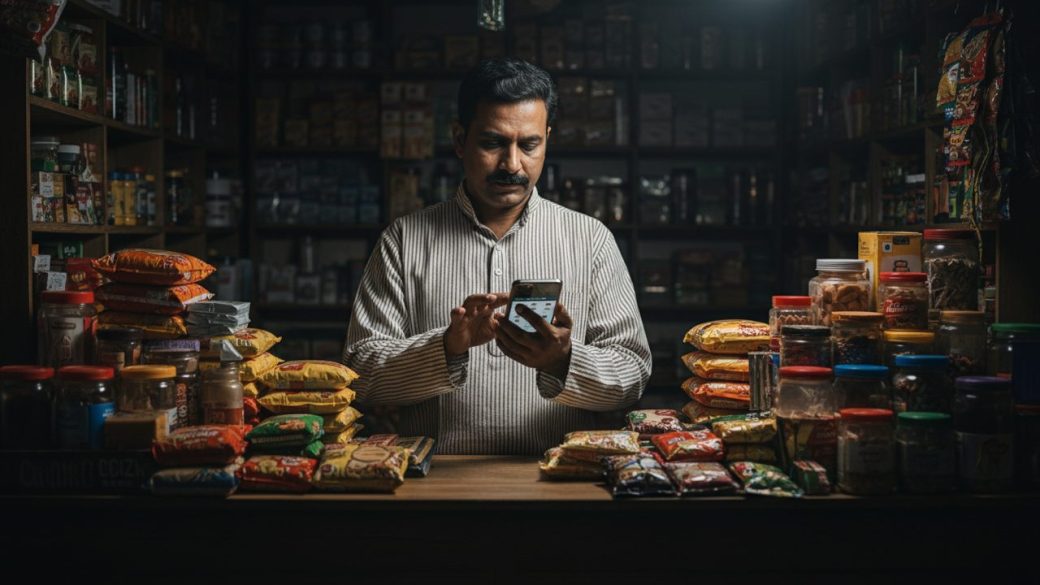
But the way these shops order stock is messy. Most of it still happens by hand. A salesman walks in. The shopkeeper calls out the items. The order gets written on paper. This causes real problems:
- Shopkeepers cannot easily see all the products or prices on offer.
- Special discount deals are often missed.
- Distributors spend a lot of money sending salesmen door to door.
- Brands find it hard to learn what shops are really selling.
DigiDukaan tries to fix all of this. It moves the ordering online, onto one shared network.
How DigiDukaan works
DigiDukaan connects three groups on one digital network. These are the shops, the distributors and the brands. The shopkeeper opens an app. They see the full list of products and prices. They pick what they need and place the order. No paper. No waiting for a salesman.
Everyone gains something different:
- Shopkeepers get clear prices. They can see every product and every discount deal.
- Distributors collect orders online. So they spend less money on salesmen in the field.
- Brands finally see real demand and “secondary sales” data. Secondary sales means what is actually selling in the shops, not just what they sent to distributors.
Where it has launched so far
DigiDukaan started as a pilot. A pilot is a small test run before something goes wide. The first test began in Hyderabad in March 2026. It ran through an ONDC partner called Qwipo. The results there were strong. More than 10,000 retailers (shops) signed up, and 35+ brands joined in.
On 19 June 2026, it launched in Jaipur. This was through another partner, Salescode.ai. Next on the list are Mumbai, Bengaluru and Delhi NCR.
Key facts
| Detail | Figure |
|---|---|
| Kirana stores in India | ~1.4 crore |
| Share of FMCG sales via kirana | 75-80% |
| Hyderabad pilot start | March 2026 (via Qwipo) |
| Retailers onboarded in Hyderabad | 10,000+ |
| Brands participating | 35+ |
| Jaipur launch | 19 June 2026 (via Salescode.ai) |
| Next cities planned | Mumbai, Bengaluru, Delhi NCR |
| ONDC transactions in FY26 | 21.8 crore |
| Cities ONDC covers | 616 |
| Sellers/providers on ONDC | 7.64 lakh+ |
The bigger ONDC picture
DigiDukaan is just one piece of a much bigger ONDC network. In FY26 (the financial year 2025-26, the period India uses to count business years), ONDC recorded 21.8 crore transactions. (A transaction is one buy-or-sell deal.) These happened across 616 cities. More than 7.64 lakh sellers and service providers were on board. (One lakh is one hundred thousand.) So the network is no longer just a small experiment.
ONDC also recently raised ₹220 crore. Raising money means getting cash from investors to grow. This money came from Uber, Zoho, One97 Communications (the company behind Paytm) and the BSE stock exchange. ONDC’s CFO Krishan Agarwal said the investment shows “growing confidence in the ability of open digital networks to create a level playing field.” (A CFO is the chief financial officer, the person who runs a company’s money.)
FAQ
What is ONDC DigiDukaan in simple words?
It is a digital network. It lets small shops order their stock from distributors and brands on a phone or app. They no longer need paper, and they no longer wait for salesmen.
Does it cost the shopkeeper money to join?
The reports do not give a fee for shops. The main idea is to save money for everyone by cutting waste. The biggest saving is the cost of sending salesmen door to door.
Is DigiDukaan available everywhere in India?
Not yet. It started in Hyderabad in March 2026. Then it came to Jaipur in June 2026. Mumbai, Bengaluru and Delhi NCR are planned next.
How is this different from apps like Udaan or Jio Mart?
Those are single companies running their own apps. DigiDukaan runs on ONDC, which is an open network. That means many different apps and partners can plug in. One company does not own the whole market.
Why it matters (especially for India / founders)
Kirana stores are the backbone of Indian retail. They make 75-80% of FMCG sales. If even a small slice of that moves to a clean digital system, it is a massive change. Better prices and clearer deals can help small shopkeepers earn a bit more.
For founders, the lesson is the “open network” model. Because DigiDukaan runs on ONDC, startups do not need to build the whole system alone. They can become a partner, like Qwipo or Salescode.ai. Then they can serve thousands of shops by plugging into shared rails (the ready-made network). That makes it cheaper to enter a giant market.
It is also a reminder of something. The next big tech wins in India may be hidden in everyday, simple places. Like how a corner shop reorders its biscuits.
The takeaway
DigiDukaan is an early but serious attempt to digitise a boring-but-huge job: restocking India’s kirana stores. The early numbers from Hyderabad look good, and more cities are coming. If it works at a big scale, it could quietly upgrade one of the largest retail systems in the world. And it would do it one small shop at a time.
Source: Inc42