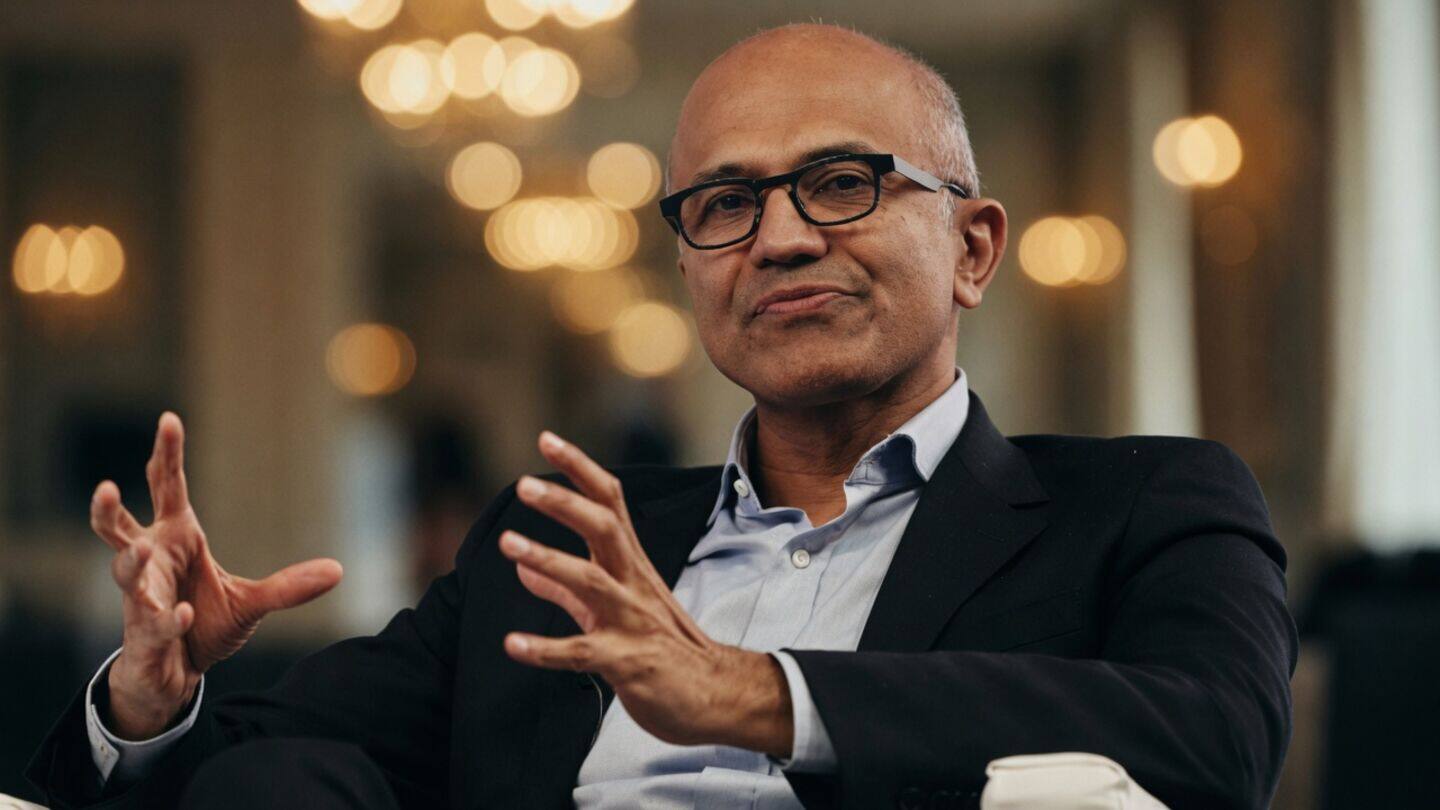
As the tech sector transitions from rapid experimentation to strict fiscal discipline, Microsoft CEO Satya Nadella has issued a blunt warning to the corporate world regarding the unchecked, over-hyped overconsumption of artificial intelligence. Speaking at a live taping of The New York Times’ Hard Fork podcast in San Francisco, Nadella coined a new corporate warning against “token-maxing”—the habit of reflexively throwing the most powerful, expensive frontier AI models at basic, routine tasks.
The warning marks a distinct phase shift for enterprise AI. After two years of urging employees to use generative tools at all costs, tech leaders are looking at massive data center cloud bills and demanding a calculated return on investment (ROI).
What is Token-Maxing?
Derived from internet slang, “token-maxing” refers to the uncritical, high-volume consumption of AI processing units (tokens) without regard for efficiency or cost. Nadella noted that because frontier models feel frictionless and magically helpful, workers default to them out of sheer habit.
However, the Microsoft chief admitted that the behavior is deeply embedded within his own company’s culture, and even his own habits:
“There is a lot of token-maxing happening at Microsoft,” Nadella joked during the interview. “I’m a token-maxer too. So it is addictive. But you have to step back when the novelty wears off to say, ‘What is it that I’m trying to create?'”
The Simple Rule: Frontier vs. Non-Frontier Problems
To combat the massive compute and electricity drain of over-powered queries, Nadella introduced a straightforward framework for IT departments and developers: “Don’t use frontier models for non-frontier problems.”
| Task Classification | Appropriate Model Tier | Examples of Workloads |
| Non-Frontier Tasks | Small Language Models (SLMs) / Edge AI | Routine text summarization, formatting, code variable renaming, basic data classification, email drafting. |
| Frontier Tasks | Advanced Reasoning & Heavy Infrastructure | Complex system architecture design, multi-agent coordination, novel scientific synthesis, cross-dependency code debugging. |
Nadella argued that using a top-tier model to summarize a standard text chain or draft boilerplate code is an unviable waste of raw computing power. “The hard truth is that the marginal cost of productivity improvement has to match the marginal cost of the token,” he explained.
The Platform Solution: Copilot’s Auto Mode
Recognizing that everyday enterprise users cannot be expected to constantly calculate the underlying computing costs of their text prompts, Nadella highlighted Microsoft’s product-level solution: Copilot’s Auto Mode.
The architecture takes model selection entirely out of the user’s hands. Instead of defaulting every query to a premium system, the application layer acts as an automated traffic controller. It analyzes the user’s prompt, determines the true complexity of the task, and routes the request to the most cost-effective model—saving frontier compute pipelines for truly complex problems.
A Sweeping Vision for AI Agents
Despite his warnings regarding raw token inflation, Nadella remains highly bullish on deep architectural automation. He outlined a shifting paradigm for software engineering where human developers will no longer spend their days writing line-by-line syntax.
Instead, programmers will move into oversight roles, managing hundreds or thousands of specialized AI agents simultaneously. Nadella called this emerging workplace skill “cognitive coverage”—the ability to deeply understand, review, and verify massive codebases generated entirely by autonomous agents. Even in an automated environment, he emphasized, a robust computer science foundation remains completely indispensable to ensure structural quality and safety.