

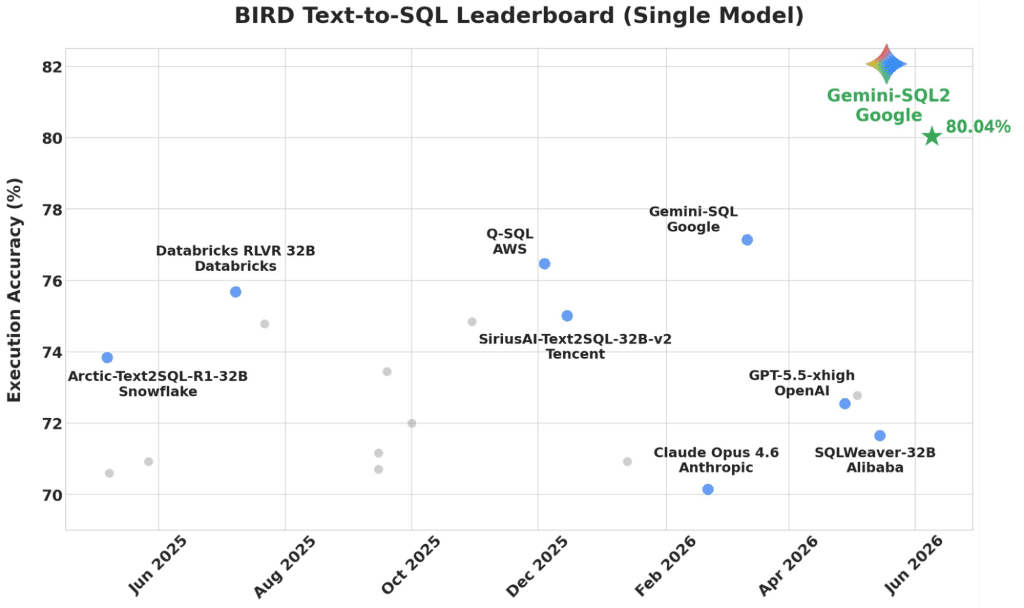
Moving to claim absolute dominance over the enterprise data stack, Google Research has officially unveiled Gemini-SQL2. The specialized text-to-SQL capability, engineered on top of Google’s flagship Gemini 3.1 Pro architecture, has become the first single-model system to break the elusive 80% accuracy threshold on the industry-standard BIRD benchmark.
The announcement positions Google significantly ahead of rival frontier LLMs, transforming natural language interfaces from basic chatbot features into highly accurate, production-grade database operators.
The Benchmark Breakdown: Why 80% on BIRD Matters
For data engineers, the BIRD (BIg Bench for LaRge-scale Database Grounded Text-to-SQL Evaluation) benchmark is considered the gold standard for testing AI database capabilities. Spanning 12,751 unique question-SQL pairs across 95 multi-table databases and 37 professional domains, BIRD purposely injects dirty data values, schema ambiguities, and complex business logic to mimic messy, real-world corporate warehouses.
Crucially, BIRD evaluates systems based on Execution Accuracy—meaning a generated query scores a zero if it is syntactically perfect but returns the wrong rows or empty datasets.
| Model / System | BIRD Execution Accuracy (Single-Model) | Margin vs. Gemini-SQL2 |
| Human Expert | 92.96% | +12.92% (Human Lead) |
| Gemini-SQL2 (Google) | 80.04% | Baseline |
| Gemini-SQL (Legacy) | ~77.20% | -2.84% |
| Q-SQL (Amazon AWS) | ~76.50% | -3.54% |
| Databricks RLVR (32B) | ~75.70% | -4.34% |
| GPT-5.5-xhigh (OpenAI) | 72.80% | -7.24% |
| Claude Opus 4.6 (Anthropic) | 70.90% | -9.14% |
By registering 80.04% execution accuracy, Gemini-SQL2 sits more than seven percentage points clear of OpenAI’s top-tier offering, narrowing the gap to human-level performance to just 12.92 points.
Under the Hood: Resolving Real-World Ambiguity
According to Google Research, Gemini-SQL2 is not a brand-new foundation model from scratch. Instead, it utilizes targeted post-training, multitask learning, and specialized agentic scaffolding layered over Gemini 3.1 Pro.
Traditional text-to-SQL generators frequently break down when dealing with production enterprise schemas containing thousands of columns and complex business logic (e.g., distinguishing whether “revenue” in an orders table implies gross or net totals). Gemini-SQL2 tackles this through a multi-stage approach:
- Massive In-Context Processing: It leverages Gemini’s native 1-million-token context window to ingest entire raw database schemas and data documentation at inference time, completely eliminating the need for expensive fine-tuning.
- Two-Stage Execution Verification: The scaffolding executes a rigorous internal loop where generated queries are pre-run against isolated data samples. Queries that yield syntax errors, processing timeouts, or mathematically impossible empty sets are auto-corrected before being served to the user.
- Multitask Test-Time Scaling: The system relies on advanced self-consistency voting mechanics to cross-examine multiple query candidates, selecting the version that matches the highest logical probability.
Product Integration: No API, Native Cloud Rollout
As of its research debut, Google has not released a standalone API model string or public model card for Gemini-SQL2. Instead, the tech giant is pursuing an ecosystem lock-in strategy, confirming that the capability will be directly hardwired into Google Cloud’s core data infrastructure platforms.
Target integration surfaces include:
- BigQuery Studio: Upgrading conversational analytics so business managers can extract complex ad-hoc reports (e.g., “Show MRR by region for users who churned within 90 days of an upgrade”) with multi-table joins and window logic.
- AlloyDB AI & Spanner Studio: Empowering full-stack developers to automatically draft transactional backend queries directly from English documentation.
- Cloud SQL Studio: Enhancing native, natural-language database management and index tuning.
Enterprise Advisory: While an 80% accuracy score represents a massive evolutionary leap, data architects emphasize that professional SQL engineers aren’t going anywhere. Because one in five queries can still technically return a silently wrong answer under highly unorganized data setups, the industry recommendation remains to expose Gemini-SQL2 to curated, tightly governed database views rather than dropping the AI directly into raw, unmapped data lakes.