

With Jio Platforms officially filing its Draft Red Herring Prospectus (DRHP) with SEBI for a mega public listing, early Silicon Valley backers are looking at massive paper gains.
According to financial estimates following the regulatory filing, early mega-investors Google and Meta are on track to lock in an estimated 280% return on their initial capital injection within six years of their 2020 entry.
The investment dynamics and valuation multipliers driving this windfall highlight several key financial details:
1. The Value Re-Rating (2020 vs. 2026)
During the peak of the pandemic in mid-2020, Jio Platforms raised more than $20 billion by selling roughly a 33% equity stake to global tech giants and private equity players. The ongoing public market filing has dramatically reassessed those investment valuations:
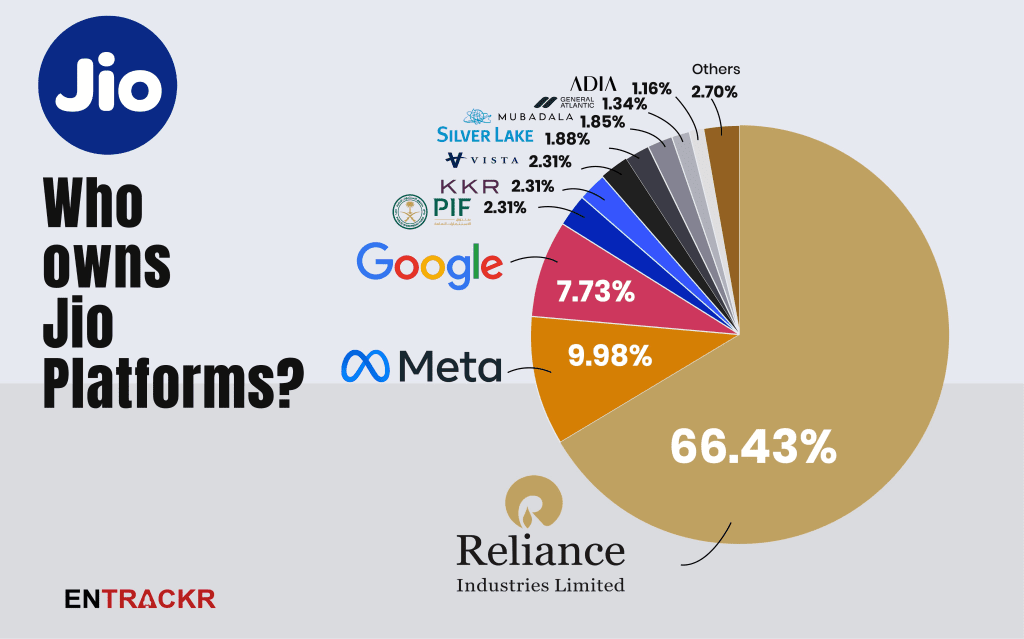
- Google’s Positioning: Google originally acquired a .73% equity stake in Jio Platforms for ₹33,737 crore ($4.5 billion) in July 2020. At the target listing parameters, the value of that exact stake is projected to scale to roughly ₹94,500 crore, netting a near 280% jump.
- Meta’s Positioning: Meta remains Jio’s largest external strategic stakeholder, holding a 9.99% equity slice acquired via its affiliate Jaadhu Holdings for ₹43,574 crore ($5.7 billion) in April 2020.
- The Valuation Multiplier: Based on the DRHP framework—where a ₹27,500 crore debt prepayment allocation is legally capped at 75% of the gross issue size—analysts place Jio’s target debut market valuation at approximately ₹12.2 lakh crore (~$137 billion).
2. Why the Backers are “Sitting Tight”
Despite the massive spike in book returns, global tech giants will not be cashing out anytime soon.
A major detail in the DRHP revealed that Reliance has structured the public market debut as a 100% fresh issue of 27 crore shares, completely eliminating the previously anticipated Offer for Sale (OFS) component.
What this means for investors: Neither Reliance Industries nor external promoters like Meta, Google, KKR, or Saudi Arabia’s Public Investment Fund (PIF) are selling a single share through the initial public offering. Their equity holdings will dilute slightly post-issue, but their capital remains locked in as they ride the long-term digital growth curve.
3. Where the Capital Inflow is Moving
Because the IPO is structured purely around fresh equity, 100% of the estimated ₹35,000 crore to ₹37,700 crore in public funds raised will go directly onto Jio’s corporate balance sheet:
- ₹27,500 crore is legally earmarked to completely or partially clear outstanding debt and commercial borrowings held by its telecom subsidiary, Reliance Jio Infocomm Ltd (RJIL).
- The remaining capital will be funneled directly into underwriting Jio’s ongoing high-capex push into 5G network deep-fiber monetization, domestic low-earth orbit (LEO) satellite broadband deployments, and sovereign AI computing grids.