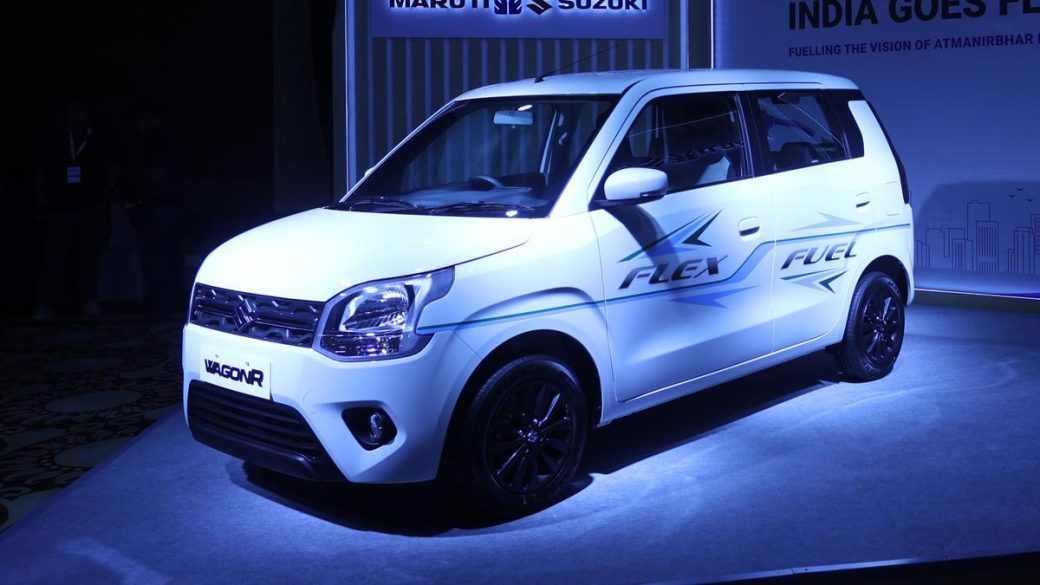
The slow start of Maruti Suzuki’s newly launched Wagon R Bioflex—selling just three units in its first four weeks of launch—highlights the massive gap between cutting-edge automotive tech and the actual infrastructure realities on the ground.
While a figure that low would typically signal a disaster for a mainstream hatchback, Maruti Suzuki expected it. The “failure” is entirely structural, exposing a classic chicken-and-egg dilemma holding back India’s alternative fuel push.
1. The Core Culprit: The Invisible E85 Network
The primary reason behind the three-car milestone is that customers literally have nowhere to fill it up.
The Wagon R Bioflex is engineered specifically to run on high-ethanol blends, most notably E85 (85% ethanol mixed with 15% petrol). However, while the central government has successfully pushed E20 blending across a vast network of traditional petrol pumps, standalone E85 or E100 dispensing stations are still virtually non-existent for the general public.
Maruti Suzuki executive Rahul Bharti openly warned analysts during a recent earnings call that volumes would be “minimal” at this stage:
“We have the technology and we’ll support the government whenever the need arises… but the volumes will be minimal at this stage. It will take 5 to 10 years from now to become a meaningful volume, nothing immediately.”
2. A Restricted, Commercial-Only Experiment
Because fuel availability is confined to isolated test pockets, the Wagon R Bioflex is not available to private retail buyers.
Maruti Suzuki has purposely restricted early sales to a small, controlled group of commercial fleet operators and corporate buyers who operate near designated alternative-fuel pilot pumps. The strategy allows Maruti’s engineering teams to collect crucial high-mileage engine data from real-world driving conditions without exposing regular retail customers to the frustration of running out of fuel options.
 [ Maruti Wagon R Bioflex Tech ] ──► Engineered for E85 (85% Ethanol) ──► Lowers oil import reliance
                                                  │
                                                  ▼ (The Commercial Bottleneck)
 [ Strict Pilot Rollout        ] ──► Banned for private buyers ──► Limited to a few corporate fleets
                                                  │
                                                  ▼ (The Retail Math)
 [ The Premium Disincentive    ] ──► Costs ₹7.24 Lakh (Commands a heavy ₹86,000 premium over petrol equivalent)
3. The Economic Deficit for Operators
Even for the select fleet operators allowed to buy it, the financial math for the Bioflex is hard to justify without heavy government fuel subsidies:
- The Upfront Premium: Priced at ₹7.24 lakh (ex-showroom), the Bioflex commands a steep ₹86,000 premium over the standard petrol-powered Wagon R ZXi+ variant it is based on.
- The Mileage Penalty: Because ethanol has lower energy density than pure petrol, running an engine on E85 results in a noticeable drop in real-world fuel efficiency (mileage).
- The Cost Parity Friction: Until oil marketing companies explicitly establish a sharp, state-mandated price gap that makes E85 significantly cheaper than standard petrol, the cost-per-kilometer for a commercial operator remains higher on ethanol than on existing, hyper-efficient factory-fitted CNG variants.
The Outlook
The three units sold are a reality check for the ambitious timelines mapped out by the Ministry of Road Transport and Highways. The government has committed to setting up 5,000 E100/E85 stations across the country over the next two years. Until that infrastructure physical footprint arrives on local highways, India’s mass-market flex-fuel revolution will remain confined to corporate pilot programs and automotive exhibition floors.