📚 New to this topic? Read our full guide: Biggest Companies in India.
India’s Electric Two-Wheeler Sales Jump 12% in June as TVS Widens Its Lead
India sold more electric two-wheelers in June 2026. An electric two-wheeler (a scooter or bike that runs on a battery, not petrol) is called an E2W for short. Sales went up 12.2% from the month before. That means 1.93 lakh of them were sold.
TVS Motor stayed in first place. It also pulled even further ahead of the other companies. Hero MotoCorp grew the fastest out of the big names.
The numbers come from Vahan. Vahan is the government’s list of all vehicles. When a vehicle is put on this list, it is called a “registration.” It means the vehicle is now allowed on the road. So these numbers tell us about real sales.
Who leads the market
| Company | June registrations | Market share | Growth over May |
|---|---|---|---|
| TVS Motor | 46,999 | 24.29% | +9.4% |
| Bajaj Auto | 43,234 | 22.34% | +9.4% |
| Ather Energy | 31,188 | 16.12% | +9.4% |
| Hero MotoCorp | 21,792 | 11.26% | +13.4% |
| Ola Electric | 16,144 | 8.34% | +6.1% |
Market share means the slice of all sales that one company gets. If a company has a 24% market share, it made about 24 out of every 100 sales.
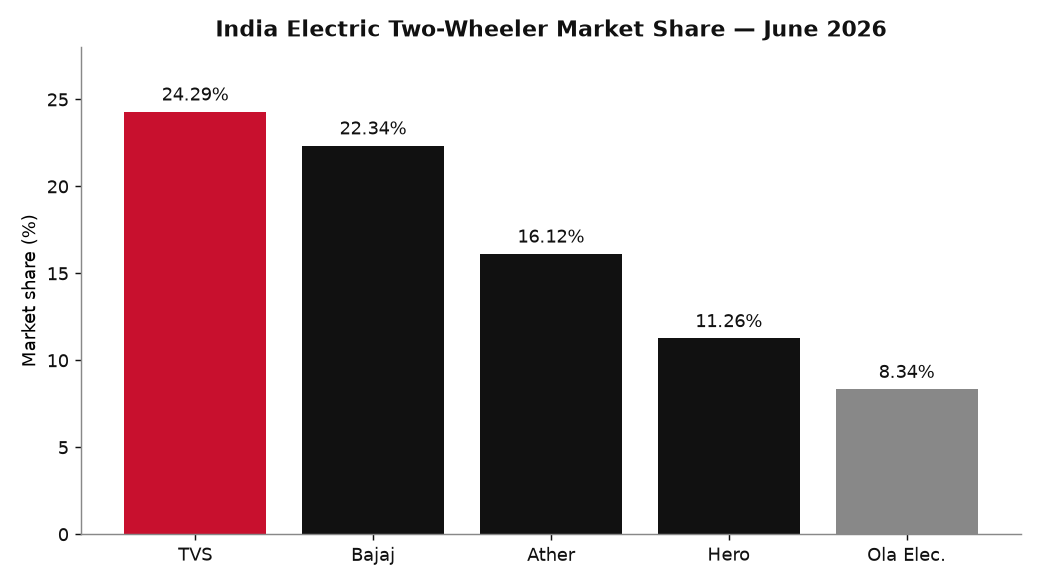
TVS stays ahead, Bajaj chases
TVS Motor was in first place. It sold 46,999 units and had a 24.29% market share. That was 4,034 more than in May. Bajaj Auto was close behind. It sold 43,234 units and had a 22.34% share. So the gap between them got smaller.
Ather Energy was third with 31,188 units. Hero MotoCorp was fourth with 21,792 units. Hero also grew the fastest of the top five, at 13.4%.
Ola Electric used to be the leader. Now it is trying to bounce back. It sold 16,144 units, which was 6.1% more than in May. That gave it an 8.34% share. All four bigger companies are now ahead of it.
Smaller players growing fast
Some smaller companies did really well too. Greaves Electric Mobility jumped 41.9% to 10,928 units. River Mobility grew 16%. BGauss grew 18.7%. Among the tiny companies, E-Sprinto Green Energy almost doubled its sales to 1,878 units. When many companies compete, buyers usually get more choices and better prices.
Policy is giving EVs a push
The government is helping too. This week, the Delhi government said yes to a new EV Policy. (A policy is a set of rules the government makes.) From April 2028, only electric two-wheelers can be newly registered in Delhi.
In the first year, the policy also gives an incentive. An incentive is a reward or discount to get people to buy. Here, buyers can get up to Rs 30,000 off an electric two-wheeler. Delhi buys a lot of two-wheelers. So this rule could make many more people switch to electric.
Why it matters (especially for India and founders)
Most people in India travel on two-wheelers. When these go electric, families spend less on fuel. Cities also get less pollution. Strong sales and government help make this one of India’s most exciting clean-tech markets. (Clean-tech means technology that is better for the planet.)
Founders (people who start companies) and investors (people who put money into companies) are watching closely. The fast growth of small brands shows there is still room for new companies to win. This clean push also links to India’s plan to make more things at home. You can see this in the new Semiconductor Mission 2.0, because EVs need lots of chips and batteries.
FAQ
What is Vahan data? It is the government’s official list of vehicle registrations. People use it to track real sales.
Who is the market leader? TVS Motor. It had a 24.29% share in June 2026.
What does the Delhi EV Policy do? From April 2028, only electric two-wheelers can be newly registered in Delhi. In the first year, buyers can get up to Rs 30,000 off.
Why the EV two-wheeler race is one to watch
Two-wheelers are the heart of Indian roads. Millions of people ride scooters and bikes to work, school, and shops every day. Because they are used so much, making them electric helps a lot. It can cut fuel spending and city pollution faster than switching cars. That is why this market matters so much for India’s clean-energy goals.
The costs are getting better too. The battery is the most expensive part of an electric vehicle. Battery prices have been dropping over the years. Running an electric scooter is also much cheaper than one that burns petrol. Government rewards, like Delhi’s up-to Rs 30,000 discount, make the price even lower.
Two worries still remain. One is finding a place to charge. The other is how long the battery lasts. But as more companies compete and more chargers are built, buyers get better products and prices. Big brands and small startups are all fighting for share. So the electric scooter market should stay one of India’s hottest business stories.
For buyers, all this fighting is good news. More brands and models mean better features and more price choices. Companies also give better help after the sale to keep their customers. As more chargers open and batteries get better, there are fewer reasons to stick with petrol scooters. This points to even faster switching to electric in the years ahead.
The June numbers also show how fast the lead can change in this young market. Ola Electric was once seen as the front-runner. Now it sits fifth, behind TVS, Bajaj, Ather, and Hero. This shows that an early lead can be lost fast when big two-wheeler companies go all in on electric.
What comes next? Steady government help, cheaper batteries, and tough competition could keep breaking sales records. For India, every petrol scooter that turns electric is a small win. It means less fuel bought from other countries and less city smog. That is why people watch these numbers so closely each month.
The takeaway
India’s electric scooters are selling faster. TVS is in the lead, with Bajaj close behind. With strong sales and firm government support, the two-wheeler EV race is only heating up.