
Indian Economy This Week: 8th Pay Commission Moves, Core Sector Slows, FDI Jumps, Monsoon Lags
The Indian economy gave mixed news this week. Some of it was good. Some of it was not. More foreign money came in. But factory output grew slowly. The rains came late, and that worried farmers. The government also took the first step to raise pay for nearly one crore workers and pensioners. (A pensioner is a retired worker who gets a monthly payment from the government.) This story explains four big updates in plain words. We explain each new term the first time we use it. So you do not need to know finance to follow along.
Here is the quick picture first. The 8th Pay Commission has started its work. Core sector growth slowed to just 0.5%. India FDI rose to $6.6 billion in April. And the monsoon deficit grew to 42%. Let us look at each one.
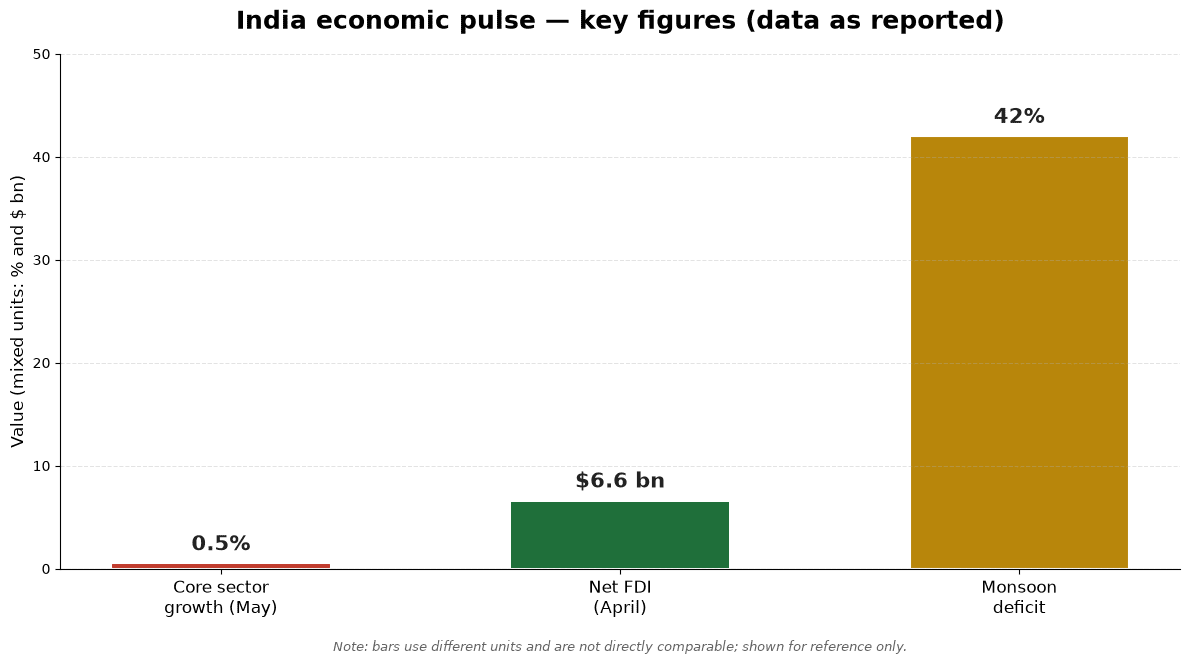
Overview: what changed and why it counts
These four updates touch different parts of daily life. The Pay Commission news affects salaries and pensions. The core sector number shows how big industries are doing. The FDI number shows how much foreign firms trust India. And the monsoon news shapes the food we grow and the prices we pay. Put together, they give a fair idea of where the economy is going. Let us read each one.
1. 8th Pay Commission starts collecting pay and pension data
First, what is a Pay Commission? It is a group the government sets up every few years. Its job is to check and update the pay, the extra allowances, and the pensions of central government workers. The 8th Pay Commission is the newest one.
This week, the commission asked government departments to send it key data about their workers and pensioners. The deadline is reported to be around June 30. This data covers how many people work in each department and what they are paid now. It is an early step, but an important one. Once the numbers come in, the group can study them. Then it can suggest new pay levels.
This is a big deal. The new pay is expected to cover about one crore (10 million) central government workers and pensioners. So it is not a small change. When pay goes up, people tend to spend more. And more spending can help the whole economy grow later on.
2. Core sector growth slows to 0.5% in May
Next is the factory side of the story. The “core sector” is a group of eight key industries. They are coal, crude oil, natural gas, refinery products, fertilisers, steel, cement, and electricity. These are the building blocks of the economy. When they slow down, a lot of other things slow down too.
In May, core sector growth slowed to just 0.5%. That is a weak number. The main reason was lower output of coal and refinery products. Both of them fell. In simple words, India dug out less coal and made less fuel than before. These eight industries power our plants, roads, and buildings. So a low number here is a warning sign worth watching.
3. Net FDI surges to $6.6 billion in April
Now for some good news. FDI stands for foreign direct investment. It is the long-term money that foreign companies put into India. For example, a foreign firm may build a factory here. Or it may buy a big stake (a large share of ownership) in an Indian company. This number is “net” FDI. That means the money coming in, minus the money going out.
In April, net India FDI jumped to $6.6 billion. That is a big rise. It shows that foreign firms still see India as a good place to invest for the long run. Money like this can create jobs, bring new skills, and help local firms grow.
4. Monsoon deficit widens to 42%, delaying Kharif sowing
The last update is about the rains. The “monsoon deficit” is the gap between the rain India should have got and the rain it actually got. A 42% deficit means rainfall is well below normal. This week, that gap grew to 42%.
Why does this matter so much? Because of Kharif crops. “Kharif” is the name for crops planted in the monsoon season, like rice, cotton, and pulses. They need the rains to grow. With the rains running late, planting has been delayed. Some farmers may switch to short-duration crops. These are crops that grow and ripen faster, so they can still be planted in time. A poor monsoon can push food prices up and cut farm incomes. So this affects almost everyone.
Key facts at a glance
| Update | Key figure | What it means |
|---|---|---|
| 8th Pay Commission | Data due ~June 30 | First step to revise pay for ~1 crore staff and pensioners |
| Core sector growth (May) | 0.5% | Heavy industry slowed; coal and refinery output fell |
| Net FDI (April) | $6.6 billion | Foreign long-term investment surged |
| Monsoon deficit | 42% | Rains lagging; Kharif sowing delayed |
Why it matters (especially for India and founders)
For normal families, these four stories shape jobs, prices, and pay. A higher pay award later could help people spend more. Strong FDI can mean more jobs. But weak core sector growth and a poor monsoon could push prices up and slow things down.
For founders and small business owners, these signals are useful too. (A founder is a person who starts a company.) Rising FDI shows that foreign firms feel sure about India. That can help with funding and partnerships. A pay rise later could lift demand for goods and services. But a slow core sector and a late monsoon are reasons to plan with care. Keep an eye on your input costs. And watch how much rural areas keep buying if the rains stay weak.
Frequently asked questions
What is a Pay Commission?
It is a government group set up every few years. It checks and updates the pay, allowances, and pensions of central government workers. The 8th Pay Commission is the current one.
What are the eight core industries?
They are coal, crude oil, natural gas, refinery products, fertilisers, steel, cement, and electricity. They make up the core of the economy. So their growth rate is watched closely.
What does net FDI mean?
FDI is the long-term money that foreign companies invest in India. “Net” FDI is the money coming in, minus the money going out. In April, net FDI was $6.6 billion.
What is a monsoon deficit?
It is the gap between the rain India should get and the rain it actually gets. A 42% deficit means rainfall is far below normal. This can delay the planting of monsoon-season (Kharif) crops.
Closing takeaway
This week showed an economy pulling in two directions. The foreign money and the Pay Commission step are good signs. The slow core sector and the late monsoon are worries. For the coming months, the rains and factory output will be the numbers to watch most. For more, see our coverage of the India-US trade talks and Goyal’s red lines, the latest India IPO watch with Zypp and Turtlemint, and Sarvam AI’s funding and scale plans.
Sources: 8th Pay Commission data deadline (Financial Express); Core sector growth slows to 0.5% (Financial Express); Net FDI surges to $6.6 billion (Financial Express); Monsoon deficit widens to 42% (Financial Express).