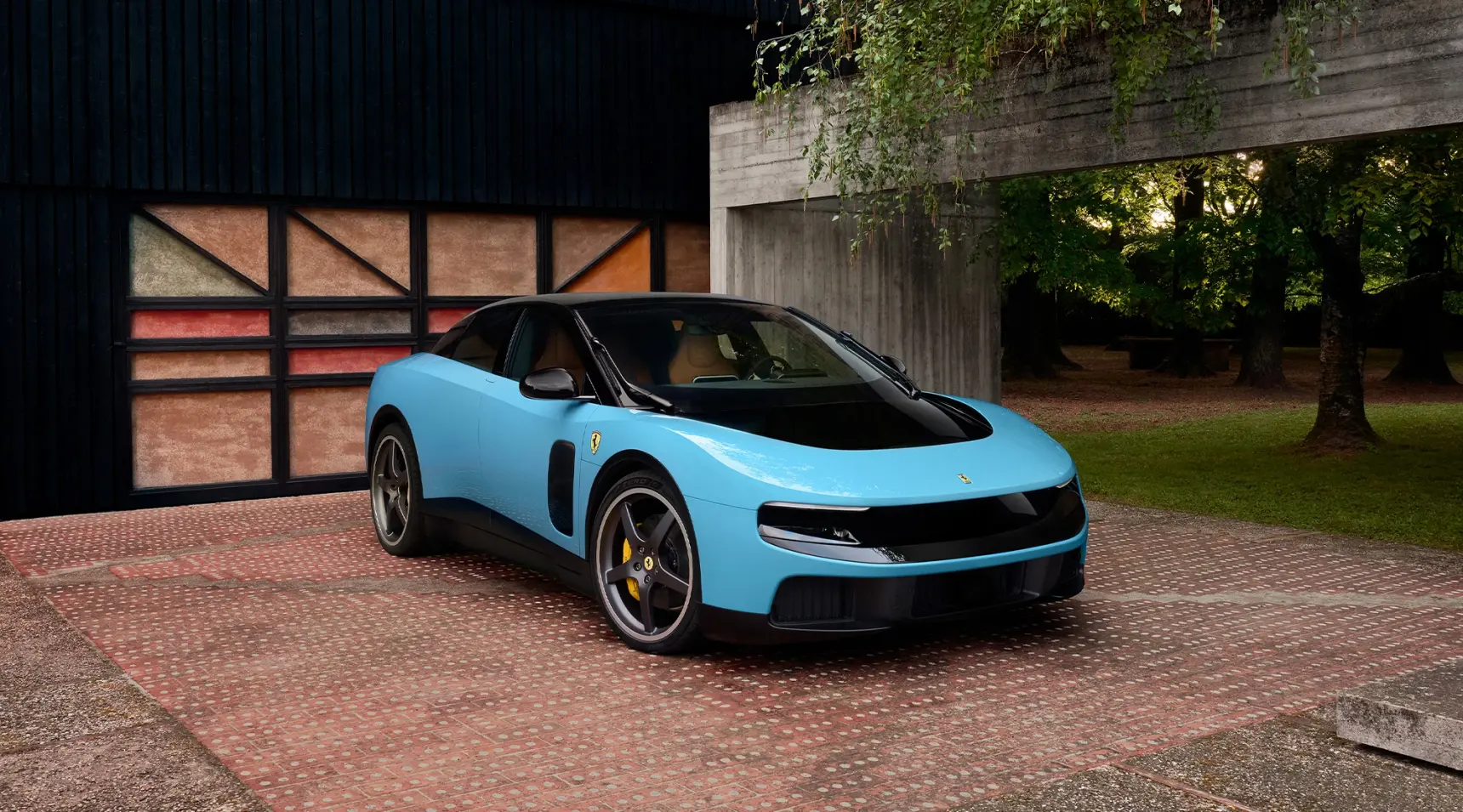
In a stark reminder of Wall Street’s complex relationship with automotive electrification, Ferrari NV (RACE) watched its shares plunge over 8% in heavy trading today. The sudden market correction occurred immediately after the luxury Italian automaker officially pulled the silk sheet off its first-ever fully electric supercar.
The sharp drop represents one of the steepest single-day declines for the Maranello-based company since its initial public offering, wiping roughly €7.4 billion off its market capitalization.
The Debut: A €500,000 Electric Pioneer
The market volatility directly follows the official world premiere of Ferrari’s unnamed battery-electric vehicle (BEV) at its newly constructed e-building factory line in Maranello. Designed to preserve the brand’s legendary performance metrics while transitioning away from combustion architectures, the vehicle features highly advanced performance baselines:
- The Retail Entry Threshold: Base pricing is confirmed to start at a staggering €500,000 (approximately $543,000), placing it firmly ahead of competing luxury EV offerings like the Porsche Taycan Turbo GT.
- Acoustic Engineering: To counter purist anxieties regarding the “silent nature” of electric drivetrains, Ferrari patented a complex mechanical sound amplification system that channels the genuine core frequencies of the electric motors straight into the cabin.
Why Did Wall Street Pull Back?
While auto enthusiasts focused on the vehicle’s aggressive aesthetics and sub-two-second acceleration metrics, institutional investors and equity analysts immediately zeroed in on structural financial risks.
Market experts point to three primary drivers behind the 8% sell-off:
1. The Global EV Macro Slowdown
The debut lands during a challenging period for global premium EV adoption. Major automotive giants across Europe and North America have spent the first half of 2026 scaling back their long-term EV volume targets, citing saturated consumer demand, high interest rates, and patchy public fast-charging infrastructure. Investors fear Ferrari may be scaling up electric assembly capacity just as global appetite for premium electric vehicles hits a temporary ceiling.
2. High CAPEX and Margin Dilution Risks
Ferrari has historically commanded industry-leading EBITDA margins hovering near 38%, treated by the market more like a high-margin Hermes-style luxury stock than a traditional car manufacturer.
However, developing bespoke high-voltage battery modules and solid-state cooling mechanisms natively requires massive capital expenditure (CAPEX). Analysts from Morgan Stanley and Jefferies expressed caution that the initial production cycles of the new EV line could dilute Ferrari’s premium margins over the next 24 months as the e-building infrastructure scales up to optimal yield efficiency.
3. “Purist” Brand Dissociation
There remains an intangible risk regarding core brand identity. A segment of Ferrari’s ultra-high-net-worth collector base values the brand specifically for the mechanical symphony and raw feedback of its high-revving naturally aspirated V12 and twin-turbo V8 engines. Investors are questioning whether an electric motor—regardless of how meticulously engineered—can command the same multi-year waiting lists and long-term auction appreciation that fuel Ferrari’s recurring economic engine.
Long-Term Outlook Remains Grounded
Despite the immediate 8% drop in share pricing, several long-term fund managers view the correction as a healthy technical retracement rather than a fundamental flaw in Ferrari’s corporate thesis.
The company’s order books across its existing internal combustion engine (ICE) and hybrid portfolios (like the SF90 and Purosangue SUV) remain completely filled through the end of 2028. This massive backlog gives the luxury manufacturer an unmatched financial cushion, allowing it to slowly refine its electric rollout without facing the immediate cash-flow crises that plague pure-play EV startups.
Get the day’s top stories in your inbox
One concise email. No spam, unsubscribe anytime.