Meta has unveiled Muse Spark 1.1, an upgraded version of its AI coding model that reportedly outperforms GLM-5.2 on several programming benchmarks while costing slightly less to use. The launch marks another escalation in the increasingly competitive AI model market, where leading developers are racing to deliver stronger coding performance at lower prices.
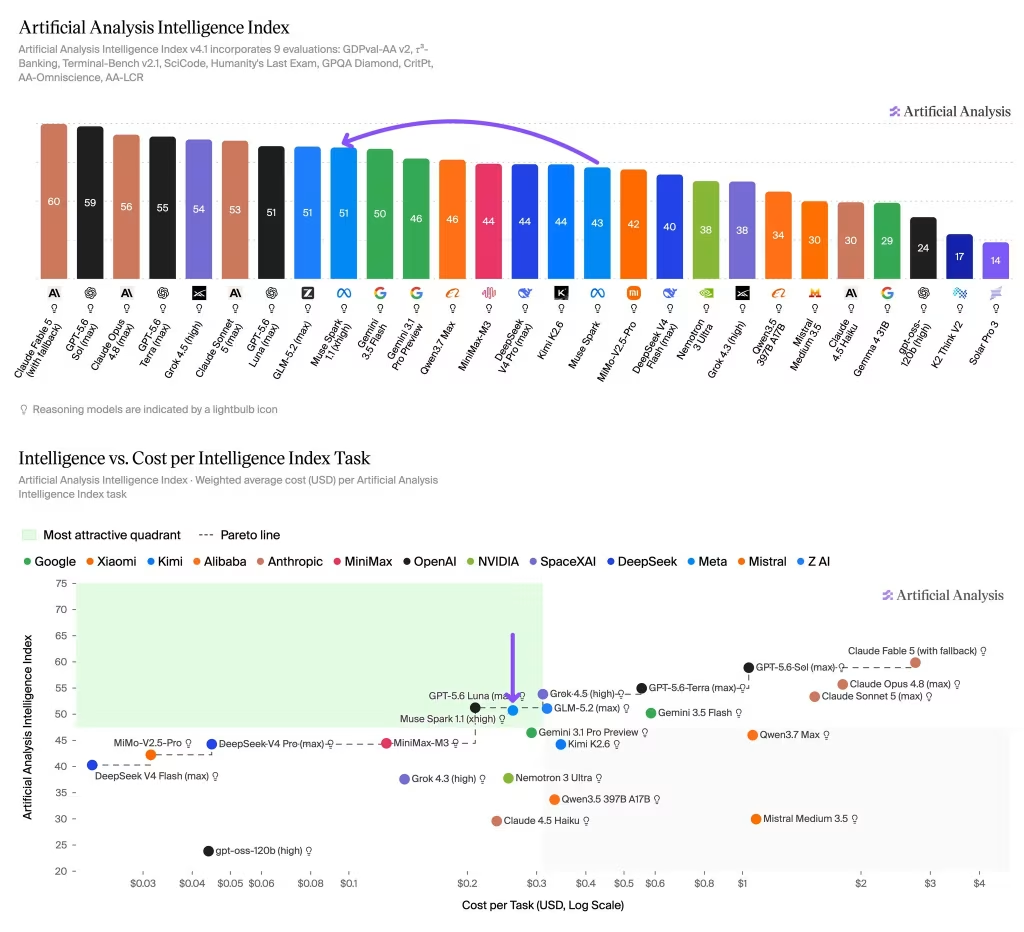
According to Meta, Muse Spark 1.1 improves code generation, debugging, reasoning, and software engineering capabilities while offering more competitive API pricing. The release comes as enterprise customers place growing emphasis on balancing AI model quality with operating costs, making pricing an increasingly important factor alongside benchmark performance.
Meta Positions Muse Spark 1.1 as a Stronger Coding Model
Muse Spark 1.1 has been designed primarily for software engineering tasks, including writing code, fixing bugs, explaining complex programs, and assisting developers throughout the software development lifecycle.
Meta says the latest version delivers improvements in:
- Code generation.
- Bug fixing.
- Multi-step reasoning.
- Instruction following.
- Programming language support.
- Agentic software development.
The company claims these enhancements allow the model to produce more accurate and reliable coding outputs across a broad range of programming tasks.
Benchmark Results
According to Meta, Muse Spark 1.1 performs better than GLM-5.2 across several coding evaluations.
| Feature | Muse Spark 1.1 | GLM-5.2 |
|---|---|---|
| Primary focus | Coding and software engineering | General-purpose AI with coding support |
| Coding benchmarks | Reportedly higher | Competitive |
| API pricing | Slightly lower | Slightly higher |
| Target users | Developers and enterprises | Developers and enterprises |
The reported benchmark improvements are based on Meta’s published evaluation results. Independent third-party testing may produce different outcomes depending on workloads and testing methodologies.
Pricing Becomes a Competitive Weapon
Beyond raw performance, pricing has become one of the biggest battlegrounds among AI providers.
Meta says Muse Spark 1.1 is priced slightly below GLM-5.2, allowing businesses to reduce AI inference costs while maintaining strong coding performance.
Several factors are driving pricing competition:
- Falling inference costs.
- Improved hardware efficiency.
- Better model optimization.
- Increasing number of competing AI providers.
- Enterprise demand for lower operating expenses.
Industry analysts expect API prices to continue declining as competition intensifies.
AI Coding Market Heats Up
Software engineering has emerged as one of the fastest-growing applications for generative AI.
Today’s coding models assist developers with:
- Writing new code.
- Debugging applications.
- Refactoring software.
- Code reviews.
- Documentation.
- Test generation.
| AI Coding Capability | Business Benefit |
|---|---|
| Code generation | Faster development |
| Bug detection | Improved software quality |
| Documentation | Higher productivity |
| Automated testing | Reduced development time |
As organizations increasingly adopt AI-assisted software development, demand for specialized coding models continues to grow.
Competition Intensifies
Meta’s latest release enters an increasingly crowded AI coding market.
Major competitors include models from:
- OpenAI.
- Anthropic.
- Google.
- xAI.
- Alibaba.
- DeepSeek.
- Zhipu AI (GLM).
Rather than competing solely on benchmark scores, providers are now differentiating themselves through pricing, speed, context window size, enterprise features, and agentic capabilities.
Enterprise Adoption Accelerates
Businesses are rapidly integrating AI coding assistants into daily software development workflows.
Organizations are using coding models to:
- Accelerate product development.
- Reduce repetitive programming tasks.
- Improve developer productivity.
- Assist junior engineers.
- Support legacy code maintenance.
Lower API pricing could further accelerate enterprise adoption, particularly among startups and companies deploying AI at scale.
AI Price War Continues
The launch of Muse Spark 1.1 is part of a broader trend in which frontier AI models are becoming both more capable and more affordable.
Over the past year, multiple AI providers have reduced prices while simultaneously improving reasoning, coding performance, and context length.
Industry experts believe this competition is benefiting customers by making advanced AI models increasingly accessible to businesses of all sizes.
What It Means for Developers
Meta’s release of Muse Spark 1.1 highlights the rapid pace of innovation in AI-assisted software development. By combining stronger reported coding performance with lower API pricing than GLM-5.2, the company is targeting developers and enterprises seeking high-quality coding assistance without significantly increasing operational costs.
For the broader AI industry, the launch reinforces a growing trend in which pricing, efficiency, and specialized capabilities are becoming just as important as benchmark performance. As competition among AI providers continues to intensify, developers are likely to benefit from increasingly powerful coding models that are both more affordable and better suited for real-world software engineering tasks.
Get the day’s top stories in your inbox
One concise email. No spam, unsubscribe anytime.