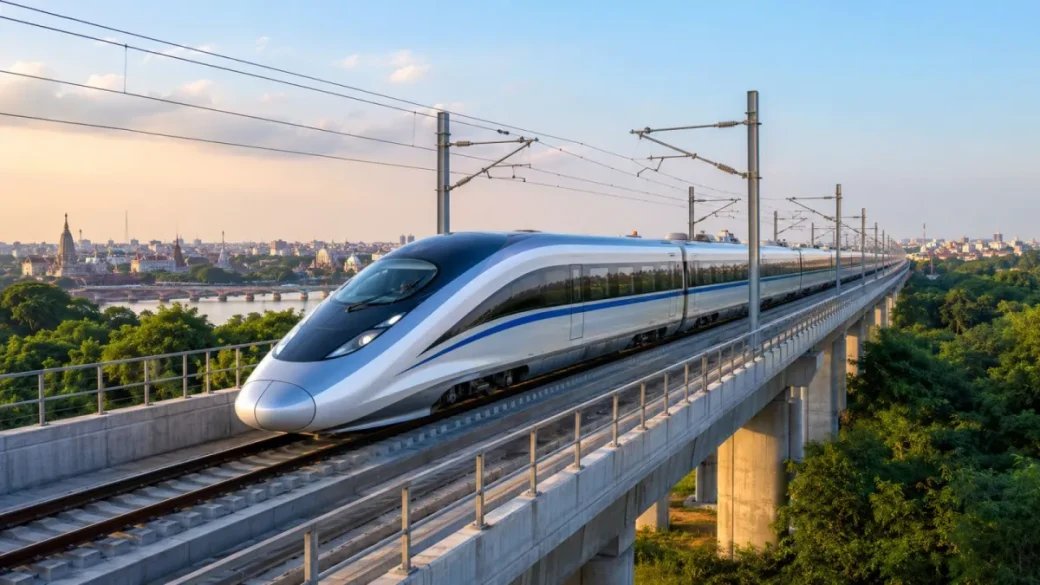
India’s Mumbai-Ahmedabad Bullet Train Project is facing a potential ₹40,000 crore cost escalation after the National High Speed Rail Corporation Limited (NHSRCL) warned the Gujarat High Court that recent land compensation awards could dramatically increase the project’s financial burden. The project authority has challenged orders passed by the Land Acquisition, Rehabilitation and Resettlement Authority (LARRA), arguing that if the enhanced compensation is applied across similar land parcels, the additional liability could threaten the viability of India’s first high-speed rail corridor.
The dispute centers on compensation awarded to landowners whose properties were acquired for the 508-kilometre Mumbai-Ahmedabad High-Speed Rail (MAHSR) corridor. According to NHSRCL, the compensation ordered in several cases is substantially higher than the original acquisition awards and, if extended to other affected landowners, could add nearly ₹40,000 crore to the project’s overall cost.
Land Compensation Case Reaches High Court
NHSRCL has approached the Gujarat High Court seeking relief against orders passed by the Land Acquisition, Rehabilitation and Resettlement Authority.
According to the project authority:
- Enhanced compensation has been awarded in multiple cases.
- Similar claims could be filed by thousands of other landowners.
- The financial impact could significantly raise project costs.
- The increase may affect the project’s long-term sustainability.
| Key Issue | Details |
|---|---|
| Project | Mumbai-Ahmedabad Bullet Train |
| Potential additional cost | Around ₹40,000 crore |
| Reason | Enhanced land compensation awards |
| Court | Gujarat High Court |
The corporation has argued that the legal interpretation adopted by the authority could create a precedent for future compensation claims.
Why the Cost Could Rise
The dispute relates to how compensation should be calculated under land acquisition laws.
If the higher compensation formula is upheld:
- More landowners may seek revised compensation.
- Existing awards could be reopened.
- Project acquisition costs would increase substantially.
- Additional government funding may become necessary.
Officials reportedly warned that widespread application of the revised compensation methodology could add nearly ₹40,000 crore to the project’s financial burden.
A Project Already Facing Cost Escalation
The Mumbai-Ahmedabad Bullet Train project has already experienced delays due to:
- Land acquisition challenges.
- COVID-19 disruptions.
- Construction delays.
- Inflation in material costs.
| Project Snapshot | Details |
|---|---|
| Corridor length | 508 km |
| Original approved cost | ₹1.08 lakh crore |
| Key technology | Japanese Shinkansen |
| Funding | India and Japan (JICA loan) |
Earlier reports had already indicated significant cost increases compared with the project’s original estimate because of delays in land acquisition and construction.
Why Land Acquisition Matters
Land acquisition has been one of the biggest hurdles since the project began.
The corridor passes through:
- Gujarat.
- Maharashtra.
- Dadra & Nagar Haveli.
Thousands of private land parcels were acquired for stations, viaducts, depots, and supporting infrastructure. Compensation disputes in several locations delayed construction during the project’s early years before acquisition was substantially completed.
Strategic Importance of the Bullet Train
The Mumbai-Ahmedabad High-Speed Rail corridor is India’s first bullet train project and is expected to introduce Japanese Shinkansen technology to the country.
The project aims to:
- Reduce travel time between Mumbai and Ahmedabad.
- Improve regional connectivity.
- Promote economic development.
- Introduce high-speed rail technology.
- Support long-term infrastructure modernization.
It remains one of India’s largest transportation infrastructure projects.
What Happens Next?
The Gujarat High Court will now examine NHSRCL’s challenge to the compensation awards.
Possible outcomes include:
- Upholding the enhanced compensation.
- Modifying the compensation formula.
- Referring legal questions for further review.
- Limiting the impact to specific cases.
The final decision could influence compensation claims across other infrastructure projects involving land acquisition.
What It Means for the Bullet Train Project
The latest legal challenge highlights that land acquisition remains one of the most significant financial risks for large infrastructure projects in India, even after construction has advanced. If the Gujarat High Court ultimately upholds the higher compensation awards across similar cases, the Mumbai-Ahmedabad Bullet Train project could face an additional ₹40,000 crore in costs, increasing pressure on project finances and government funding.
While construction on the corridor continues, the outcome of the case could have implications beyond the bullet train project by influencing how compensation is determined for future land acquisitions under India’s infrastructure development programmes.
Get the day’s top stories in your inbox
One concise email. No spam, unsubscribe anytime.