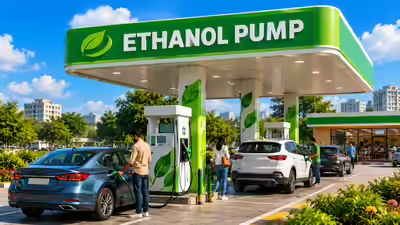
The Ministry of Petroleum and Natural Gas has issued a comprehensive, 10-point scientific rebuttal to counter a wave of viral misinformation and social media myths surrounding India’s E20 (20% ethanol-blended petrol) program.
The government reiterated that the transition is not an “untested experiment,” but a globally accepted policy supported by extensive research, automotive trials, and global best practices across nations like the US, Brazil, and Japan.
1. Fact vs. Fiction: The 5 Biggest Myths Busted
The Ministry, in collaboration with the Automotive Research Association of India (ARAI) and major Oil Marketing Companies (OMCs), addressed the most prominent claims circulating online:
- The “Engine Damage” Myth: Social media posts claimed E20 causes widespread engine corrosion and breakdowns. The government cited rigorous ARAI-led testing—covering 40,000 km in passenger cars and 20,000 km in two-wheelers—confirming zero issues with metal or plastic component compatibility. Drivability remains unaffected, though some older legacy vehicles may eventually require routine rubber seal replacements.
- The “10,000-Litre Water” Distortion: Critics claimed producing one litre of ethanol drains 10,000 litres of groundwater. The ministry clarified that crops like paddy are grown for national food security, not exclusively for fuel. Modern distilleries consume just 3 to 5 litres of process water per litre of ethanol, utilizing Zero Liquid Discharge (ZLD) systems to recycle nearly all of it. Furthermore, over 40% of India’s ethanol is now made from maize, which requires minimal irrigation.
- The “Insect Attraction” Oddity: Viral videos suggested E20 attracts ants and bees to vehicle fuel caps due to residual sugars. Bharat Petroleum (BPCL) dismissed this, explaining that industrial fermentation and distillation extract pure, sugar-free ethanol. Additionally, the fuel contains chemical denaturants that actively act as an insect repellent.
- The “Direct Sugarcane Mix” Claims: Fabricated videos showed sugarcane juice being mixed straight into petrol tanks. The government stressed that fuel-grade ethanol is a highly regulated, pure chemical compound conforming to strict Bureau of Indian Standards (BIS) parameters before it ever touches an OMC depot.
- The “Voided Warranty” Scare: Rumors claimed E20 voids vehicle insurance and manufacturer warranties. Both the Society of Indian Automobile Manufacturers (SIAM) and major insurers have formally clarified that E20-compliant vehicles maintain full, uninterrupted warranty and insurance coverage.
 [ MYTH ] ──► E20 is a risky experiment that breaks down engines and drains groundwater.
   │
   ▼ (THE SCIENTIFIC VERDICT)
 [ FACT ] ──► Tested over 60,000 km by ARAI; uses just 3-5L of process water; sugar-free & insect-repellent.
2. Macro Achievements of the Blending Program
India officially hit its 20% ethanol blending target in December 2025, ahead of its original 2030 timeline. The macro-economic benefits delivered by the initiative include:
| Metric Economy Layer | Cumulative Impact | Long-Term Strategic Value |
| Foreign Exchange Savings | Greater than ₹1.9 lakh crore | Substituted over 310 lakh metric tonnes of expensive crude oil imports, insulating the economy from energy shocks. |
| Agricultural Infrastructure | Over ₹1.6 lakh crore paid directly to farmers | Created a highly predictable secondary income model for sugarcane, maize, and broken grain farmers. |
| Environmental Protection | ~930 lakh metric tonnes of CO₂ mitigated | Deeply supports India’s global climate goals and urban air quality by utilizing cleaner-burning oxygenates. |
Moving Beyond E20
With E20 now fully deployed at public sector fuel stations nationwide, India is already executing its next phase of energy independence. The government recently launched E85 fuel networks alongside a push for Flex-Fuel Vehicles (FFVs) capable of running on up to 85% ethanol, positioning the country alongside Brazil as a global leader in sustainable biofuel adoption.
To learn more about the transition and how it is reshaping transport infrastructure, watch this News18 panel report on India’s E20 fuel mission, which details the technical timeline, agricultural impact, and the future of flex-fuel technology.