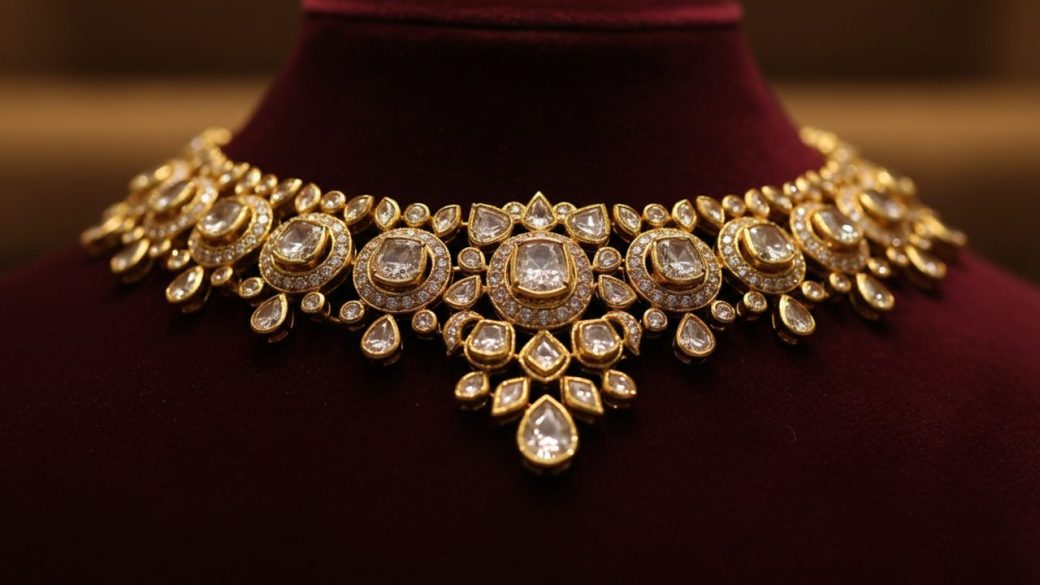
Advit Jewels IPO Opens With a Strong Grey-Market Premium
The Advit Jewels IPO opened for bidding on June 23, 2026. It is already getting a lot of buzz. An IPO is the first time a company sells its shares to the public. After an IPO, anyone can buy or sell those shares on the stock market. Before the shares even start trading, the grey market is hinting at a big jump on day one.
Here is what the company is offering. Here are the early signals. And here are the risks you should think about before you bid. This is news, not investment advice.
What Advit Jewels does
Advit Jewels makes fine jewellery. Its pieces include Kundan, Polki, diamond, and studded designs. The company sells under the brand name Rambhajo.
It sells in two ways. First, it supplies dealers, showrooms, and shops. This is called B2B, which means business-to-business. Second, it sells straight to shoppers. This is called B2C, which means business-to-customer. So it earns money from big buyers and from everyday customers.
The basics: price band, dates, and size
The price band is ₹130 to ₹138 per share. A price band is the price range set for the IPO. You place your bid somewhere inside this range. The final price is fixed later. Most people bid at the top price, here ₹138. They do this to get a better chance of getting shares.
The total issue size is about ₹165.16 crore. This is how much money the company wants to raise. The whole amount is a “fresh issue.” That means the company is making brand-new shares to raise cash for itself. None of the money goes to old owners selling their stake (their share of the company).
The IPO opens on June 23, 2026. It closes on June 25, 2026. Shares are expected to be given out, or allotted, on June 29, 2026. The listing is when the shares start trading. It is expected on July 1, 2026, on both the BSE and the NSE. These are India’s two big stock exchanges. This is a mainboard IPO, not an SME IPO.
What “SME IPO” means
An SME IPO is a smaller listing. It is meant for small and medium companies. These listings have their own special board. They also have bigger minimum bid sizes. Advit Jewels is not one of these. It is going straight onto the main BSE and NSE boards. That is where the larger, better-known companies trade.
How the bidding works
You cannot bid for just one share. You bid in fixed bunches called lots. One lot here is 100 shares. So the smallest bid is about ₹13,800 at the top price.
The shares are split between three groups. Retail investors are regular small bidders, like you. They get 35%. QIBs are large institutions, like big banks and funds. They get 50%. HNIs are rich individual investors. They get the other 15%. Splitting shares this way is normal for a mainboard IPO.
One more word to know is subscription. Subscription tells you how many times the offer was applied for. Say an IPO is “subscribed 5 times.” That means people asked for five times more shares than are available. Heavy subscription usually shows strong demand. But it also means fewer people will actually get shares.
The grey-market premium signal
The GMP, or grey market premium, is the big talking point here. The grey market is an unofficial market. People trade IPO shares there before the shares list. The GMP is the extra price buyers will pay there, above the IPO price. It is an early, rough guess at how the shares might open.
On day one, the GMP for Advit Jewels was around ₹55 to ₹61 per share. Add that to the ₹138 top price. The grey market is then hinting at a listing price near ₹193 to ₹199. That points to a gain of about 40% to 46% on day one. Financial Express is the source for this story. It called the early signal about a 46% premium.
Here is the catch. The GMP is not official and not promised. It is based on informal trades and rumours. It can change every hour. It can even vanish by listing day. A high GMP is a hopeful sign, not a sure thing. Many IPOs with strong GMPs have still listed flat or fallen.
Key facts
| Detail | Figure |
|---|---|
| Price band | ₹130 – ₹138 per share |
| Issue size | ~₹165.16 crore (100% fresh issue) |
| Lot size | 100 shares (min. ~₹13,800) |
| IPO opens | June 23, 2026 |
| IPO closes | June 25, 2026 |
| Allotment | June 29, 2026 |
| Listing (BSE & NSE) | July 1, 2026 |
| Grey-market premium | ~₹55 – ₹61 (≈40–46% over top price) |
| FY2025 revenue | ₹124.94 crore |
| FY2025 net profit | ₹25.37 crore |
| Lead manager / Registrar | Holani Consultants / Bigshare Services |
The money side and the risks
The numbers look healthy on the surface. In FY2025 (the company’s financial year), revenue was about ₹124.94 crore. Revenue is the total money a company takes in from sales. Net profit was about ₹25.37 crore. Net profit is the money left after paying all costs. That is a profit margin above 20%. The margin is the share of sales that turns into profit. This is strong for a jewellery maker.
The company plans to use the IPO money in two main ways. About ₹65 crore is set aside for working capital. Working capital is the everyday cash a business needs to run. Another ₹65 crore is meant to pay back some of its loans.
That second point hints at the main risk. The company carries a lot of debt. Debt is money the company has borrowed. Its debt-to-equity ratio is about 1.29. This ratio compares borrowed money to the owners’ own money. A ratio of 1.29 means it owes more than the owners have put in. Using IPO cash to repay loans is smart. But high debt can squeeze profits if sales slow or interest costs rise.
There are other things to watch. Jewellery demand swings with gold prices. It also swings with the festive and wedding seasons. The grey-market hype could fade. And a strong listing pop is never a sure thing.
FAQ
What is the Advit Jewels IPO price band?
The price band is ₹130 to ₹138 per share. You bid within this range. The final price is fixed after bidding closes.
Does a high GMP guarantee a profit?
No. The GMP is just an unofficial guess from the grey market. It can change quickly. It can even disappear before listing. It is a signal of demand, not a promise of gains.
Is this an SME IPO?
No. It is a mainboard IPO. It will list on the main BSE and NSE boards. It will not list on a separate SME platform.
What is the minimum amount needed to apply?
One lot is 100 shares. At the top price of ₹138, the smallest retail bid is about ₹13,800.
Why it matters (especially for India / founders)
India’s IPO market is busy again. Even old, traditional businesses like jewellery are joining in. For founders, the Advit Jewels deal is a clear lesson. A company that makes a profit can raise public money. It can use that money to clear loans and grow. It does not have to rely only on private investors or bank loans.
For students and new investors, this IPO is a good case study. It shows how to read the signals. Look past the GMP excitement. Check the real numbers: profit, margins, debt, and how the money will be used. The grey market grabs headlines. But the company’s accounts tell the longer story.
Takeaway: The Advit Jewels IPO opens with strong grey-market buzz and solid profits. But it also carries real debt. The early premium is a hopeful hint, not a sure payday. Read the full risks before you bid. And treat any GMP number as a rumour, not a rule.
Source: Financial Express