Brexit at 10: What the Numbers Say About the UK Economy
About 10 years ago, the United Kingdom voted to leave the European Union. The European Union (often called the EU) is a club of European countries that trade and work closely together. This decision to leave is called Brexit (short for “Britain exiting” the EU). Ten years later, people still argue about it. Did it help the country, or hurt it? Let’s skip the noise and look at the numbers. A new review of the data by CNBC, a business news company, shows a clear pattern. The UK economy is smaller than it likely would have been. And trade with Europe has slowed down.
No number here is perfect. No one can replay history to see what would have happened if Britain had stayed. But experts build careful “what if” guesses using real data. And most of them point the same way.
First, a few simple words
Before the numbers, here are the key words in plain English:
- GDP (Gross Domestic Product) is the total value of everything a country makes and sells in a year. It is the simplest way to measure how big an economy is.
- Trade means buying and selling things between countries. Exports are what you sell to other countries. Imports are what you buy from them.
- The single market was the EU’s shared trading zone. Inside it, goods, services, money, and workers could move between countries almost as easily as inside one country. There were very few checks or extra costs. Brexit took the UK out of it.
- FDI (Foreign Direct Investment) is money that companies from other countries put into a place. For example, they might build a factory or an office. This usually brings new jobs and skills.
The headline: a smaller economy
The biggest question is simple. Is the UK economy smaller because of Brexit? Most careful studies say yes.
The UK’s official forecaster is the Office for Budget Responsibility, or the OBR. A forecaster is a group that predicts how the economy will do, and the OBR is the government’s independent number-checker. The OBR thinks Brexit will lower long-run productivity by about 4%. Productivity means how much value each worker makes per hour. A 4% drop sounds small. But across a whole country, it is huge. The Institute for Government, a research group, calls it “over a trillion pounds of lost opportunity” over a decade. A trillion is a million million.
Other guesses are even bigger. The Centre for Economic Policy Research (CEPR), a respected research group, said the harm was about 2% to 3% of GDP by July 2023. Nicholas Bloom, a professor at Stanford University, thinks the hit was about 6% to 8% of GDP by 2025. Some studies of “lost growth” reach about 8%. The chart below puts these guesses side by side so you can compare them.
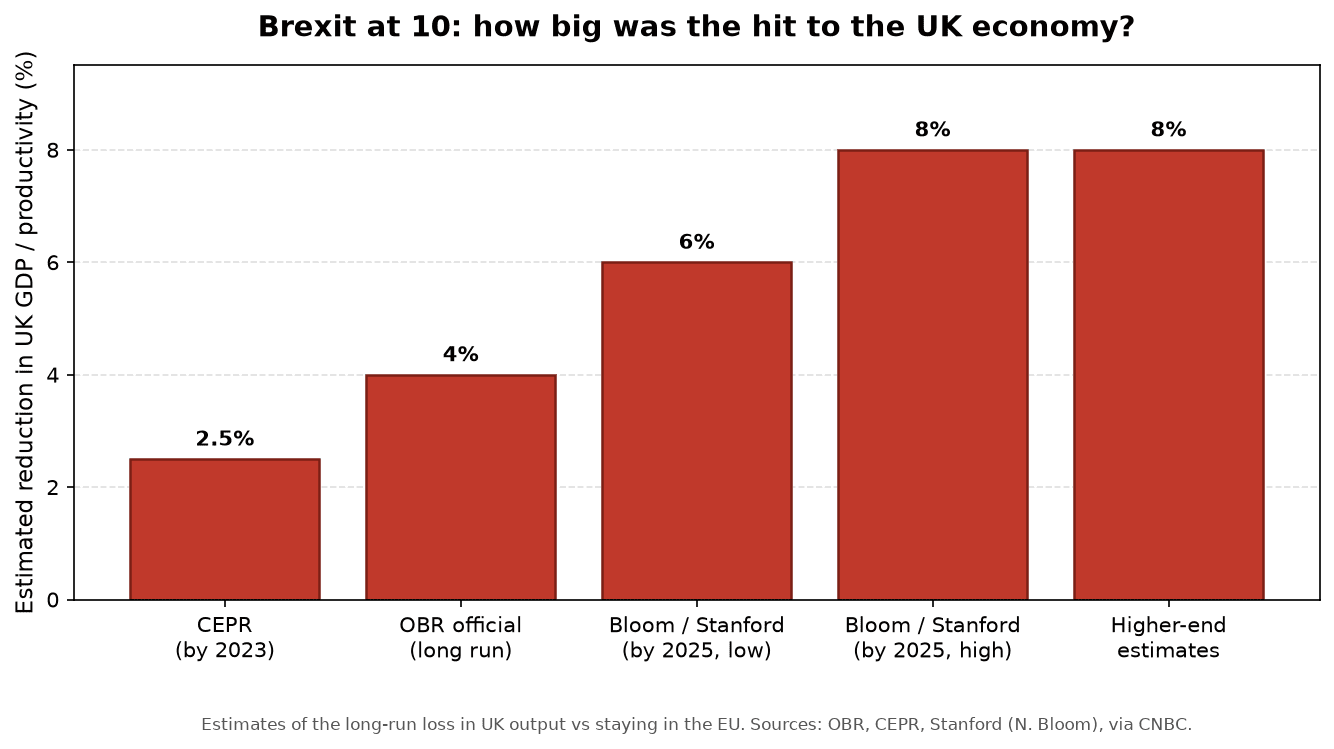
The numbers are different, but the direction is the same. In nearly all of them, the economy ends up smaller than it would have been inside the EU.
Trade with Europe slowed down
The main reason for the hit is trade. When Britain left the single market, buying from and selling to Europe got harder. Now there are more forms, more checks, and more rules at the border. Each one adds cost and time.
The OBR thinks both UK exports and imports will be about 15% lower in the long run than if Britain had stayed in the EU. That is a big gap. Researchers at UK in a Changing Europe, another research group, think goods exports and imports are about 10% to 15% below where they would have been.
Here is a useful comparison. In late 2023, UK trade intensity was about 1.7% below its 2019 level. Trade intensity means how much a country trades compared with the size of its economy. In the rest of the G7 (a group of seven rich nations), trade intensity went up by about 1.7% above 2019 on average. So Britain moved the opposite way to its peers.
Investment took the quiet hit
Trade gets the headlines. But experts say investment may matter more over time. Business investment is money that companies spend on new buildings, machines, and technology to grow. The Institute for Government says UK business investment came up short by over 10% compared with where it could have been.
The years of doubt after the 2016 vote were a big reason. Companies did not know the new rules. So many of them waited before spending. That pause adds up. Fewer factories, fewer upgrades, and weaker links to European suppliers all slow growth. These effects are hard to see, but they are real.
What about migration and the pound?
Migration means people moving to live in a new country. EU migration to the UK dropped sharply after 2016. But migration from outside the EU rose by even more. So the total number of people coming in actually went up. What changed most was where the new workers came from.
The pound is the UK’s money. It fell hard right after the vote. When a country’s money is worth less, its exports usually get cheaper and more popular abroad. Even so, the data shows goods trade still lagged behind. That tells us the trade barriers mattered more than the cheaper pound.
Key facts
| Measure | Figure | Source |
|---|---|---|
| Long-run productivity hit | About 4% lower | OBR (official) |
| GDP hit by July 2023 | About 2% to 3% | CEPR |
| GDP hit by 2025 | About 6% to 8% | Stanford / Nicholas Bloom |
| Long-run drop in exports and imports | About 15% lower | OBR |
| UK trade intensity vs 2019 (late 2023) | About 1.7% below | Reported data |
| G7 trade intensity vs 2019 (late 2023) | About 1.7% above | Reported data |
| Business investment shortfall | Over 10% below potential | Institute for Government |
| UK GDP growth forecast, 2026 | About 0.6% to 1.1% | OBR / OECD / forecasters |
FAQ
Did Brexit make the UK economy smaller?
Most studies say yes. The guesses for the loss range from about 2% to 8% of GDP. The official OBR figure is about 4% of long-run productivity. No guess is exact, but nearly all point the same way.
Why did trade fall?
Leaving the single market added border checks, paperwork, and rules. These extra steps cost money and time. So trade with the EU got harder. The OBR thinks exports and imports will stay about 15% lower than they would have been.
Did immigration go up or down?
EU migration fell sharply. But migration from outside the EU rose by even more. So the total number of people coming to the UK actually went up. The big change was in where the new workers came from.
Is the UK economy growing now?
Yes, but slowly. Forecasters expect UK GDP to grow about 0.6% to 1.1% in 2026. That is weak compared with many other countries. Brexit is one reason people often give for the slow pace.
Why it matters (especially for India / founders)
For Indian founders and students, Brexit is a live example of how borders shape business. (A founder is a person who starts a company.) When a country makes trade harder, growth and investment slow down, even years later. That is a lesson for anyone who plans to sell across borders.
It also matters in a direct way. India and the UK have been working on a free trade deal. A free trade deal is an agreement between countries to make trade easier, with fewer taxes and rules. A smaller, slower UK changes how much that deal is worth. At the same time, a UK that wants new trade partners outside Europe may try harder to win over India. For startups eyeing the UK market, the lesson is simple: read the trade rules before you read the marketing. Rules at the border can quietly decide whether a market is worth entering.
The takeaway
Ten years after the vote, the Brexit story is not about one big crash. It is about a slow, steady drag. A bit less trade. A bit less investment. A bit less growth, year after year. People argue about the exact size, but the direction is clear. For a country, just like for a company, small problems repeated over 10 years add up to a very big number.
Source: CNBC