5 Indian Manufacturing Startups to Watch in June 2026
India’s factories are full of new ideas. A fresh group of Indian manufacturing startups (new companies that build real, physical things in factories) is busy at work. They do not just make apps. They build clean-air machines, flying cargo drones, smart shop robots, aircraft parts, and cooling boards for electric cars. In June 2026, a business magazine called Inc42 picked five young companies that stood out. Here is a simple guide to each one. We will tell you who started it, what it makes, and how far it has come.
This is a chosen list, not an ad. We are just sharing the facts so you can decide for yourself. None of these companies shared new money numbers in the report. So we will focus on what they build and the markets they want to win.
Why India’s manufacturing scene is heating up
For many years, Indian startups mostly built software and apps. Now more founders are choosing hard manufacturing. That means making real machines and parts in factories. Inc42 says India’s manufacturing sector is seeing “fresh momentum.” This is happening in precision engineering (making parts to very exact sizes), electronics, and aerospace (planes and space gear).
There are clear signs of this. A company called Ethereal Machines raised $28.5 million in a Series B (a later, bigger round of money raised by a growing company). An electronics maker named Jabil opened a new factory in Pune to build hardware for AI and cloud computing.
The five startups below all share one thing. Each one solves a clear problem with a product you can touch. Let’s meet them.
1. Airth — turning ordinary ACs into air purifiers
Airth makes a smart air filter. It fits onto an air conditioner (AC) you already own. So you do not need to buy a separate air purifier (a machine that cleans the air). Your AC starts cleaning the air too. The company was started in 2020 by Ravi Kaushik and Abhimanyu Kumar.
Its main technology is called FILTRIX. It was built with help from top Indian colleges: IISc Bengaluru, IIT Kanpur, and IIT Delhi. So far, Airth says it has upgraded more than 75,000 air conditioners. These are in homes and offices across India. The timing is good. India’s air purifier market is expected to grow to $1.8 billion by 2034. It was $579 million in 2025.
2. Aspera Industries — pilotless cargo aircraft
Aspera Industries is building an autonomous amphibious aircraft. “Autonomous” means it flies itself, with no pilot. “Amphibious” means it can use both land and water. The plan is to carry cargo (goods) over long distances at a low cost.
The startup was started in 2025 by Khushi Mittal. It is still at the prototype stage. That means it is building and testing an early model. Its first markets are New Zealand, Australia, and Southeast Asia. India is planned for later. This is an early and bold bet. The risk is high, but the reward could be high too.
3. Estro Tech Robotics — robots that sell in stores
Estro Tech Robotics makes a robot called RobAd. It works inside shops. It uses movement, lights, and voice to grab a shopper’s attention. It promotes products right on the store floor. Think of it as a friendly robot salesperson.
It was started in 2020 by Christo Varghese, Christo Kollannur, Rahul Vincent, and Bonsto Wilson. The company says Indian brands and store chains now use its robots. Shoppers pay more attention, and the company can measure that jump. The chance here is big. India’s in-store retail media market (advertising shown inside shops) is expected to reach $34.73 billion by 2031.
4. FledgeTec Systems — parts for planes and defence
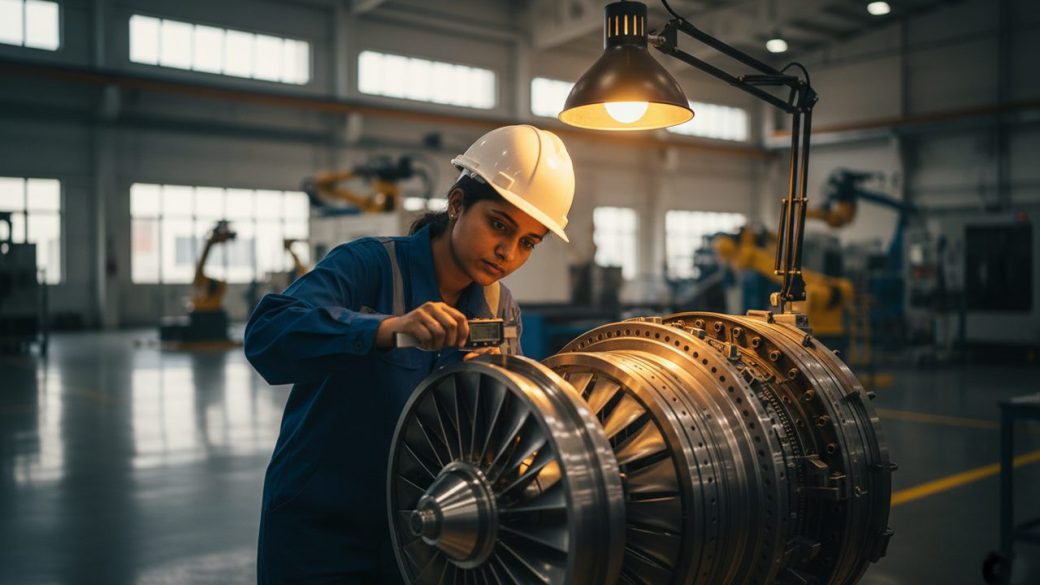
FledgeTec Systems builds precision parts for aerospace and defence. “Precision” means the parts are made to very exact sizes. Even a tiny error is not allowed. These parts go into aircraft and military equipment.
It was started in 2021 by Suneesh Nair and Chandrashekhar Hiremath. The company does precision machining, sheet metal work, embedded systems (small computers built inside machines), and automation. India’s precision aerospace parts market is expected to reach $21.48 billion by 2030. It is growing about 6.8% each year. India is now building more of its own defence gear. So suppliers like this one could be very important.
5. Helionis Labs — keeping electronics cool
Helionis Labs makes insulated metal substrate (IMS) boards. In simple words, these are special circuit boards. They pull heat away from electronics so the parts do not get too hot. They are used in LED lights, electric vehicles (EVs, which are cars and bikes that run on a battery, not petrol), and power electronics.
It was started in 2024 by Tarun Jha. The company prints its own cooling material straight onto aluminium. It says this can drop the temperature by up to 20°C. That helps parts last longer and work better. Its main uses are EV power systems, battery management, charging stations, and factory lighting. The global IMS market was worth $867.77 million in 2024. It is expected to reach $1.58 billion by 2034.
Key facts at a glance
| Startup | Founded | What it makes | Traction / market size |
|---|---|---|---|
| Airth | 2020 | Air filters that upgrade ACs | 75,000+ ACs upgraded; market $1.8B by 2034 |
| Aspera Industries | 2025 | Pilotless cargo aircraft | Prototype stage; NZ, Australia, SE Asia first |
| Estro Tech Robotics | 2020 | In-store marketing robots | Used by retail chains; market $34.73B by 2031 |
| FledgeTec Systems | 2021 | Aerospace & defence parts | Market $21.48B by 2030 (6.8% CAGR) |
| Helionis Labs | 2024 | Cooling boards for EVs, LEDs | Claims 20°C cooling; market $1.58B by 2034 |
Note: in the table, “Founded” means the year the company started. “Traction” means how far it has come, like customers or progress so far. “CAGR” means the average growth each year.
Why it matters (especially for India and founders)
These five names show a clear change. More Indian founders are building hard, physical products. They are not only making apps. That is good news for jobs, skills, and exports (goods we sell to other countries). It also fits the country’s plan to make more goods at home.
For founders and students, the lesson is simple. There is real opportunity in manufacturing, robotics, aerospace, and clean technology. It is not just in consumer apps. Many of these companies also work closely with research colleges. This shows how science and business can join hands. If you are planning a startup, hard-tech (building real machines, not just software) is now a serious and respected path in India.
FAQ
What are manufacturing startups?
They are young companies that build real, physical products in factories. This can be machines, parts, robots, or devices. They do not only make software or apps.
Which startups are on this June 2026 list?
Inc42 picked five: Airth, Aspera Industries, Estro Tech Robotics, FledgeTec Systems, and Helionis Labs. Each one works in a different area, from clean air to aerospace.
How much funding have these startups raised?
The report did not share exact funding (money raised from investors) amounts for these five companies. We have only shared facts that were confirmed. These include the founders, the start years, and the progress so far.
Why is India’s manufacturing sector growing?
Inc42 says there is fresh momentum in precision engineering, electronics, and aerospace. Bigger moves point to rising interest in making things in India. Examples are Ethereal Machines’ $28.5 million round and Jabil’s new Pune factory.
The takeaway
These five Indian manufacturing startups each solve a real-world problem. And each one has a product you can hold. Some are early and risky, like Aspera. Others already have thousands of customers, like Airth. Together they show something big. India’s next wave of startups may be built in factories, not just on phones. They are worth watching through 2026.
Source: Inc42