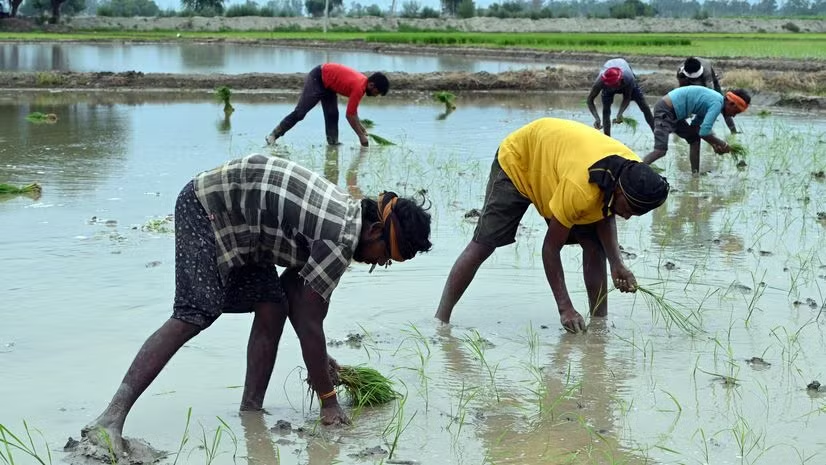
Right as India breathes a sigh of relief over absorbing the initial shockwaves of volatile crude oil prices and West Asia geopolitical tensions, a massive domestic challenge has appeared on the horizon.
Following a compounding El Niño weather pattern, the India Meteorological Department (IMD) has revised its southwest monsoon forecast down to 90% of the Long Period Average (LPA). Coming on the heels of a dry, blistering June that saw national rainfall drop 42% to 43% below normal, India is officially facing its weakest start to the monsoon season in over a decade.
Because the four-month monsoon brings nearly 75% of India’s annual rain, this deficit has moved past a simple weather headline to become India’s primary macroeconomic headwind, directly clouding the country’s growth-inflation balance.
1. The Twin Macro Headwinds: GDP Cooling & Sticky Inflation
The combination of elevated energy costs from earlier in the year and the subpar monsoon has forced major financial institutions and the Reserve Bank of India (RBI) to adjust their macroeconomic models for the current fiscal year (FY26–27):
- The GDP Growth Brake: S&P Global Ratings, the National Stock Exchange (NSE), and the RBI have flagged the climate risk as a core driver slowing real GDP growth. Projections for FY27 have moderated to 6.6%, down noticeably from the 7.7% provisional growth recorded in the previous fiscal cycle.
- The Food Inflation Spike: Food accounts for close to half of India’s Consumer Price Index (CPI) basket. QuantEco Research models indicate that a 10% seasonal rainfall deficit could easily tack on an extra 250 to 300 basis points to food inflation alone. Consequently, analysts have pushed baseline CPI inflation expectations up to 5.1% for the fiscal year, threatening to keep retail interest rates higher for longer.
                    [ India's Dual Macro Squeeze Matrix ]
                                      │
         ┌────────────────────────────┴────────────────────────────┐
         ▼                                                         ▼
[ External Drag: Energy Cost ]                             [ Domestic Drag: Weak Monsoon ]
 ├─ Sticky crude prices (West Asia)                        ├─ National rain deficit (~42% in June)
 └─ Passes business costs to consumer                      └─ Drags GDP to 6.6% (from 7.7% baseline)
         │                                                         │
         └────────────────────────────┬────────────────────────────┘
                                      ▼
                   [ Combined FY27 CPI Inflation Push: 5.1% ]
2. Structural Pain Points on the Ground
The real economic fallout of the dry spell is concentrated across three critical operational layers of the domestic market:
- The Kharif Sowing Interruption: Early sowing for core summer (Kharif) crops is lagging behind last year’s pace. While coarse cereals are showing mild resilience, highly vulnerable rain-dependent crops are under acute stress. Less than 10% of India’s vast soybean belt is artificially irrigated, leaving oilseeds, pulses, cotton, and coarse grains completely exposed to soil moisture depletion.
- The Squeezing of Rural Demand: With nearly half of Indian farmland entirely lacking assured canal or tube-well irrigation, a weak harvest directly undercuts the disposable income of millions of agrarian families. This immediate dip in rural purchasing power typically triggers a cooling wave across consumer fast-moving consumer goods (FMCG), two-wheeler sales, and entry-level retail demand.
- The Hydro and Urban Water Crisis: The drought is straining infrastructure far beyond the fields. Central reservoir storage levels dropped to 27.7% by the third week of June—the steepest late-spring depletion seen in six years. Major agricultural and industrial states like Maharashtra, Karnataka, and Rajasthan are tracking reservoir capacities well below last year’s averages. In Mumbai, key supplying reservoirs hit a precarious 10.35% capacity, leaving the financial capital navigating tight drinking water allocations.
3. The Preparedness Buffer vs. Policy Interventions
Despite the severe start, economists emphasize that India is structurally better equipped to handle a weak monsoon than it was during the severe El Niño shocks of past decades:
| Strategic Defense Layer | Government Mitigation Strategy | Potential Market Side-Effects |
| District Contingency Plans | MeitY and Krishi Vigyan Kendras have deployed tailored, local climate contingency playbooks across 315 highly vulnerable districts. | Farmers in dry zones are being financially incentivized to immediately pivot away from water-heavy crops toward millets and short-duration pulses. |
| Rural Asset Building | Massive deployment of the MGNREGA rural employment scheme over recent cycles has focused strictly on building decentralized rainwater harvesting and check dams. | Helps naturally recharge groundwater tables to buffer rainless weeks, preventing total crop death. |
| Trade and Export Defense | The government is prioritizing domestic price stability over international market presence. | High likelihood of long-term extensions on export bans for staples like rice and sugar, which shields Indian consumers but risks triggering volatility in global food markets. |
While India’s improved rural infrastructure and strong foreign exchange reserves provide a solid baseline defense, the coming six weeks of spatial distribution across Central and Northwest India will determine whether the economy can navigate this climate hurdle smoothly, or if the RBI will be forced to adjust interest rates to keep inflation from boiling over.