UPI in May 2026: PhonePe and Google Pay Lose a Little Market Share
India’s two biggest payment apps lost a little bit in May 2026. PhonePe and Google Pay both got a slightly smaller piece of the UPI market. UPI (the Unified Payments Interface) is the system that lets you send money or pay a shop just by scanning a QR code or typing in a phone number. It runs most digital payments in India. New numbers came from Inc42, who used data from NPCI (the group that runs UPI). The numbers show the two top apps are still in front. But smaller apps are slowly winning a few more users.
Here, “market share” just means how much of all UPI payments each app handles. Think of every UPI payment in India as one big pie. Market share is the size of each app’s slice.
What the May numbers show
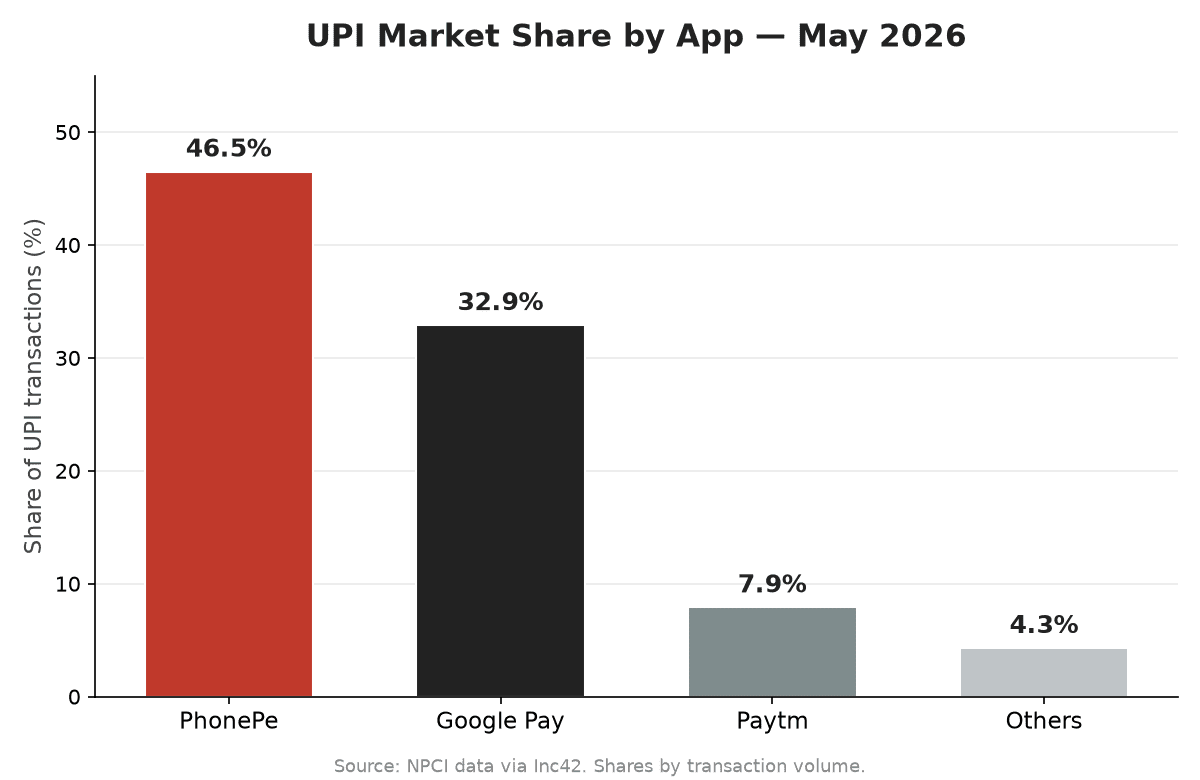
PhonePe stayed in first place. It handled 1,073.5 crore payments in May. (A crore is 10 million, or 1 followed by 7 zeros.) The total money moved through it was about ₹14.67 lakh crore. (A lakh crore is a huge number — 1 followed by 12 zeros.) Here, “transaction volume” means the number of payments. “Transaction value” means the total money moved. PhonePe’s share of all UPI payments was 46.5% in May. In April it was 47.1%. So it went down by 0.6 percentage points. (A percentage point is just the gap between two percentages — here, 47.1 minus 46.5.)
Google Pay came second. It handled 759.8 crore payments in May. That was 3.1% more than the 735.9 crore it had in April. But its market share still fell to 32.9% from 33.5%. So it did more payments, yet its slice of the pie got a little smaller. This can happen when the whole market grows faster than one app.
Paytm came third. It handled 183.6 crore payments worth ₹1.99 lakh crore. In April it had 177.8 crore payments worth ₹1.90 lakh crore. So Paytm grew too. But its share still dipped to 7.9% from 8.1%.
Smaller apps are gaining ground
The real story is at the bottom of the list. Smaller apps like WhatsApp, MobiKwik and Kiwi grew their share together to 4.3% in May. In April they had only 2.4% between them. That is a jump of 1.9 percentage points in just one month. The number is still small. But it is a clear sign that people are starting to try other apps.
This matters because of an old rule idea. NPCI, the group that runs UPI, has long wanted no single app to get too big. Back in 2020 it suggested a 30% cap. (A cap is a top limit — no app would be allowed to handle more than 30% of UPI payments.) That cap has been put off many times. For now, PhonePe and Google Pay together still hold nearly 80% of all UPI payments. So the market is still very lopsided.
Key facts at a glance
| App | May share | April share | May transactions |
|---|---|---|---|
| PhonePe | 46.5% | 47.1% | 1,073.5 Cr |
| Google Pay | 32.9% | 33.5% | 759.8 Cr |
| Paytm | 7.9% | 8.1% | 183.6 Cr |
| Others (WhatsApp, MobiKwik, Kiwi, etc.) | 4.3% | 2.4% | ~294 Cr |
Why the leaders can grow yet still slip
This part confuses a lot of people, so let us keep it simple. The whole UPI market keeps growing fast. More people pay with their phones every month. So an app can do more payments than before and still see its share fall. That is just what happened to Google Pay and Paytm. Their numbers went up. But their slice of the pie went down, because the pie grew even faster.
The top three apps together handled over 2,300 crore payments in May. That was about 6.6% more than in April. When the whole market grows this fast, even big apps can lose a little share to rivals that grow faster.
Why it matters (especially for India and founders)
UPI is the backbone of digital money in India. Billions of payments go through it every month. So even a tiny change in shares is worth watching. A 0.6 point drop sounds small. But across billions of payments, it shows where people and habits are moving.
For founders and startups (people who build new companies), this is good news. The slow rise of smaller apps shows the market is not closed. There is still room to compete. WhatsApp already has a huge number of users, which gives it a head start. New apps with simple features can still win people over. If NPCI ever brings in the 30% cap, the door could open even wider for new apps.
For business owners and shopkeepers, the lesson is simple. Most customers still pay with PhonePe or Google Pay. So keep those QR codes ready. But it also helps to accept any UPI app, because users are spreading out to more apps.
FAQ
What does UPI market share mean?
It is the part of all UPI payments that one app handles. If PhonePe has a 46.5% share, it means about 46.5 out of every 100 UPI payments in India happen on PhonePe.
Did PhonePe and Google Pay actually shrink?
No. Both still did more payments. Their share of the total just dipped a little, because the whole UPI market grew faster and smaller apps gained ground.
What is the 30% cap?
It is a rule NPCI suggested in 2020 to stop any single app from handling more than 30% of UPI payments. The idea is to keep the market fair. The rule has been put off several times and is not in force yet.
Which smaller apps are growing?
Apps like WhatsApp, MobiKwik and Kiwi are some of the smaller ones. Together they grew their share from 2.4% in April to 4.3% in May.
The takeaway
India’s UPI market is still led by two giants. But May 2026 showed small cracks at the top and fresh energy at the bottom. PhonePe and Google Pay each lost 0.6 points of share, while smaller apps almost doubled their slice. The numbers are tiny, but the direction is clear. The race for India’s payments is far from over.
Source: Inc42