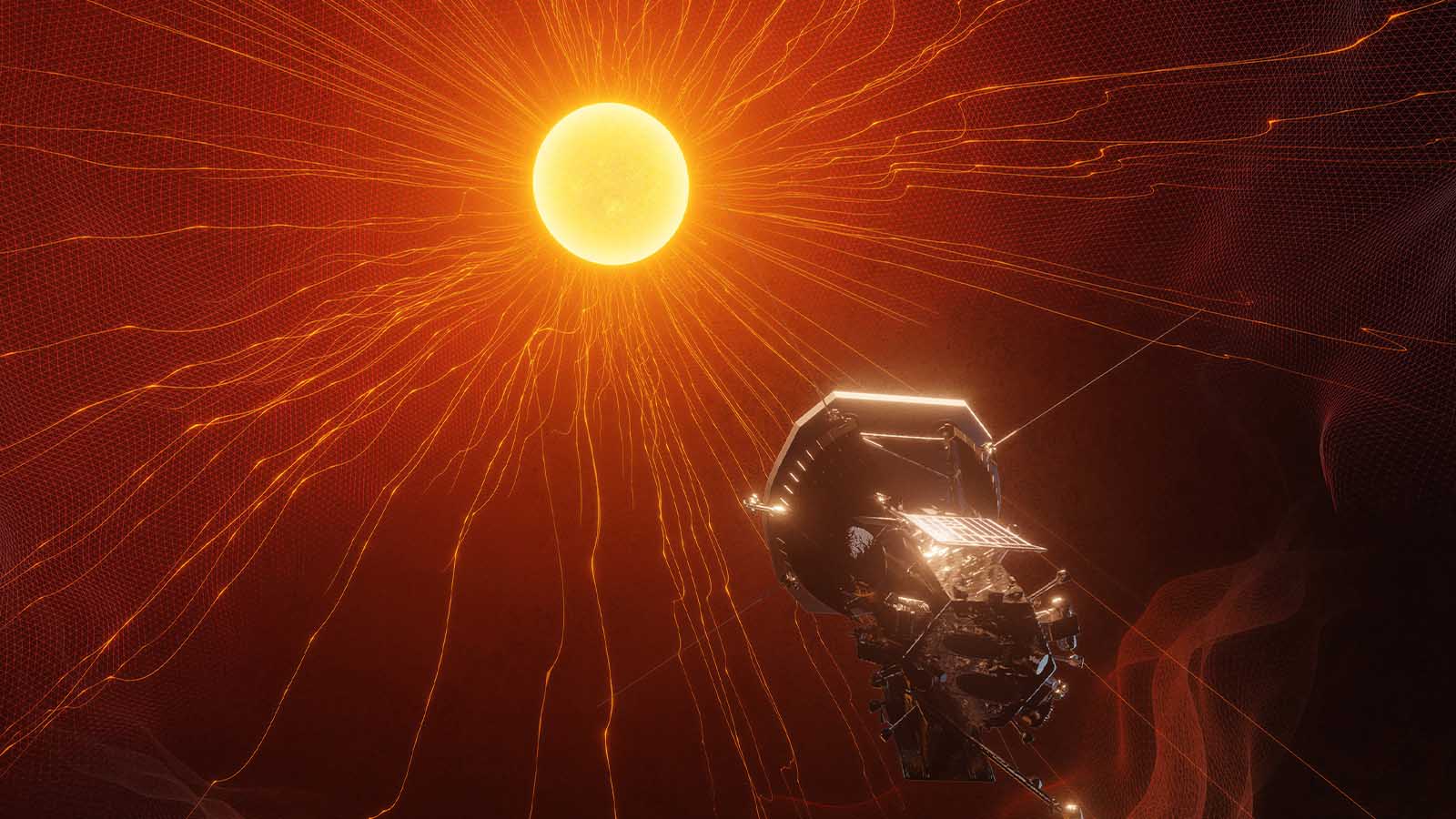
In a discovery that challenges standard models of solar cycle progression and space weather forecasting, an international team of astrophysicists has revealed that the Sun’s internal magnetic activity is systematically squeezing itself upward into a shallow subsurface layer.
The study, published in the Monthly Notices of the Royal Astronomical Society, indicates that over the past four decades, the structural changes driving the solar cycle have become increasingly concentrated in a narrow band just 1,000 kilometres beneath the photosphere—the visible surface of the Sun. This region represents a mere 0.15% of the star’s total radius, meaning the physical engine shaping space weather is becoming increasingly “skin-deep”.
Helioseismology: Listening to the Solar Interior
Because the Sun’s interior is completely opaque to conventional telescopes, scientists cannot directly observe the magnetic fields churning deep underground. To bypass this limitation, researchers turned to helioseismology—a technique analogous to using terrestrial earthquake data to map the Earth’s mantle.
By analyzing nearly 40 years of pressure-wave acoustic telemetry collected by the global Birmingham Solar Oscillations Network (BiSON), the team tracked global sound waves (known as p-modes) that naturally reverberate through the star. Because the frequencies of these acoustic ripples predictably shift when passing through varying thermal and magnetic fields, they function as high-resolution structural probes.
By isolating high-frequency seismic bands—which are uniquely sensitive to structural properties in the outermost shell—the team uncovered a distinct trend that conventional surface-watching instruments missed entirely:
- The Divergence of Cycle 25: Based on traditional surface indicators (like tracking individual sunspot numbers), the current Solar Cycle 25 was initially projected by expert panels to be a relatively weak, below-average cycle.
- The High-Frequency Truth: The high-frequency seismic data painted a radically different picture. Subsurface structural signatures reveal that Cycle 25’s internal magnetic intensity is burning just as strongly as previous, historically violent cycles; the energy is simply stored differently.
“We discovered that the relationship between internal solar oscillations and surface activity has evolved over the past few cycles,” stated co-author Professor Sarbani Basu, an astronomer at Yale University. “This trend cannot be explained simply by weaker magnetic fields. Instead, it indicates a structural reorganization of how the Sun’s magnetic activity is stored beneath the surface.”
The Theoretical Clash: Deep Engine vs. Shallow Storage
The discovery injects a fascinating complication into solar physics, coming just months after a separate, highly publicized March 2026 study by the New Jersey Institute of Technology (NJIT). The NJIT team provided definitive empirical proof that the primary solar dynamo—the deep magnetic engine powering the broader 11-year cycle—originates roughly 200,000 kilometres deep at the tachocline, the shearing boundary layer between the stable radiative core and the churning convective zone.
| Feature | Deep Solar Dynamo (NJIT – March 2026) | Shallow Magnetic Confinement (BiSON – May 2026) |
| Depth Location | ~200,000 km below the surface (Tachocline) | ~1,000 km below the surface (Outer Convective Layer) |
| Physical Role | Generates, rotates, and reorganizes core magnetic field lines. | Stores, concentrates, and structures near-surface magnetic energy. |
| Cycle Indicator | Tracks macro plasma bands forming long-term “butterfly” migration flows. | Tracks high-frequency sound wave shifts over a 40-year baseline. |
Rather than contradicting one another, the two findings outline an interconnected processing chain. While the raw magnetic fields are generated 16 Earth-widths deep at the tachocline, the way that plasma floats upward and registers at the surface is evolving. The BiSON team speculates that this progressive 1,000 km squeezing effect might be a localized manifestation of the 22-year Hale Cycle—the broader period during which the Sun’s magnetic polarity undergoes a full physical reversal and returns to its starting alignment.
The Impact on Space Weather Models
The fact that the Sun’s internal magnetic activity is structurally reorganizing carries serious real-world implications for telecommunications, satellite operations, and terrestrial electrical infrastructure.
Currently, the predictive space weather algorithms used by organizations like NOAA and NASA rely heavily on surface-level proxies, such as visible sunspot density and radio flux indices, to forecast the severity of solar flares and coronal mass ejections (CMEs). If these visible markers are systematically underreporting the actual volume of magnetic stress pooling just 1,000 km below the surface, operational forecasting models could be structurally miscalibrated, leaving orbital grids blind to impending geomagnetic storms.
The BiSON international research network plans to continuously monitor the remainder of Solar Cycle 25 into the early 2030s to determine whether this shallow concentration of energy represents a permanent structural shift or a temporary cyclical rhythm.
Get the day’s top stories in your inbox
One concise email. No spam, unsubscribe anytime.