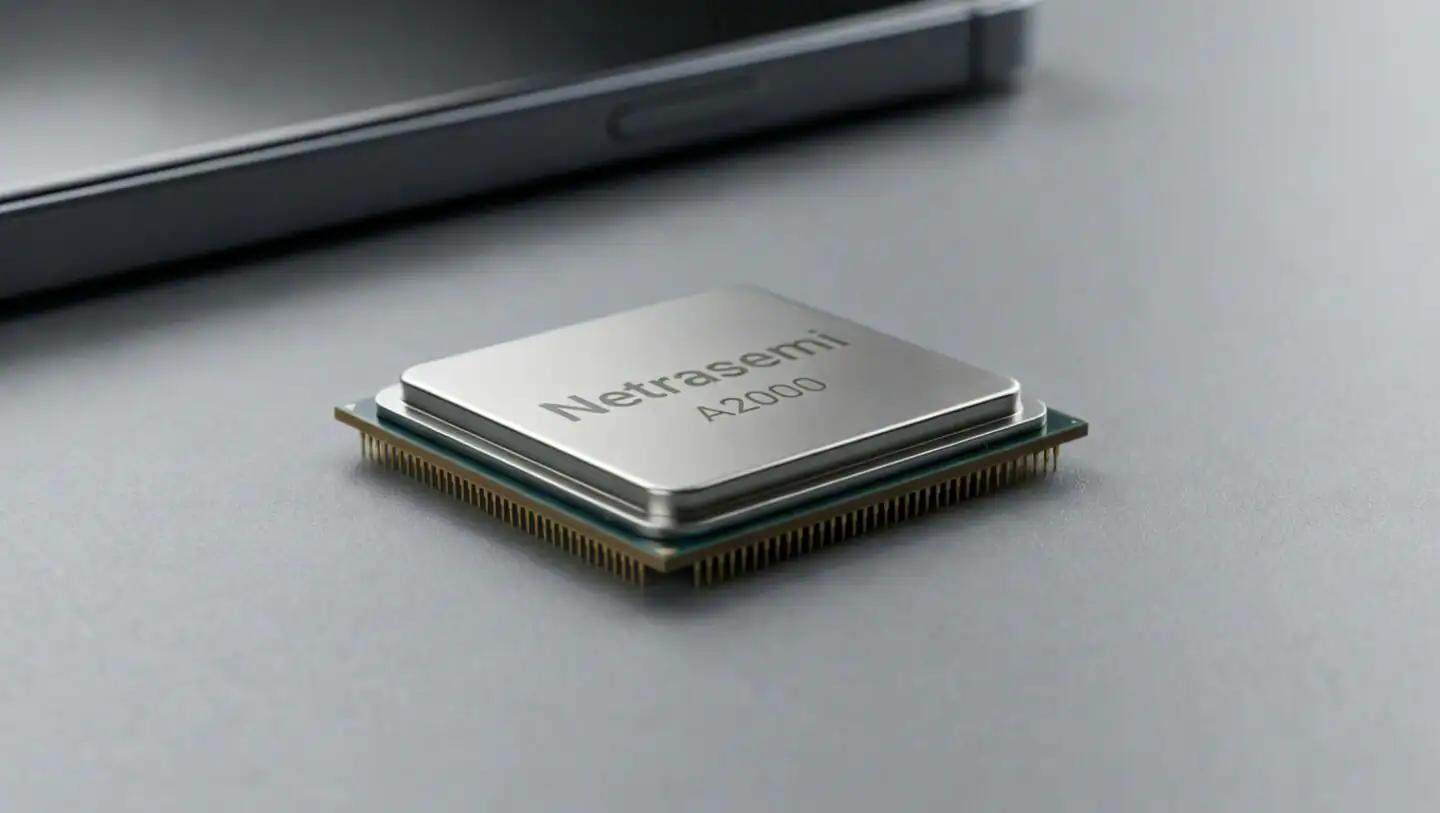
Marking a monumental milestone in India’s race for semiconductor self-reliance, Thiruvananthapuram-based fabless startup Netrasemi has officially launched its flagship Edge AI system-on-chip (SoC), the A2000.
The company confirmed it has successfully achieved “silicon bring-up”—meaning the physical hardware has been powered on, tested, and validated as fully functional in the lab—and is now moving swiftly toward field deployments. The company is currently running early sample evaluations and advanced R&D co-development trials with three major original equipment manufacturers (OEMs) across the surveillance and automotive sectors ahead of a wider scale-out.
Under the Hood: The A2000 Hardware Specifications
The A2000 is engineered specifically to bring high-performance, real-time artificial intelligence capabilities directly to compact, power-sensitive edge devices without requiring a constant cloud connection.
- The Fabrication Node: The chip has been fabricated on Taiwan Semiconductor Manufacturing Company’s (TSMC) advanced 12nm technology node.
- The Core Architecture: Moving away from standard off-the-shelf configurations, the A2000 incorporates Netrasemi’s patented heterogeneous graph-stream parallel processing architecture.
- In-House Acceleration IPs: The SoC packs several processing engines designed entirely in-house by the startup, including a dedicated Neural Processing Unit (NPU) for machine learning execution, a Vision Processing Unit (VPU) for computer vision algorithms, an Image Signal Processor (ISP), and localized crypto-engines for secure boot operations.
- High-Speed Connectivity: The chip supports significant high-speed I/O interfaces, including native PCIe connectivity, to seamlessly handle intensive video streaming data.
The tailored mix of domain-specific hardware accelerators allows the chip to deliver high-TOPS (Trillion Operations Per Second) AI processing efficiency. This makes it an ideal engine for smart CCTV cameras, drone-based inspection rigs, industrial automation machinery, and intelligent video gateways.
Supported by Local Capital and Central Incentives
The successful development of the A2000 represents a textbook validation of the Central Government’s domestic tech incubation policies. Netrasemi was notably one of the very first four hardware startups selected by the Ministry of Electronics and Information Technology (MeitY) to receive ₹15 crore in direct support under the Semiconductor Design Linked Incentive (DLI) scheme in 2023.
The public grant has been heavily fortified by private institutional backing. To date, Netrasemi has raised a total of ₹125 crore in venture funding, driven by early-stage tech investor Unicorn India Ventures and enterprise SaaS bellwether Zoho Corporation.
Road to Commercialization: The Production Timeline
While early-stage testing units are actively being integrated into client hardware, Netrasemi’s CEO and co-founder, Jyothis Indirabhai, outlined a multi-year road to full commercial availability:
- Late 2026: Completion of advanced R&D evaluation loops and early customer field pilots.
- Mid-2027: The commencement of high-volume commercial production, which will initially utilize TSMC’s foundries in Taiwan.
- The Long-Term Pivot: To further bolster geographic resilience, the startup plans to eventually shift its mass-manufacturing volume contracts directly over to Tata Electronics’ upcoming multi-billion dollar fabrication facility in Dholera, Gujarat, once the local ecosystem achieves operational maturity.
Expanding the Pipeline: IoT and Server Innovations
The A2000 is just the first entry in Netrasemi’s expanding silicon portfolio. Under the government’s Chip-to-Startup (C2S) program, the company has co-developed a second microcontroller chip called the R1000 AI/ML MCU in direct academic collaboration with the College of Engineering, Trivandrum (CET). Aimed at the high-volume IoT sensor market, the R1000 designs were officially sent out to fabrication at TSMC’s 12nm node last month, making it the first Indian AI chip produced via an active academic partnership.
Furthermore, the fabless team is aggressively drawing up plans for its most powerful silicon architecture yet: the A4000, an advanced edge AI server chip. Backed by ongoing MeitY infrastructure support, the A4000 is projected to be fully tape-out and fabrication-ready by the second quarter of 2027, establishing a comprehensive, end-to-end Indian processing ecosystem spanning miniature IoT sensors, smart edge devices, and local servers.
Get the day’s top stories in your inbox
One concise email. No spam, unsubscribe anytime.