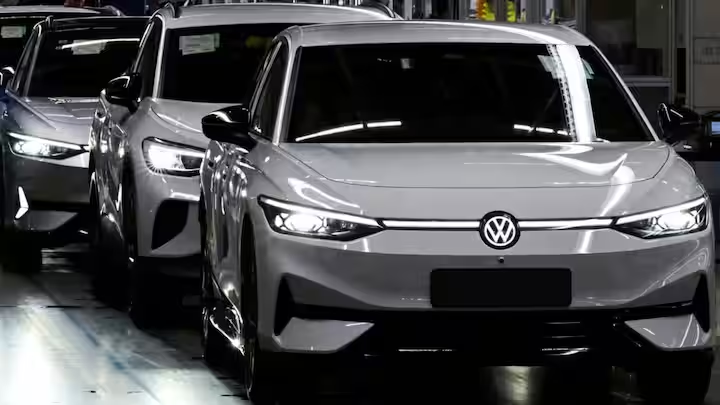
Volkswagen Group is considering cutting up to 100,000 jobs globally as part of its most extensive restructuring effort in decades, according to internal discussions cited by Reuters. The potential reduction includes 50,000 job cuts already agreed across Volkswagen, Audi, and Porsche, along with another 50,000 positions that management says may be needed to restore the automaker’s competitiveness.
In an internal memo to employees, CEO Oliver Blume said Volkswagen faces a 20% cost disadvantage compared with key rivals, while also dealing with U.S. tariffs, slowing demand, and intense competition from Chinese automakers, particularly in the electric vehicle (EV) market. Although the company is evaluating significant workforce reductions, Blume said he prefers “intelligent solutions” over factory closures wherever possible.
Volkswagen Considers Up to 100,000 Job Cuts
The proposed restructuring could become the largest in the company’s history.
| Key Highlights | Details |
|---|---|
| Company | Volkswagen Group |
| Potential job cuts | Up to 100,000 worldwide |
| Already planned | 50,000 positions |
| Additional under consideration | Around 50,000 positions |
| Main objective | Improve competitiveness and reduce costs |
The proposal remains under discussion and has not been formally approved.
Why Volkswagen Is Restructuring
The automaker is facing multiple financial and operational pressures.
Key challenges include:
- Rising U.S. import tariffs.
- Intensifying competition from Chinese EV manufacturers.
- Weak demand in China.
- Underutilized production capacity in Germany.
- High manufacturing costs.
- Pressure to accelerate the EV transition.
Management estimates the company currently operates with a 20% cost disadvantage compared with major competitors.
Plants Under Review
Reports indicate several German facilities are being evaluated.
Sites mentioned include:
- Emden.
- Hanover.
- Zwickau.
- Audi’s Neckarsulm plant.
Management has stated that long-term production plans for these facilities remain uncertain, although no final closure decisions have been announced.
Labor Opposition Intensifies
| Stakeholder | Position |
|---|---|
| Volkswagen management | Seeking deeper cost reductions |
| Labor representatives | Oppose additional layoffs and plant closures |
| IG Metall union | Strongly resisting restructuring proposals |
Volkswagen’s restructuring plans have encountered resistance from labor representatives and union leaders, who argue that factory closures and deeper workforce reductions would significantly affect employees and local communities.
Why China Matters
China remains Volkswagen’s largest market but has become increasingly challenging.
Key factors include:
- Rapid growth of domestic EV manufacturers.
- Falling market share for foreign automakers.
- Aggressive price competition.
- Slower vehicle demand.
- Faster product innovation by local rivals.
Chinese competition has become one of the biggest drivers behind Volkswagen’s restructuring efforts.
Broader Industry Pressures
The restructuring reflects wider changes affecting global automakers.
Industry trends include:
- Expensive transition to electric vehicles.
- Rising software development costs.
- Trade and tariff uncertainty.
- Overcapacity in mature markets.
- Growing competition from Chinese brands.
Many legacy manufacturers are rethinking production networks and cost structures as the automotive industry undergoes rapid transformation.
Challenges Ahead
Volkswagen must balance restructuring with long-term growth.
Key challenges include:
- Negotiating with labor unions.
- Maintaining production during restructuring.
- Funding EV and software investments.
- Restoring profitability.
- Competing against lower-cost rivals.
The company has not finalized the scope or timeline of any additional workforce reductions.
Outlook
Volkswagen’s consideration of up to 100,000 job cuts underscores the unprecedented pressures facing traditional automakers as the industry shifts toward electrification and software-defined vehicles. While management argues that significant cost reductions are necessary to remain competitive, particularly against rapidly expanding Chinese manufacturers, the proposals are expected to face strong opposition from labor representatives and political stakeholders in Germany.
The eventual outcome will likely shape Volkswagen’s competitiveness over the next decade. Whether through workforce reductions, plant repurposing, or alternative restructuring measures, the company is attempting to reposition itself for a market increasingly defined by electric mobility, digital technologies, and global cost competition.
What It Means for the Global Auto Industry
Volkswagen’s restructuring discussions highlight the scale of change confronting legacy automotive manufacturers. Companies that once dominated the internal combustion engine market are now investing heavily in EVs, software, batteries, and digital services while simultaneously reducing legacy costs.
For the broader industry, the developments signal that automakers may continue prioritizing efficiency, automation, and strategic realignment as competition intensifies. The ability to lower production costs while accelerating innovation will likely determine which manufacturers emerge strongest in the next phase of the global automotive transition.
Get the day’s top stories in your inbox
One concise email. No spam, unsubscribe anytime.