Key takeaways
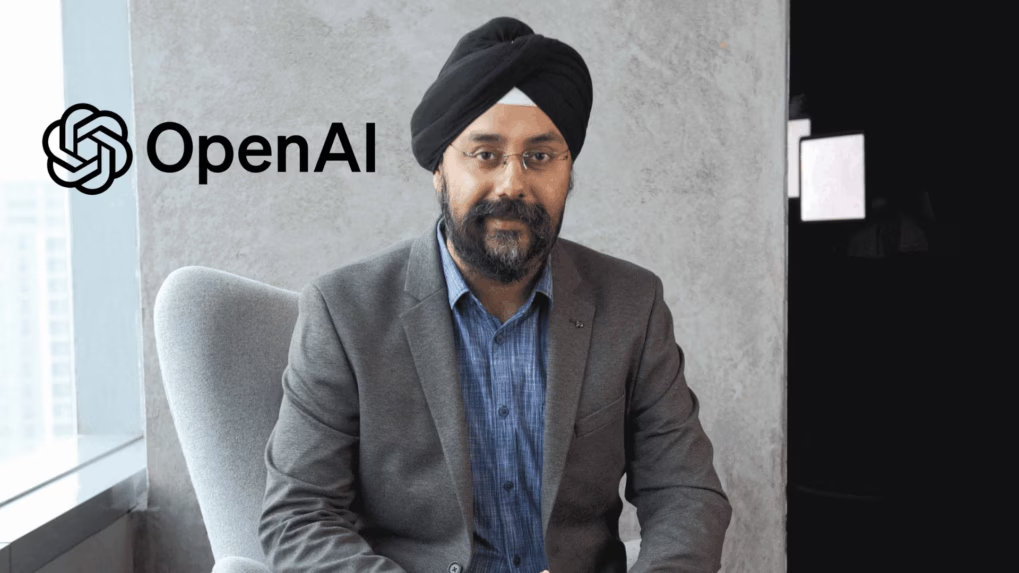
- OpenAI India head is now Prabhjeet Singh, a former Uber executive.
- He will lead OpenAI’s business push in one of its biggest growth markets.
- India matters because it has a huge user base, many developers, and active AI policy talks.
- The move suggests OpenAI wants deeper ties with firms, startups, and the government.
OpenAI India head is the person who leads OpenAI’s work in India. That now means Prabhjeet Singh, a former Uber executive, will guide the company’s local push. India is a major AI market, so this hire is a big signal. It shows OpenAI wants to grow faster here.
OpenAI has picked a senior business leader, not just a research expert. That choice tells you a lot. The company seems focused on partnerships, sales, and policy talks in India. Those are the nuts and bolts of building a real local business.
Why did OpenAI choose Prabhjeet Singh as OpenAI India head?
Prabhjeet Singh is best known for his work at Uber. He helped build and run large operations in India and nearby markets. That matters because India is huge, busy, and very price-sensitive. A leader here must know how to scale fast without losing focus.
Scale means growing a business to serve many more people. In plain words, it is about handling bigger demand without things breaking. Singh has done that before. So OpenAI likely sees him as someone who can turn interest into paying customers and strong local ties.
India is not a small side market for AI firms anymore. It is one of the biggest places for developers, students, startups, and businesses trying AI tools. OpenAI CEO Sam Altman has also spoken often about India’s talent and size, which makes this appointment even more important.
That mix matters because AI companies now need more than clever models. They also need enterprise deals, which are large contracts with companies. They need policy trust, cloud support, and a local team that can move quickly.
Why is India so important for OpenAI right now?
India offers three things at once: scale, talent, and urgency. Scale means lots of users. Talent means engineers and founders. Urgency means companies feel pressure to use AI before rivals do.
India has more than 900 million internet users, according to government and industry estimates. It also has one of the world’s largest developer bases. GitHub said in 2023 that India had over 13 million developers on its platform, and it expects India to become the largest developer community by 2027.
That is a giant runway for OpenAI. A runway is room to grow. If even a small slice of Indian businesses pay for AI tools, the market can become very large.
Meanwhile, India’s AI debate is moving fast. The government is backing local AI efforts, including compute and models. Compute means the chips and server power needed to run AI. We recently covered how the government plans to buy a small stake in Sarvam AI, which shows how serious India is about building domestic capacity.
OpenAI will want a seat at that table. It needs to talk with companies, ministries, and developers. An OpenAI India head can do that on the ground, in real time.
What could the OpenAI India head actually do?
The job is likely much broader than public relations. The OpenAI India head may help win enterprise customers, support startup deals, guide education tie-ups, and manage policy outreach. Enterprise customers are big companies that buy tools for many employees.
He may also help with local pricing and support. That matters because Indian customers are often careful with software budgets. A $20 monthly tool can feel cheap in the US, but not always in India.
There is also the partner angle. OpenAI works with cloud firms, app builders, and service companies. India has thousands of software firms that could build on OpenAI models, so local leadership can speed that up.
For readers tracking AI economics, this fits a wider pattern. Companies are watching costs closely. For example, our report on how Coinbase cut its AI bill by using cheaper Chinese models shows that buyers care about price as much as power.
India AI market signals13M+GitHub devs900M+internet users$20ChatGPT Plus
The chart above is simple, but it tells the story. India has a huge user base. It has a huge builder base too. But pricing still matters, so local strategy matters as well.
How does this fit the wider AI race in India?
India is becoming a crowded AI battleground. OpenAI is not alone. Google, Microsoft, Anthropic, Meta, and local players all want users, developers, and business clients.
Some rivals are pushing cheaper models. Others are pushing open models, which means software weights are shared more freely. That can attract developers who want more control. We also reported that ICAI and Sarvam are building an AI model for chartered accountants, which shows how local and sector-specific AI is gaining ground.
That is why the OpenAI India head role matters beyond one executive move. OpenAI needs someone who understands local business habits, regulation, and competition. India is not one simple market. It is more like many markets packed into one country.
There is also a trust angle. AI firms face questions about data use, safety, and bias. Bias means a system may treat some groups unfairly. A local leader can respond faster to those concerns and build relationships before problems grow.
What does this mean for Indian startups and big companies?
For startups, this could mean faster partnerships and clearer access to OpenAI tools. A local team can answer questions, support pilots, and help close deals. A pilot is a small test before a full launch.
For large companies, it could mean stronger sales support and more local outreach. Banks, retailers, software firms, and service companies are all testing AI. Many want help with customer service, coding, search, and document work.
India’s IT services giants may also watch this closely. If OpenAI grows its India presence, service firms could build more products around its models. That could create fresh business, but also sharper competition.
| Area | Why it matters | What Singh may focus on |
|---|---|---|
| Enterprise sales | Big contracts bring revenue | Win large Indian clients |
| Developer ecosystem | More apps increase model use | Build partner and startup ties |
| Policy outreach | Rules can shape market access | Work with government and industry |
| Pricing and support | India is cost-sensitive | Adapt offers for local demand |
Here is the clearest way to read this move: OpenAI has named Prabhjeet Singh because India is too important to manage from far away. A local chief can turn broad interest into deals, partnerships, and policy access faster than a remote team can.
That does not mean instant success. Competition is fierce, and customers will compare price, accuracy, and control. But it does mean OpenAI is planting a stronger flag in a market it cannot afford to treat lightly.
For primary details on OpenAI’s products and company updates, readers can check OpenAI’s official website. For developer numbers often used in industry analysis, see GitHub’s research and outlook.
FAQs
Who is the new OpenAI India head?
The new OpenAI India head is Prabhjeet Singh, a former Uber executive with experience in scaling large operations.
Why did OpenAI appoint an India leader now?
OpenAI likely made the move because India is a fast-growing AI market with many users, developers, startups, and business customers.
What will the OpenAI India head do?
The OpenAI India head is expected to lead local business growth, partnerships, customer outreach, and policy engagement in India.
How could this affect Indian AI users?
It could bring faster support, more partnerships, and better local focus for companies and developers using OpenAI tools.