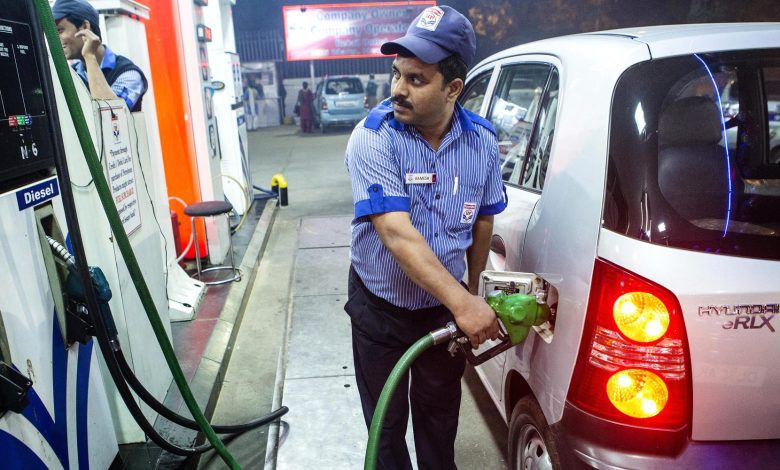
Even after executing four consecutive retail price hikes within a span of ten days, India’s state-run Oil Marketing Companies (OMCs)—including Indian Oil Corporation (IOC), Bharat Petroleum Corporation Limited (BPCL), and Hindustan Petroleum Corporation Limited (HPCL)—continue to bear heavy financial strain, logging collective under-recoveries of nearly ₹600 crore every single day.
The updated fiscal data, confirmed by Sujata Sharma, Joint Secretary in the Ministry of Petroleum and Natural Gas, highlights a massive gap between international procurement realities and domestic consumer pricing caps, even as policy makers execute staggered adjustments to relieve energy sector balance sheets.
Trimming the Bleeding: The Post-May 25 Realities
Prior to the current cycle of price revisions that kicked off on May 15, the financial baseline for the country’s public refiners was severely compromised. OMCs were bleeding an unprecedented ₹1,000 crore per day as international crude markers spiked due to maritime bottlenecks in West Asia.
The latest dynamic fuel revision on May 25 raised domestic petrol rates by ₹2.61 per litre and diesel by ₹2.71 per litre—bringing the cumulative, multi-round price adjustment to roughly ₹7.50 per litre.
While these adjustments have successfully erased about 40% of the daily operational drain, they have failed to bring the marketing margins of public refiners back into the green.
The Under-Recovery Disconnect:
- The Global Volatility: Triggered by prolonged conflict parameters in the Middle East and the closure of the Strait of Hormuz, global prices for motor spirit (petrol) surged by roughly 22%, while high-speed diesel shot up by 27%.
- The Domestic Shield: In stark contrast, India’s permitted retail price adjustments have been capped at just 7.7% for petrol and 8.6% for diesel. This intentional compression ensures that while consumers are partially exposed to inflation, public sector sheets continue to absorb the remaining deficit.
“Our oil marketing companies are buying crude oil at higher rates but are not selling at corresponding rates to protect our consumers; this impacts their finances,” Joint Secretary Sujata Sharma noted. “Even after taking major mitigation steps, OMCs are still making under-recoveries slightly below ₹600 crore per day.”
The Twin Crises: High Crude Baselines and the LPG Subsidy Vacuum
The structural stickiness of the ₹600 crore daily drain stems from two distinct operational pain points:
1. Skyrocketing Procurement Indicators
Before the escalation of regional hostilities, India’s average crude import basket hovered near a comfortable baseline of $69.01 per barrel in February. However, following the severe shipping constraints and risk insurance premiums added across maritime shipping routes, India’s average crude procurement index jumped to $107.84 per barrel this May, with spot Brent benchmarks repeatedly crossing the $117 to $120 threshold.
2. The Multi-Billion Crore LPG Leak
According to energy rating analysts at ICRA, a massive portion of the daily under-recovery layout is driven by domestic liquefied petroleum gas (LPG) sales. By the close of the previous fiscal period in March, cumulative OMC under-recoveries on domestic LPG cylinders reached a staggering ₹31,000 crore, with companies facing a deficit of ₹290 per cylinder under current market-to-retail pricing imbalances.
Foregoing ₹14,000 Crore in Monthly Excise Collections
The financial strain isn’t localized to the energy corporations alone; it is actively impacting the Centre’s broader fiscal deficit calculations.
Before allowing the recent series of pump price revisions, the Ministry of Finance stepped in to absorb part of the input shock by slashing central excise duties on petrol and diesel by ₹10 per litre each. Union Finance Minister Nirmala Sitharaman stated that the policy intervention was critical to shielding the economy during the initial months of the regional crisis, providing over ₹1 lakh crore in annualized consumer relief. However, this tax buffer means the government is currently foregoing approximately ₹14,000 crore every month in traditional energy revenues.
With the IEA reporting a steep contraction in broader Asian refining throughputs due to structural feedstock constraints, the Petroleum Ministry is scheduled to execute an intensive audit of total accumulated under-recoveries by July. The resulting fiscal brief will determine whether the government will need to announce a multi-trillion rupee emergency equity compensation package to insulate OMC credit ratings over the upcoming quarters.