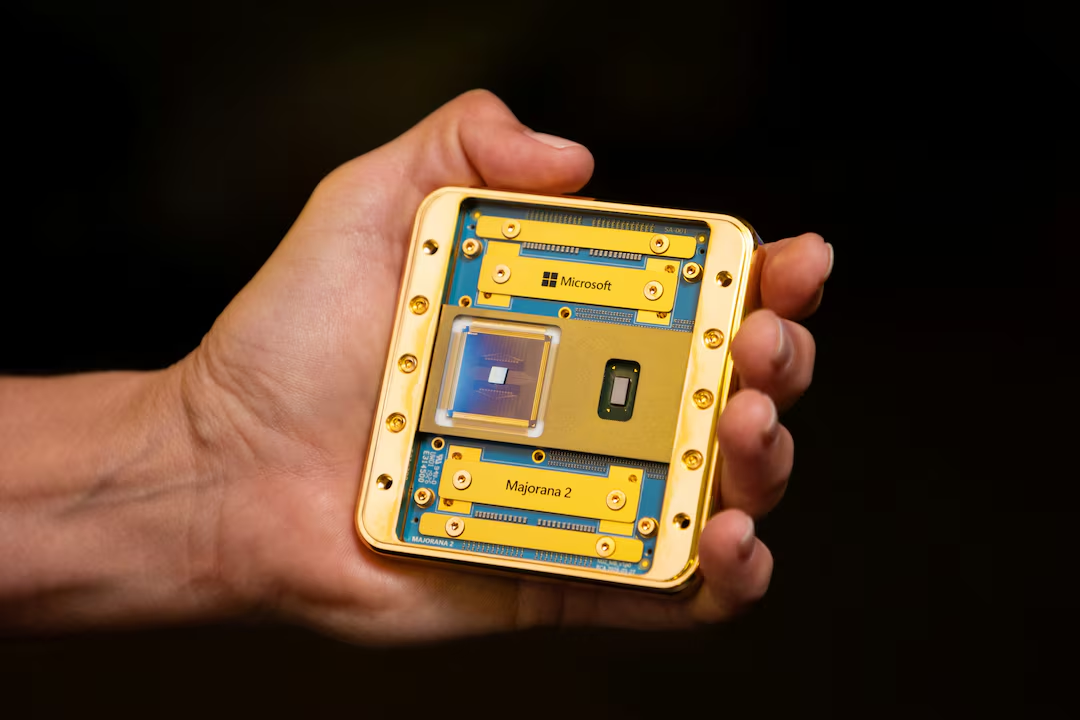
Taking the stage at its annual Build 2026 developer conference, Microsoft has officially unveiled Majorana 2, its second-generation topological quantum computing chip.
Featuring a radical re-engineering of its underlying material science, the tech giant claims the new hardware achieves a 1,000-fold improvement in qubit reliability over its predecessor. The dramatic stability breakthrough has allowed Microsoft to aggressively compress its operational roadmap, halving its original timeline to deliver a commercially valuable, utility-scale quantum computer from 2033 down to 2029.
During his keynote address, Microsoft CEO Satya Nadella framed the milestone as a pivot from theoretical physics to structural engineering: “With Majorana 1, we had proven out the foundational physics, and with Majorana 2 now we begin the engineering scale.”
1. Stabilizing the Qubit: Swapping Aluminum for Lead
The primary challenge plaguing modern quantum hardware is environmental noise—such as cosmic radiation and temperature fluctuations—which routinely collapses fragile qubits before they can finish complex mathematical operations.
To overcome this, Microsoft’s Majorana framework utilizes a topological quantum computing approach, which protects data by storing information across multiple split particles (rather than a single particle) and measuring electron parity. With Majorana 2, Microsoft introduced a completely revamped semiconductor materials stack:
- The Superconductor Pivot: Engineers completely replaced the aluminum superconductors used in Majorana 1 with lead. Lead acts as a significantly larger-gap superconductor, effectively shielding the qubits from cosmic disturbances.
- Unprecedented Coherence Lifetimes: While conventional quantum approaches measure a qubit’s operational lifespan in volatile microseconds, Majorana 2 registers a mean qubit lifetime of 20 seconds, with standout instances maintaining parity for up to a full minute.
- The Scale Formula: The hardware operates at fast, one-microsecond speeds while keeping individual qubits down to an ultra-compact footprint of just 1/100th of a millimeter.
2. Co-Design: The Material Role of Agentic AI
The fabrication and calibration of an Indium Arsenide-Lead tetron structure are so complex that human researchers alone could not manage the parameter variables. Microsoft revealed that the creation of Majorana 2 was heavily accelerated by its newly commercialized research software, Microsoft Discovery.
               [ MICROSOFT DISCOVERY AI IN QUANTUM R&D ]
                                   │
       ┌───────────────────────────┴───────────────────────────┐
       ▼                                                       ▼
 [ PARALLEL VOLTAGE MAPPING ]                             [ KNOWLEDGE SYNTHESIS ]
 • Adjusted hundreds of gate parameters.                  • Flattened 20 years of data silos.
 • Built continuous 3D qubit condition maps.              • Unified physics, mechanical, and
 • Compressed multi-week cycles into hours.                 process engineering logs globally.
To establish a stable topological quantum state, engineers must precisely calibrate hundreds of individual voltage parameters before measurement can begin. While older machine learning models failed at this task, Discovery’s autonomous AI agent teams ran parallel voltage adjustments and mapped continuous three-dimensional qubit condition maps in real time. The automation compressed diagnostic measurement workflows that previously consumed weeks down into automated, rapid operational cycles.
3. The 1-Million Qubit Monolith Architecture
The structural goal for Microsoft’s 2029 utility-scale machine is to pack more than 1 million reliable qubits onto a single physical silicon wafer.
Crucially, Microsoft Technical Fellows confirmed that the company is actively rejecting the modular paths chosen by competitors like IBM, Google, and Amazon, who are designing multi-chip configurations spread out across multiple refrigeration units. Because topological protection naturally keeps the physical footprint tiny without sacrificing controllability, Microsoft is placing its bets on a single-chip, single-fridge monolithic architecture delivered directly to enterprise customers via Azure cloud rails.
4. Microsoft Discovery Enters General Availability
Coinciding with the hardware reveal, Microsoft announced the General Availability of Microsoft Discovery, opening the exact same agentic AI scientific platform used by its quantum labs to paying enterprise R&D clients.
The software platform allows organizations across life sciences, advanced chemistry, energy production, and manufacturing to deploy autonomous, human-guided AI agent teams. These agents can digest immense volumes of siloed research data, generate novel chemical hypotheses, and optimize continuous experimental loops under strict corporate governance and compliance controls. To democratize access for individual developers, Microsoft also launched a local desktop preview of the Discovery application that links natively with existing GitHub Copilot accounts.
Get the day’s top stories in your inbox
One concise email. No spam, unsubscribe anytime.