In a pragmatic development that redefines how humans interact with software, Microsoft has officially unveiled Project Solara—a new chip-to-cloud operating system built from the ground up for devices that run AI agents instead of traditional applications.
Announced at the company’s Build 2026 developer conference, the surprise headline isn’t just Microsoft’s aggressive pivot into hardware-level agentic computing—it’s the underlying code. Moving away from Windows, Project Solara utilizes the Android Open Source Project (AOSP) as its foundational baseline.
The technical decision highlights a shift from apps to agents: “The next platform shift is from apps to agents—from software you open to intelligence you invoke,” Microsoft declared during the unveiling.
1. The Architecture: Why Android Over Windows?
To power a new wave of ambient, lightweight, and lower-power edge devices, Windows was deemed too heavy and structurally misaligned. Project Solara is built directly upon the Microsoft Device Ecosystem Platform (MDEP), an enterprise-hardened version of Android that Microsoft originally built for smart conference room hardware.
By adopting an Android AOSP foundation, Microsoft secures immediate access to a massive global ecosystem of off-the-shelf mobile hardware drivers, components, and silicon compatibility, while maintaining total freedom from Google’s standard licensing packages. Microsoft has completely stripped away the traditional mobile interface—there is no app store, no web-browser focus, and no app icon grid.
Instead, the OS relies on a system Microsoft calls “Just-in-Time UI”. Rather than developers coding fixed interfaces, Solara-powered AI agents dynamically render clean graphical elements on the fly based on the user’s immediate voice command, touch input, or screen layout.
2. Enterprise-Grade Security and Device Management
Because these devices are designed to continuously listen to, transcribe, and automate high-value workplace actions, Microsoft has integrated its full enterprise security stack natively into the MDEP layer:
- Identity & Access: Out-of-the-box support for Entra ID sign-in and secure biometric authentication via Windows Hello for Business.
- Fleet Management: IT administrators can push out over-the-air patches, track integrity, and manage device access rules using standard Microsoft Intune.
- Network Defense: Constant device scanning driven by built-in Microsoft Defender protections.
- Physical Privacy Controls: Recognizing user anxiety over ambient microphones, the system includes hardwired physical privacy kill-switches to instantly isolate microphone inputs at the component level.
3. Hardware Reference Concepts: The Smart Badge and Desk Hub
Microsoft stated it does not intend to mass-produce and sell its own Solara hardware retail units. Instead, it has introduced two open reference designs built on off-the-shelf Qualcomm and MediaTek silicon architectures, allowing third-party original equipment manufacturers (OEMs) to easily modify the blueprints.
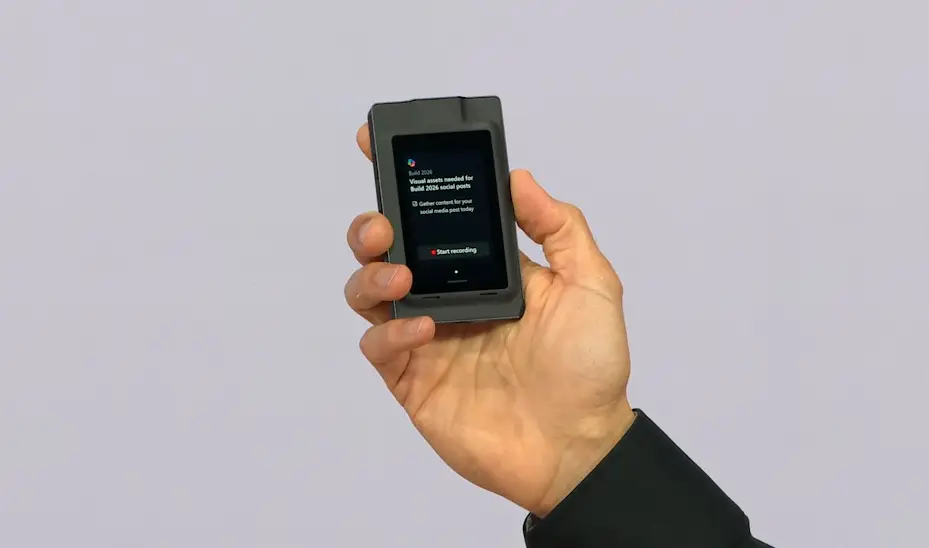
Concept A: The Wearable Smart Badge
Reimagining the standard corporate ID lanyard, this portable device is aimed directly at frontline workers in medical, retail, and industrial spaces. Driven by Qualcomm wearable silicon, it features a lightweight touchscreen display, a built-in camera, far-field microphones, 5G, and satellite connectivity. In a demonstration tailored for healthcare, a doctor or nurse can use a dedicated fingerprint button to prompt an agent, scan a patient’s QR code, record and transcribe an ongoing medical visit, automatically calculate vitals, and prepare a prescription order hands-free.
Concept B: The Intelligent Desk Companion
A stationary device built on MediaTek IoT silicon designed to sit directly alongside a primary office PC. It uses ultra-wideband (UWB) presence detection to wake up via facial recognition as the user approaches. The Desk Hub runs multiple concurrent agents (such as Microsoft’s Copilot, Researcher, Facilitator, or custom corporate tools) to display rolling, real-time priority tasks and meeting transcriptions without requiring the user to open tabs or jump between browser windows on their main workspace monitor. Furthermore, when plugged directly into an external display via USB-C, it transforms into a Windows 365 cloud PC client, acting as a lightweight enterprise thin-client terminal.
4. Immediate Industry Pilot Programs
Microsoft’s open multiple-agent blueprint is already stepping into live corporate deployments. The tech giant confirmed that initial pilot programs utilizing Solara reference designs are actively kicking off with several multi-national brands across major logistics, retail, and consumer sectors, including Best Buy, CVS Health, Levi’s, Target, and AccuWeather.
By placing an open-weights agent framework directly onto highly affordable, low-power hardware layouts, Microsoft and its silicon partners are aiming to secure an early lead in the race for physical AI placement—establishing a new enterprise procurement cycle that could challenge traditional app-centric mobile architectures at scale.
Get the day’s top stories in your inbox
One concise email. No spam, unsubscribe anytime.