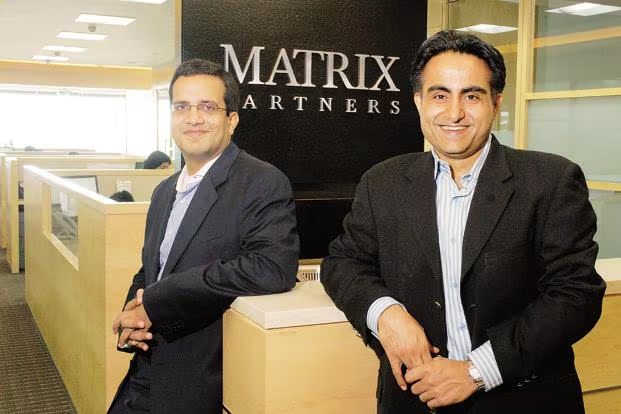
Matrix Partners rebrand is the new name for a big change inside the venture capital firm. Venture capital means money that investors put into young companies. Matrix is separating how its India and China teams look and operate, but it is not doing a full spin-off.
Key takeaways
- Matrix Partners is changing the branding of its India and China arms.
- The move creates clearer local identities without a complete breakup.
- India’s former Matrix business is now called Z47.
- China’s business is also adopting a separate name and path.
- The change shows how global investing has become more regional.
What is happening in the Matrix Partners rebrand?
The Matrix Partners rebrand is really about drawing cleaner lines. Matrix Partners has long backed startups in the US, India, and China. But those markets now work very differently, so the firm is giving local teams more distinct identities.
That means India and China will not carry the old Matrix name in the same way. The US business still exists, but the overseas teams are stepping out with local brands. This is not a full spin-off, though, because the separation is not being described as a total legal break.
India already took a major step earlier. Matrix Partners India rebranded as Z47 in 2024. So this latest shift matters because it shows the wider Matrix network is moving in the same direction.
Why would Matrix do this now?
Money firms are under pressure to look local. That is especially true in China and India, where politics, rules, and investor concerns have changed fast. A local brand can make fundraising and dealmaking simpler.
Geopolitics also matters here. Geopolitics means how countries use power and policy with each other. Tensions between the US and China have made cross-border investing harder, especially in sensitive sectors like chips, data, and AI.
India has its own startup story now. Big local funds, family offices, and global investors all compete for deals. Family offices are firms that manage rich families’ money. A local name can help a team show it is built for that market, not just a branch office.
This trend is not unique to Matrix. Peak XV, once known as Sequoia India and Southeast Asia, made a similar break from Sequoia in 2023. That split became one of the clearest signs that venture capital was turning more regional.
You can see that wider India startup shift in our coverage of Moneyview IPO approval and the possible listing path for Indian tech firms. We also tracked how capital moves in deals like Cars24 acquires CarInfo.
What does this mean for startups and founders?
For most founders, the name change will not alter day-to-day work much. If a startup already got money from the India team, the partner relationships usually stay the same. The people writing cheques matter more than the logo on the website.
Still, branding sends a message. It tells founders who makes decisions, where the money comes from, and which market the firm cares about most. In venture capital, trust and speed matter a lot, so a clear local identity can help.
The Matrix Partners rebrand may also help avoid confusion. A founder in Bengaluru does not want to guess whether a China issue affects an India fund. A separate brand makes the answer easier to understand.
There is another practical point. Many startups now raise from a mix of local and foreign funds. If a fund looks more independent, some investors may feel more comfortable backing it.
How big is Matrix and why does the split matter?
Matrix is not a tiny player. It has backed well-known startups across markets for years. In India, the old Matrix platform invested in names such as Ola, Razorpay, OfBusiness, and Dailyhunt, among others.
Venture capital works like a high-risk school project fund, but with huge sums. A fund gives money to many young firms, hoping a few become very valuable. One big winner can repay many losses.
Here is a simple way to see the timeline behind the Matrix Partners rebrand.
Matrix network branding timeline2023Peak XV split2024India becomes Z472025Wider Matrix Partners rebrand
The chart is simple, but it shows the pattern. First came Peak XV’s split in 2023. Then Matrix India became Z47 in 2024. Now the broader Matrix Partners rebrand is making the separation clearer across regions.
| Year | Event | Why it matters |
|---|---|---|
| 2023 | Sequoia India became Peak XV | Showed regional VC brands could stand alone |
| 2024 | Matrix India rebranded as Z47 | India team moved to its own identity |
| 2025 | Broader Matrix Partners rebrand | India and China paths look more separate |
Is this a full breakup or just a brand change?
Right now, it looks more like a brand and operating reset than a total breakup. Operating means how a business runs its daily work. The key point is that Matrix is avoiding the language of a full spin-off.
A spin-off means one unit becomes a fully separate company. That can involve ownership, legal structure, and management changes. In this case, the reported move sounds narrower, even if the public effect looks big.
That matters because venture firms depend on reputation. They want founders and investors to know the local teams are strong. But they may also want to keep some long-built links, networks, or shared history.
The clearest takeaway is this: Matrix is giving its India and China businesses more local identities because startup investing now depends more on regional trust, rules, and politics than on one global brand.
Why does this matter for India startup funding?
India’s startup market has matured a lot in the last five years. Matured means it has grown up and become more developed. Founders now have more funding choices, and investors are more careful about where they place money.
That comes at a time when exits are under close watch. An exit is how investors make money back, often through an IPO or sale. Readers following India’s capital markets may also want to see our report on PB Fintech stake sale, which shows how large investors adjust holdings.
Global funds are also thinking harder about AI, data, and national rules. You can see that pressure in tech stories like Microsoft AI division grows. Those same issues shape how venture firms present themselves.
For raw numbers, India’s startup ecosystem has created more than 110 unicorns, depending on the tracker used. A unicorn is a startup valued at $1 billion or more. Meanwhile, funding cycles have swung sharply since the 2021 boom, when money was easy, to a tougher market in 2022 and 2023.
That is why the Matrix Partners rebrand matters beyond one firm. It reflects a larger rule of the moment: global capital still moves, but local identity matters more than before.
Where can readers verify the details?
Readers can track the firm’s public brand changes on the Matrix Partners website and the Z47 website. Those are primary sources, which means they come straight from the organisations involved.
If more structural details emerge later, those will matter most for fund investors and startup founders. For now, the biggest fact is simple: the Matrix Partners rebrand shows India and China are no longer being presented under one easy shared identity.
FAQs
What is Matrix Partners rebrand?
It is a change in how Matrix presents its India and China businesses. Each side is using a more local identity instead of one shared global brand.
Why didn’t Matrix do a full spin-off?
Because a full spin-off is a bigger legal and ownership step. The reported move seems designed to separate brands and operations without going that far.
Who is affected by the Matrix Partners rebrand?
Startup founders, fund investors, and employees are the main groups watching it. The biggest effect is on how the firm is seen in India and China.