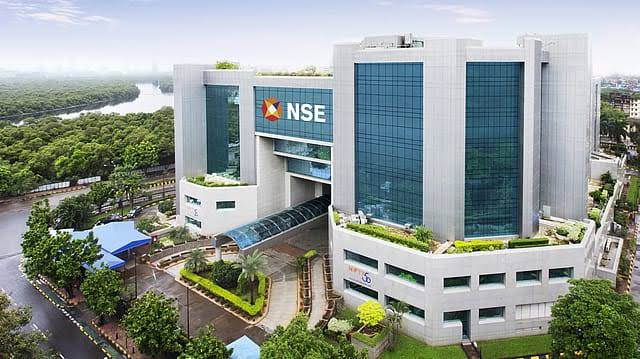
Following the National Stock Exchange’s (NSE) draft filing for a landmark $3 billion (approx. ₹25,000 crore) Initial Public Offering (IPO), global brokerage firm Jefferies has released a comprehensive note detailing the structural impact of the public debut.
Jefferies highlights that the blockbuster listing will officially complete the “troika” of publicly traded Indian Market Infrastructure Institutions (MIIs), joining its long-listed peers, the Bombay Stock Exchange (BSE) and the Multi Commodity Exchange of India (MCX).
1. Unrivaled Market Dominance
The report outlines that the NSE is uniquely positioned compared to its domestic and global peers due to its massive, near-monopolistic command over the Indian capital lifecycle:
- The 90% Command: The exchange maintains an absolute market share of over 90% across almost all core operational business segments, including equity cash, equity futures, single-stock options, currency derivatives, and bonds.
- Diversified Revenue Streams: Jefferies notes that the NSE is considerably more product-diversified than the BSE or MCX. Beyond trade transaction fees, the exchange has scaled a highly sophisticated technology and data products division that now accounts for 13% of its total operating revenues.
- Clearing Infrastructure: Its subsidiary, the National Collieries Clearing Corporation (NCL), anchors the settlement layer with an 88% market share in cash clearing and a 91% market share in derivatives clearing.
2. Navigating an “Options-Driven” Indian Market
The investment note details a permanent, structural evolution in how Indian retail and institutional capital is behaving:
- The Derivates Boom: India has rapidly morphed into an options-driven territory. The domestic equity options ecosystem logged a staggering 56% Compound Annual Growth Rate (CAGR) between FY20 and FY26, easily eclipsing the 19% CAGR seen in traditional cash market turnover.
- Top-Line Engine: Derivatives and options premiums have essentially become the core driver for the exchange, contributing roughly 70% of the entire operating revenue generated by Indian exchanges.
3. High Payouts & Global Profitability Highs
Despite bearing notable legal and operational weights over the past two fiscal years, the fundamental earning power of the exchange remains exceptionally robust:
- Normalized Margins: In FY25 and FY26, the NSE’s financials absorbed hefty regulatory provisions, including ₹1,390 crore in provisions for SEBI’s co-location and dark fiber settlements, alongside a ₹670 crore payment regarding the TAP matter. However, Jefferies emphasizes that when excluding these one-off legal settlements, the NSE is one of the most profitable exchange structures globally, with normalized operating EBITDA margins tracking consistently at 76% to 77%.
- Low Capex, High Dividends: Because the physical setup demands highly disciplined capital expenditure—averaging just 3% to 3.5% of its revenues—the exchange acts as an immense cash generator. This enabled the NSE to return 74% of its earnings in FY25 and 85% in FY26 straight back to shareholders as dividends.
4. Double Win: Unlocking Solvency for PSU Insurers
The structure of the IPO is an entirely Offer for Sale (OFS) transaction, which will see early institutional investors systematically liquidate a collective stake.
Jefferies points out that public sector general insurance companies—specifically Oriental Insurance, National Insurance, and United India Insurance—are slate to offload a combined 1.1% stake in the exchange. Because three of these four state-backed multi-line insurers are currently operating with solvency ratios below the strict 1.5x regulatory threshold, this multi-billion dollar monetization event will instantly inject fresh, critical solvency capital straight into their core balance sheets.
Get the day’s top stories in your inbox
One concise email. No spam, unsubscribe anytime.