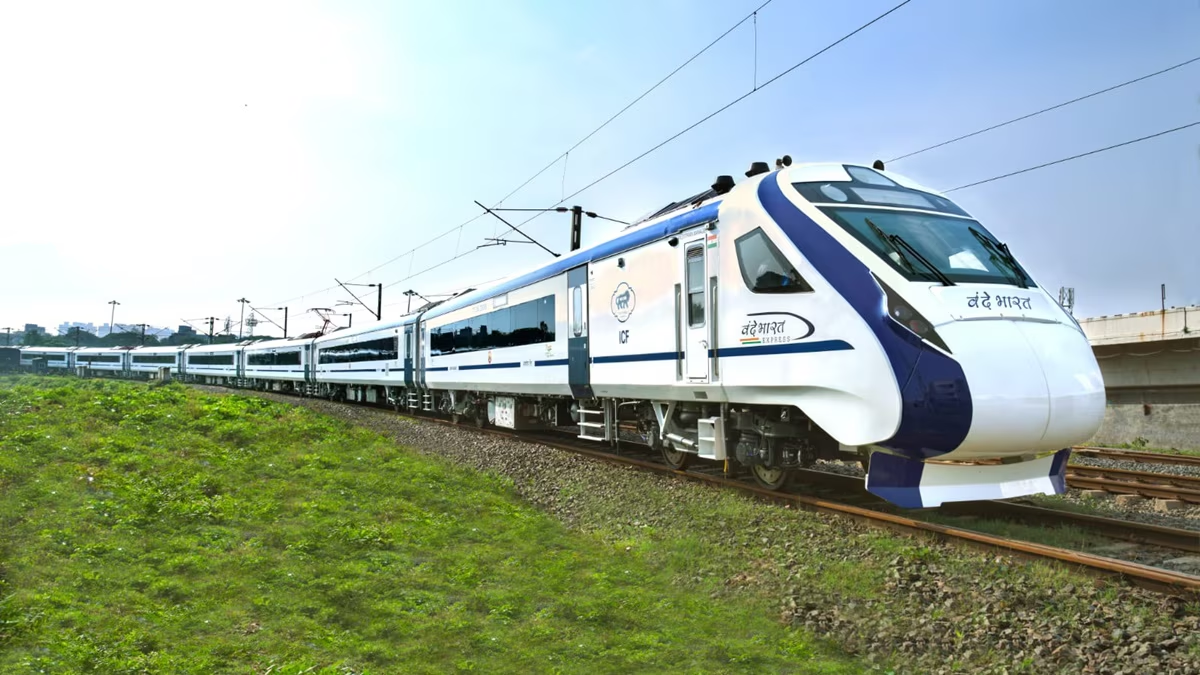
In a significant move to transform the country from a major technology importer into a premium supplier of global transit hardware, the Indian Government has officially initialized plans to export its indigenous, semi-high-speed Vande Bharat trainsets to international markets.
To bridge the gap between domestic rail layouts and global standards, Indian Railways has teamed up with RITES Ltd—its specialized engineering and export consultancy arm—to engineer a dedicated standard-gauge version of the Vande Bharat platform.
The Technological Chasm: Broad Gauge vs. Standard Gauge
The core hurdle holding back Vande Bharat’s international rollout has long been track geometry. Historically, Indian Railways operates almost exclusively on a Broad Gauge ($1676\text{ mm}$) infrastructure. Consequently, all 164+ Vande Bharat configurations built to date at the Integral Coach Factory (ICF) in Chennai, Kapurthala, and Raebareli are physically too wide to run on international networks.
Because roughly 60% to 65% of the world’s rail systems—including the majority of high-speed corridors, urban metros, and standard networks across North America, Europe, China, and parts of Latin America and Africa—rely strictly on Standard Gauge ($1435\text{ mm}$) tracks, a comprehensive structural redesign is required to access the global market.
Mapping the Global Pipeline: Target Export Regions
Rahul Mithal, Chairman and Managing Director of RITES Ltd, confirmed that the joint design and development phase is actively underway. Initial market validation and expressions of interest have already materialized across three distinct geographic rings:
- The Regional Neighbors (Broad-Gauge Ready): Countries sharing immediate geographic footprints with India—specifically Bangladesh, Sri Lanka, and Nepal—already utilize broad-gauge frameworks for parts of their networks. Delegations from these nations have visited Indian production lines to evaluate the feasibility of importing existing broad-gauge configurations to reduce onboarding lead times.
- The African Continent: Leveraging RITES’ deeply established consulting presence and rolling stock operations in sub-Saharan Africa, the government is pitching standard-gauge variants to rapidly developing regional networks looking for a cost-competitive alternative to European and Chinese manufacturing pipelines.
- Latin American Frontiers: Advanced discussions and preliminary market targeting are underway for electrified rail systems across Chile, Brazil, and Argentina, where minimal localized customization would be required once the narrower standard-gauge platform passes validation.
The Strategy: Prioritizing Domestically While Prepping Trials
While the export division is aggressively drafting blueprints, the Railway Ministry has made it clear that meeting local capacity remains the primary operational focus. Under the Viksit Bharat long-term infrastructure roadmap, Indian factories are working under intense domestic production mandates:
- The Medium-Term Cap: Reaching a fleet scaling marker of 800 operational Vande Bharat trainsets by 2030.
- The Long-Term Vision: Delivering a total domestic deployment fleet of 4,500 trainsets by 2047, including the newly launched Vande Bharat Sleeper overnight modules and the upcoming Vande Bharat 4.0 configurations.
To navigate this domestic capacity constraint without losing momentum on the international stage, RITES has suggested a strategic compromise: manufacturing and deploying at least one standalone, standard-gauge Vande Bharat rake purely for trial operations in high-priority overseas markets. By giving foreign buyers a physical prototype to run on their native networks, India aims to build concrete institutional trust, capture baseline operational telemetry, and secure the bulk forward-orders needed to open dedicated export-only assembly lines.
Get the day’s top stories in your inbox
One concise email. No spam, unsubscribe anytime.