Reliance Consumer Products Limited (RCPL), the fast-moving consumer goods (FMCG) arm of Reliance Industries, has achieved a key milestone by turning EBITDA positive for the first time, signaling that its aggressive investments in manufacturing, distribution, and brand building are beginning to translate into operating profitability. Company management said profitability is expected to improve further as scale increases and supply chain investments mature.
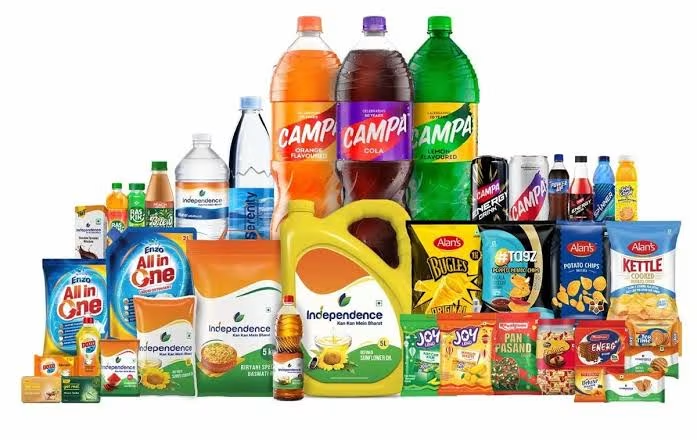
The development comes as Reliance accelerates its push into India’s highly competitive FMCG market with a portfolio spanning beverages, packaged foods, confectionery, home care, and personal care products. Backed by Reliance Retail’s vast distribution network — whose latest numbers we covered in Reliance Retail’s Q1 FY27 results — RCPL is positioning itself as a formidable challenger to established players such as Hindustan Unilever, ITC, Nestlé India, Tata Consumer Products, and Coca-Cola.
RCPL Achieves First EBITDA-Positive Quarter
Reliance management described the achievement as an important milestone in the company’s FMCG journey.
According to the company:
- RCPL turned EBITDA positive for the first time.
- Profitability is expected to improve further in the coming quarters.
- The improvement reflects higher sales volumes and operating leverage.
- Investments in manufacturing and supply chain infrastructure are beginning to yield returns.
Milestone at a Glance
| Metric | Status |
|---|---|
| EBITDA | Positive for the first time |
| Business | Reliance Consumer Products (RCPL) |
| Parent company | Reliance Industries |
| Management outlook | Further improvement in profitability expected |
Scale Is Driving Operating Leverage
RCPL has spent the past few years rapidly expanding its consumer business through:
- Launch of new brands.
- Strategic acquisitions and licensing deals.
- Expansion of manufacturing capacity.
- Growth in retail and general trade distribution.
- Leveraging Reliance Retail’s nationwide store network.
Management indicated that as fixed costs are spread across higher sales volumes, operating margins are expected to improve further. Continued optimization of procurement, logistics, and production should also support profitability.
Drivers of EBITDA Improvement
| Growth Driver | Impact |
|---|---|
| Higher sales volumes | Better operating leverage |
| Supply chain investments | Lower operating costs over time |
| Manufacturing scale | Improved production efficiency |
| Wider distribution | Higher product availability |
Challenging Established FMCG Leaders
Reliance Consumer Products has rapidly expanded its portfolio with brands across multiple categories.
Its strategy focuses on:
- Affordable pricing.
- Strong rural and urban distribution.
- Leveraging Reliance Retail stores.
- Building Indian consumer brands.
- Expanding manufacturing capabilities.
The company has entered categories including beverages, packaged foods, confectionery, home and personal care, intensifying competition in India’s multi-trillion-rupee FMCG sector. The beverages fight in particular is heating up, with Coca-Cola’s Indian bottling arm also weighing a market debut — see our report on the Coca-Cola bottling IPO in India.
RCPL’s Competitive Strategy
| Focus Area | Objective |
|---|---|
| Product portfolio | Expand across daily consumption categories |
| Distribution | Reach consumers nationwide |
| Manufacturing | Improve cost efficiency |
| Pricing | Offer competitive value propositions |
| Brand building | Increase market share |
Profitability Expected to Improve Further
Management remains optimistic that operating performance will strengthen as recent investments begin contributing more meaningfully to earnings.
Key factors supporting future profitability include:
- Greater manufacturing utilization.
- Expanding distribution reach.
- Improved supply chain efficiencies.
- Higher contribution from established brands.
- Continued scale across product categories.
Outlook
| Area | Management Expectation |
|---|---|
| EBITDA | Continued improvement |
| Margins | Expected to expand with scale |
| Distribution | Ongoing expansion |
| Supply chain | Higher efficiency over time |
Strategic Importance for Reliance
RCPL’s transition to EBITDA profitability is significant because it demonstrates that Reliance’s long-term investment strategy in the FMCG sector is beginning to deliver financial results. The group has also signalled ambitions beyond India, as reported in our story on Reliance entering the Australia and Africa FMCG markets.
The consumer business is viewed as one of Reliance Industries’ major long-term growth pillars alongside:
- Retail.
- Digital services.
- Energy transition.
- New energy businesses.
As India’s consumption market continues to expand, the company is expected to increase investments in brands, manufacturing, and distribution while focusing on sustainable profitability rather than short-term earnings.
Looking Ahead
Reliance Consumer Products’ first EBITDA-positive quarter marks an important milestone in its evolution from a rapidly expanding startup business into a scalable consumer goods company. The achievement suggests that the heavy investments made in manufacturing, logistics, product development, and distribution are beginning to generate operating leverage, with management expecting profitability to strengthen further as volumes continue to grow.
Going forward, RCPL’s ability to sustain margin expansion while aggressively competing with established FMCG leaders will be closely watched. If it successfully combines Reliance Retail’s distribution strength with a growing portfolio of consumer brands, the company could emerge as one of the most influential players reshaping India’s FMCG landscape over the coming years.
Frequently Asked Questions
Is Reliance Consumer Products listed on the stock market?
No. Reliance Consumer Products Limited is not separately listed. It is the FMCG arm of Reliance Industries, and investors get exposure to it only through the parent company’s shares. Reliance has not confirmed any listing plan for RCPL.
What does it mean that RCPL turned EBITDA positive?
EBITDA is earnings before interest, tax, depreciation and amortisation — a measure of core operating profit. Turning EBITDA positive means the business now earns more from operations than it spends running them, before financing and accounting charges. For RCPL it is the first time this has happened.
Who are Reliance Consumer Products’ main competitors in India?
RCPL competes with Hindustan Unilever, ITC, Nestlé India, Tata Consumer Products and Coca-Cola across beverages, packaged foods, confectionery, home care and personal care. Its main edge is pricing and access to Reliance Retail’s nationwide distribution network.
Get the day’s top stories in your inbox
One concise email. No spam, unsubscribe anytime.