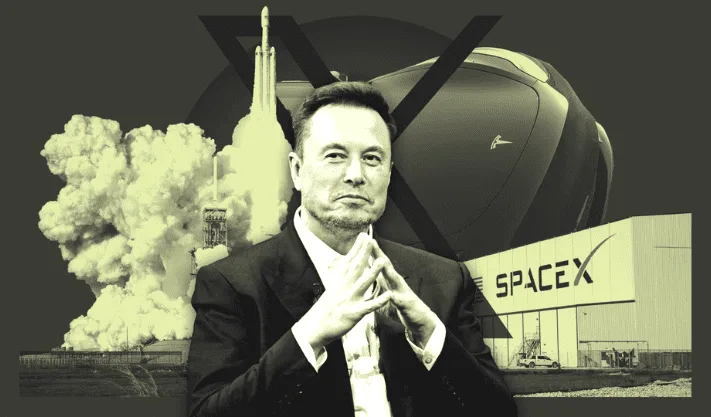
In what could become one of the most unprecedented corporate restructuring plays in financial history, Elon Musk has reportedly held private discussions with close colleagues regarding a formal merger between Tesla ($TSLA$) and SpaceX.
The revelation, first reported by CNBC, surfaces at a highly sensitive time. SpaceX officially filed its Form S-1 on May 20 and is actively preparing for its historic Wall Street roadshow. The rocket manufacturer is scheduled to make its public debut on the Nasdaq under the ticker symbol “SPCX” on June 12, 2026, targeting a record-shattering valuation of up to $1.75 trillion to $2 trillion.
A formal combination with Tesla—whose market cap currently hovers around $1.6 trillion—would collapse Musk’s vast industrial empire into a single, massive tech conglomerate notionally valued well north of $3 trillion, instantly catapulting it into the global top five most valuable enterprises.
Why Now? The Convergence of Compute, Power, and xAI
While the two entities appear structurally distinct on paper—one building mass-market passenger EVs and the other manufacturing orbital launch vehicles—the modern justification for a combined mega-entity centers almost entirely on shared AI compute architecture, energy networks, and hardware co-development.
1. The Realignment of xAI
The financial and technological ties between the companies deepened dramatically earlier this year. In January 2026, Tesla disclosed a strategic $2 billion investment in xAI. Just a month later, xAI officially completed a merger with SpaceX, pinning xAI’s high-end frontier modeling layers directly onto the rocket company’s corporate ledger and boosting its private market valuation to $1.25 trillion.
2. High-Capacity Cross-Transactions
The newly filed SpaceX IPO prospectus reveals massive commercial interlinkages. To power xAI’s sprawling data centers in Tennessee, SpaceX purchased $697 million worth of Tesla Megapack battery energy storage systems over a two-year window. Additionally, SpaceX spent $131 million on fleet purchases of Tesla Cybertrucks at standard retail pricing levels to handle localized logistics.
3. Project Terafab (Austin, Texas)
In early 2026, the two giants broke ground on “Terafab,” a massive shared semiconductor fabrication complex in Austin, Texas. The facility features two distinct, advanced lines:
- Line A (Tesla): Optimizing low-latency, low-power edge chips for Full Self-Driving (FSD) computer suites and the Optimus humanoid robotics program.
- Line B (SpaceX/xAI): Designing radiation-hardened processors capable of handling intense space environments and orbital compute clustering via the Starlink constellation.
Venture capitalists note that both companies are tackling extreme, mirrored engineering boundaries. Tesla must run powerful AI systems inside a moving vehicle under strict cooling, cost, and power constraints, while SpaceX scales high-capacity compute in orbit under punishing thermal, launch mass, and radiation limits. Merging the two entities would formalize a unified, closed-loop edge-to-cloud computing pipeline.
The Financial Incentive: Triggers for a $7.5 Trillion Target
Beyond operational synergies, analysts point to Musk’s unique performance compensation packages as a primary driver for the merger discussions.
Musk’s legacy compensation structures require both aggressive operational milestones and massive market cap tiers to unlock multi-billion dollar stock option tranches—including long-term target ceilings reaching up to $7.5 trillion. Combining the revenue streams, hardware footprints, and premium AI valuations of Tesla, xAI, and SpaceX into a single stock ticker dramatically accelerates the path toward clearing those unprecedented valuation hurdles.
The Pushback: Institutional Friction and “Self-Dealing” Concerns
While market enthusiasts reacted favorably to the merger chatter—giving Tesla shares an immediate bump past $433 per share—institutional governance desks are sounding loud alarms. If executed, a Tesla-SpaceX combination would mark Musk’s fourth multi-billion-dollar transaction between entities under his direct control, following the controversial 2016 acquisition of SolarCity ($2.6 billion), the acquisition of Twitter/X, and the recent xAI-SpaceX alignment.
Financial analysts point to severe corporate governance friction points that could trigger intensive shareholder litigation:
- The Voting Paradox: Musk holds roughly 20% of Tesla’s public equity but commands a dominant 85.1% of SpaceX’s voting power through a specialized super-voting share class. If a merger is negotiated, public Tesla shareholders could argue that Musk is effectively negotiating the valuation terms with himself.
- Capital Expenditures Strain: Tesla is already navigating intense capital deployment cycles, flagging localized capex expectations topping $25 billion for the fiscal year to support autonomous robotaxis and manufacturing scaling. Forcing Tesla’s balance sheet to absorb the massive capital requirements of Mars colonization and orbital starship arrays could severely strain near-term free cash flow narratives.
While prominent tech analysts like Wedbush’s Dan Ives place the probability of an eventual merger at an aggressive 80% to 90% by early 2027, immediate public filings indicate that the upcoming June 12 IPO will proceed strictly as a standalone listing for SpaceX. Public investors are watching the roadshow disclosures closely, treating the SPCX debut not just as a bet on space exploration, but as a gateway to Musk’s broader, unified vision for the future of artificial intelligence and infrastructure.
Get the day’s top stories in your inbox
One concise email. No spam, unsubscribe anytime.