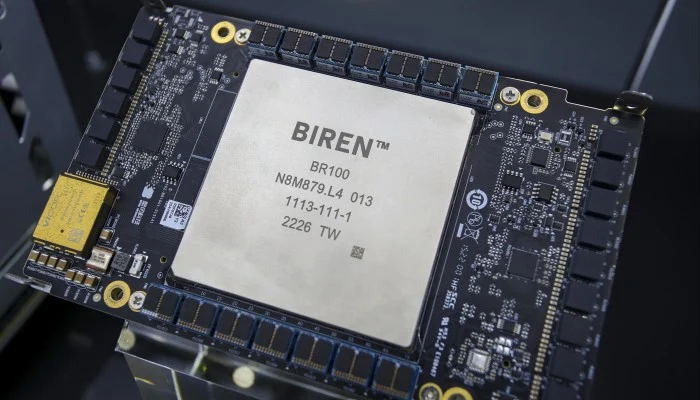
Chinese AI chip startup Biren Technology has unveiled a new generation of light-based “supernode” architecture that uses optical interconnect technology to connect more than 1,000 AI accelerator cards into a single computing cluster. The company says the approach is designed to overcome the bandwidth and scalability limitations of conventional electrical connections, enabling AI infrastructure capable of handling the next generation of trillion-parameter models and autonomous AI agents.
The announcement reflects China’s broader push to build competitive AI computing infrastructure as U.S. export restrictions limit access to Nvidia’s most advanced AI chips. Rather than focusing solely on individual chip performance, Biren is betting that faster, more efficient communication between thousands of processors will be critical for future AI workloads.
Biren Introduces Optical ‘Supernodes’ for AI Computing
Biren’s latest system centers on a distributed, decoupled supernode architecture that leverages near-packaged optics (NPO).
Unlike traditional copper-based electrical links, NPO places optical components much closer to AI processors, enabling significantly higher data transmission speeds while reducing latency and power consumption.
According to Biren, the architecture can scale clusters to 1,024 processor cards, allowing thousands of GPUs to function more like a unified computing system rather than isolated processors.
Supernode Overview
| Feature | Details |
|---|---|
| Company | Biren Technology |
| Technology | Near-Packaged Optics (NPO) |
| Architecture | Distributed AI supernode |
| Cluster scale | Up to 1,024 processor cards |
| Primary goal | Improve AI cluster scalability |
Why Optical Interconnects Matter
As AI models continue growing in size, communication between processors has become a major bottleneck.
Instead of relying only on faster individual chips, hyperscale AI systems increasingly depend on rapid data movement across thousands of accelerators.
Biren believes optical interconnects can help solve challenges such as:
- Higher bandwidth between processors.
- Lower communication latency.
- Reduced energy consumption.
- Better scalability for massive AI clusters.
- Improved performance for large language model training and inference.
The company described optical connectivity as an essential technology for overcoming the limitations of conventional electrical networking.
Benefits of Optical Supernodes
| Advantage | Potential Impact |
|---|---|
| Optical data transmission | Faster communication between AI chips |
| Lower latency | Improved distributed computing efficiency |
| Energy efficiency | Reduced power consumption |
| Large-scale clustering | Better support for trillion-parameter AI models |
Competing With Nvidia Beyond Individual Chips
Rather than claiming superior standalone GPU performance, Biren is focusing on the infrastructure layer that connects thousands of processors together.
This mirrors a broader trend across the AI industry, where system-level performance increasingly depends on networking technologies such as:
- Optical interconnects.
- High-speed switching.
- Advanced memory architectures.
- Cluster management software.
Nvidia has built a strong competitive advantage through its integrated ecosystem of GPUs, networking, and CUDA software. Chinese AI chip companies are responding by developing alternative hardware architectures and software platforms that reduce dependence on U.S. technology.
Infrastructure Comparison
| Area | Traditional AI Clusters | Biren Supernode |
|---|---|---|
| Chip communication | Primarily electrical links | Optical interconnects |
| Cluster size | Limited by networking bottlenecks | Up to 1,024 processor cards |
| Focus | Individual GPU performance | System-level scalability |
Part of China’s Broader AI Semiconductor Push
Biren’s announcement comes amid accelerating efforts by Chinese semiconductor companies to strengthen domestic AI computing capabilities despite export controls on advanced chips.
Chinese AI hardware firms are increasingly investing in:
- Homegrown GPU architectures.
- Optical networking technologies.
- Open-source software ecosystems.
- Large-scale AI infrastructure.
- Domestic semiconductor supply chains.
The strategy reflects an industry-wide shift toward building complete AI computing platforms rather than competing solely on processor specifications.
Industry Trends
| Trend | Objective |
|---|---|
| Optical networking | Eliminate communication bottlenecks |
| AI supernodes | Scale distributed computing |
| Domestic software stacks | Reduce reliance on CUDA |
| Local AI infrastructure | Improve technological self-sufficiency |
Looking Ahead
Biren’s introduction of an optical supernode architecture highlights a growing shift in AI infrastructure from maximizing individual chip performance to optimizing communication across massive processor clusters. As AI models continue expanding in size and complexity, high-speed optical networking is becoming an increasingly important component of next-generation data centers.
For China, the technology represents another effort to narrow the gap with Nvidia by innovating at the system level rather than relying solely on semiconductor manufacturing advances. While Biren will still face significant competition from established global AI infrastructure providers, its focus on light-based interconnects underscores how future AI performance may depend as much on networking architecture as on the processors themselves.
Get the day’s top stories in your inbox
One concise email. No spam, unsubscribe anytime.