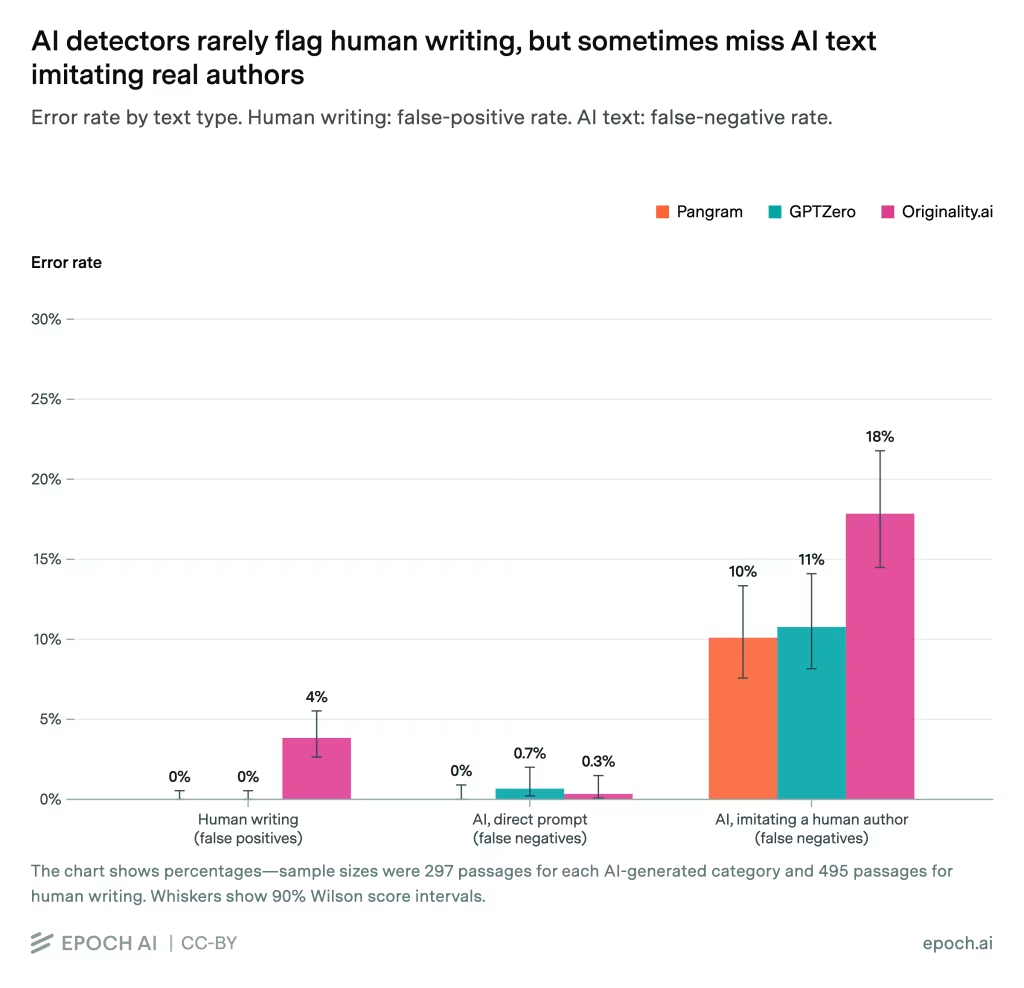
Artificial intelligence text detectors become significantly less reliable when large language models are instructed to closely imitate a specific author’s writing style, according to new research highlighted by The Decoder. The findings suggest that stylistic mimicry can reduce the effectiveness of current AI detection systems, raising fresh questions about the use of AI detectors in education, publishing, and content moderation.
The study found that when language models generate text matching an individual’s vocabulary, sentence structure, and writing patterns, many leading AI detectors struggle to distinguish machine-generated content from authentic human writing. The results underscore a growing challenge as AI models become increasingly capable of personalized writing assistance.
AI Detectors Become Less Reliable When Models Mimic Human Style
Most AI text detectors work by identifying statistical patterns commonly found in machine-generated writing, such as predictable phrasing, sentence structure, and word selection.
However, researchers found that these patterns become much less apparent when an AI model is prompted to emulate a specific person’s writing style.
Instead of producing generic AI prose, the model generates text that more closely resembles the target author’s:
- Vocabulary choices.
- Sentence length.
- Tone and voice.
- Punctuation habits.
- Overall writing rhythm.
As a result, detection accuracy declines because the generated text falls outside the detector’s expected patterns.
Key Findings
| Finding | Implication |
|---|---|
| AI mimics author style | Detection accuracy drops |
| Personalized writing | Harder to distinguish from human text |
| Generic AI signatures reduced | Higher false negatives |
| Existing detectors | Less reliable for stylized outputs |
Why Current AI Detection Tools Struggle
Most commercial AI detectors rely on stylometric analysis rather than definitive proof of authorship.
They typically analyze characteristics such as:
- Word frequency.
- Predictability of token sequences.
- Sentence complexity.
- Repetitive phrasing.
- Statistical language patterns.
When an AI model deliberately adopts the stylistic fingerprint of a human author, many of these signals become weaker or disappear altogether.
Researchers argue that this represents a broader distribution shift problem—detectors trained on one style of AI output often perform poorly when faced with newer models, unfamiliar domains, or heavily customized writing.
How Detection Changes
| Traditional AI Output | Style-Mimicking AI Output |
|—|—|—|
| Generic phrasing | Personalized language |
| Predictable structure | Matches author’s habits |
| Easier to detect | Much harder to detect |
| Strong statistical signals | Weaker AI signatures |
Implications for Education and Publishing
The findings have important implications for institutions that rely on AI detection software.
Potential challenges include:
- More false negatives where AI-written text is classified as human.
- Greater uncertainty in academic integrity investigations.
- Increased difficulty verifying authorship.
- Reduced confidence in automated detection tools.
Previous research has also shown that AI detectors can generate false positives by incorrectly labeling genuine human writing as AI-generated, particularly for non-native English speakers.
Potential Impact
| Sector | Challenge |
|---|---|
| Education | Harder to identify AI-assisted assignments |
| Publishing | More difficult content verification |
| Enterprises | Reduced effectiveness of AI detection software |
| Compliance | Greater reliance on human review |
Shift Toward Provenance Instead of Detection
The research reinforces a growing view within the AI community that detecting AI-generated text based solely on writing style may become increasingly ineffective.
Instead, researchers and technology companies are exploring alternative approaches, including:
- Cryptographic watermarking.
- Content provenance standards.
- Digital signatures.
- Metadata-based verification.
- Platform-level attribution.
These methods attempt to identify the origin of AI-generated content without relying exclusively on linguistic analysis, although they also face technical and adoption challenges.
Detection vs. Provenance
| Approach | Strength | Limitation |
|---|---|---|
| AI text detectors | Works on typical AI writing | Less effective against personalized styles |
| Watermarking | Can identify participating AI systems | Not universal and can be circumvented |
| Provenance metadata | Strong origin verification | Requires ecosystem-wide adoption |
Looking Ahead
The latest findings highlight how rapidly advancing language models are challenging the assumptions behind today’s AI text detection systems. As models become better at reproducing individual writing styles, purely stylometric detection methods are likely to become less dependable, particularly in high-stakes settings such as education, journalism, and legal documentation.
The research adds to a growing body of evidence suggesting that the future of AI content verification may depend less on identifying stylistic patterns and more on establishing trustworthy provenance through watermarking, metadata, and other cryptographic techniques. While AI detectors will likely remain useful as one signal among many, experts increasingly caution against treating their results as definitive proof that a text was—or was not—generated with artificial intelligence.
Get the day’s top stories in your inbox
One concise email. No spam, unsubscribe anytime.