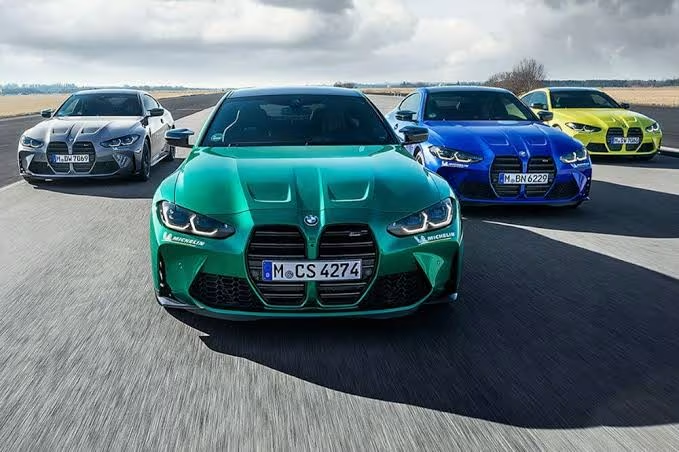
BMW India EV sales have reached a big milestone. BMW India EV sales now make up about one in four cars the company sells here. That means electric vehicles, or EVs, are battery-powered cars. The shift matters because EV prices are moving closer to petrol and diesel luxury cars.
Key takeaways
- BMW says around 25% of its India car sales are now electric.
- Price gaps between luxury EVs and fuel cars are getting smaller.
- Lower running costs are helping more buyers pick electric models.
- The trend shows EVs are moving from niche to mainstream in luxury cars.
Why are BMW India EV sales rising now?
BMW India says demand for electric cars has grown fast in its luxury lineup. A luxury car is a premium, higher-priced vehicle with extra features. The company’s latest signal is simple: buyers are no longer treating EVs like a risky experiment.
One in every four BMW cars sold in India is now electric. That is 25% of total sales. For a luxury brand, that is a strong number because EV buyers once formed only a small slice of the market.
The biggest reason is price. BMW executives told CNBC-TV18 that several electric models are getting close in price to petrol models. Price parity means two versions cost nearly the same. When that gap shrinks, buyers compare the cars more fairly.
Running costs also help. Charging an EV usually costs less than filling a tank with fuel. Service bills can also be lower because EVs have fewer moving parts.
How close are EV and petrol prices getting?
Luxury EVs used to look much more expensive than fuel cars. That made many buyers pause, even if they liked the new tech. Now the gap is smaller, so the choice feels less scary.
BMW has electric options across different price points in India, including the iX1 long wheelbase, i4, i5, i7 and iX. Long wheelbase means the car body is stretched for more rear-seat space. That matters in India because many luxury buyers sit in the back.
If an electric BMW costs only a little more than a petrol BMW, buyers start asking a new question. Why not choose the quieter car with lower day-to-day costs? That change in thinking is a big deal.
| What buyers compare | Petrol car | Electric car |
|---|---|---|
| Upfront price | Usually lower | Gap is narrowing |
| Fuel or charging cost | Higher | Usually lower |
| Engine noise | More noise | Very quiet |
| Service needs | More moving parts | Fewer moving parts |
What numbers matter in BMW India EV sales?
The headline number is 25%. That means 1 out of every 4 BMW cars sold in India is now electric. If a brand sold 100 cars, about 25 of them would be EVs. That is easy to picture.
BMW has also built a wider EV range than many rivals in India. More choice helps because buyers in this segment care about body style, rear-seat comfort, and brand image. A sedan is a regular four-door car. An SUV is taller and roomier.
India’s wider EV market is still much smaller than the petrol market, but luxury brands often move first. They can test new tech with buyers who are willing to spend more. Then the rest of the market often follows later.
BMW India sales mixElectric share: 25% | Non-electric share: 75%EV 25%Other 75%
What does this mean for India’s luxury car market?
It suggests the luxury EV market is no longer tiny. Buyers are starting to think about total cost, not just showroom price. Showroom price means the listed purchase price before many on-road costs are added.
It also shows that charging worries may be easing for rich city buyers. Many of them can install home chargers in houses or apartment towers. That makes daily charging much simpler.
BMW’s momentum may put pressure on rivals like Mercedes-Benz, Audi, and Volvo. If one brand proves buyers will switch, others usually speed up. Competition can help bring more models and better prices.
This fits a bigger pattern in India’s premium market. Companies are investing more in future-facing sectors, from manufacturing to tech. You can see that in Tata Motors’ ₹40,000 crore investment in India and in Google’s support for Indian AI startups.
Are there still roadblocks for BMW India EV sales?
Yes, a few big ones remain. Public charging is still uneven across India. Public charging means stations outside your home, like fuel pumps for EVs. Big cities are better served than smaller towns.
Battery worries also remain for some buyers. People ask how long the battery lasts and what replacement may cost later. Carmakers try to calm those fears with warranties. A warranty is a company promise to fix some problems for a set time.
Taxes and policy matter too. Government incentives can change the final price of an EV. A policy is a rule or plan set by the government. If policy support weakens, demand could slow.
Still, the direction looks clear. Buyers seem more willing to go electric when the price gap narrows. That is the core story behind BMW India EV sales right now.
How does this fit the bigger shift to electric mobility?
India’s EV journey is moving in layers. Two-wheelers and city fleets are growing in one lane. Luxury cars are growing in another lane, but for different reasons.
Luxury buyers often care about smooth performance, silence, and new tech. EVs deliver all three. In fact, electric cars can feel faster at low speeds because power comes instantly when you press the pedal.
That does not mean petrol cars are disappearing tomorrow. It means more buyers now see EVs as practical, not just futuristic. That is a major mindset change, and BMW India EV sales are a clean sign of it.
The larger business backdrop matters as well. Investors are still watching India closely, as seen in record FPI investment in Indian government bonds. Digital habits are also changing fast, with biometric UPI transactions hitting 611 million. New habits often make people more open to new kinds of cars too.
BMW India EV sales show that luxury electric cars are moving into the mainstream. When EV prices get close to petrol cars, many buyers stop asking if electric works and start asking which electric model to buy.
For primary details on BMW India’s model lineup, buyers can check the official BMW India electric range. For the bigger policy picture, the Ministry of Heavy Industries tracks EV-related schemes in India.
BMW India EV sales: what should buyers watch next?
Watch three things. First, see whether BMW can keep the EV share near 25% or push it higher. Second, watch if rivals match prices more aggressively. Third, keep an eye on charging growth in more cities.
If those three pieces improve together, luxury EV growth could speed up again. And if prices move even closer, the choice could become much easier for first-time premium buyers. That is why BMW India EV sales matter beyond one company.
FAQs
What are BMW India EV sales?
BMW India EV sales means the share of BMW cars sold in India that are fully electric. Right now, that share is about 25%.
Why are BMW India EV sales growing?
They are growing because prices are getting closer to petrol models. Buyers also like lower running costs and the quiet driving feel.
How important is the 25% figure?
It is important because 1 in 4 sales is a strong share for a luxury brand. It shows EVs are no longer a tiny niche in BMW’s India business.
Get the day’s top stories in your inbox
One concise email. No spam, unsubscribe anytime.