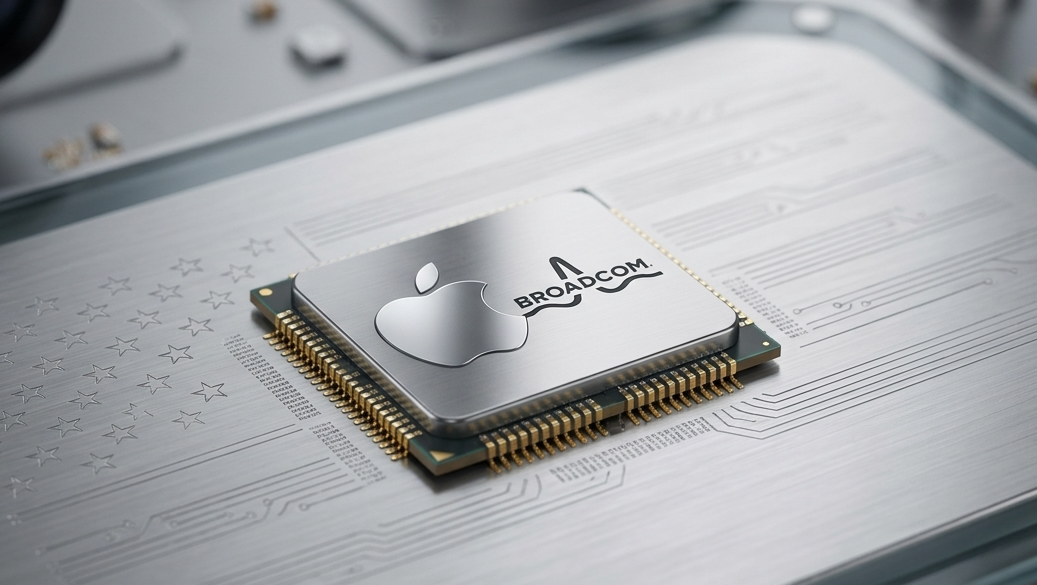
The Apple Broadcom chips deal is Apple’s plan to spend about $30 billion on chips and parts from Broadcom in the United States. That means Apple will buy more key tech pieces closer to home. It also means Broadcom plans to expand work at its Colorado factory.
Key takeaways
- Apple plans to spend about $30 billion with Broadcom on US-sourced chips and parts.
- Broadcom’s factory in Fort Collins, Colorado, is set to expand because of the deal.
- The move supports Apple’s wider push to build more of its supply chain in the US.
- Investors watch deals like this because chips power iPhones, Macs, and AI features.
What is the Apple Broadcom chips deal?
The Apple Broadcom chips deal is a long-term supply agreement, which means one company promises to buy goods from another over time. In this case, Apple will spend roughly $30 billion with Broadcom on chips and related parts made in the US. Reuters first reported the development, citing the companies.
These chips are tiny electronic brains. They help devices send signals, connect to networks, and run key functions. Apple uses Broadcom parts in products like iPhones and other devices, so this is not a random shopping trip. It’s a big supply move.
Apple did not say every product that will use the new parts. But the company made the bigger goal clear. It wants more important components to come from US facilities, because supply chains have been shaky in recent years.
Why does Apple want more US-made chips?
Apple has leaned hard on Asian manufacturing for years. That system made gadgets at huge scale, but it also faced stress during the pandemic and trade fights. A supply chain is the path parts take from factory to customer. When one link breaks, the whole chain can slow down.
So Apple has been spreading out its suppliers. It has added more production in places like India and Vietnam. It is also putting more money into US chip work, because chips are the hardest parts to replace fast.
The Apple Broadcom chips deal fits that bigger map. It is not just about buying parts. It is about making sure future iPhones, Macs, and other devices can get the chips they need on time.
Apple has made similar promises before. In 2021, it said it would invest $430 billion in the US over five years. Then in 2025, it said it planned more than $500 billion in the US over four years. That figure covers suppliers, jobs, and facilities.
What happens in Colorado now?
Broadcom said the deal will help expand its factory in Fort Collins, Colorado. Expansion usually means more equipment, more floor space, or more workers. The company did not spell out a final job number in the first reports.
Still, the dollar figure is huge. A $30 billion commitment is large even for Apple, one of the world’s richest companies. For Colorado, it signals that advanced chip work can keep growing outside the usual factory hotspots.
The Apple Broadcom chips deal also matters because Broadcom is not a small niche player. It is one of the biggest chip companies in the world. Its parts handle wireless links, radio signals, and networking inside many kinds of electronics.
Apple US spending snapshot$30B$430B$500B+Broadcom dealUS plan 2021US plan 2025
How big is this compared with Apple’s other spending?
Here is the simple view: $30 billion is a slice of Apple’s wider US push, but it is still massive on its own. It is nearly 7% of the $430 billion Apple outlined in 2021. It is also about 6% of the $500 billion-plus plan Apple announced for the next four years.
That matters because chips sit at the center of every device. If a phone misses one key part, the whole phone can’t ship. So a reliable chip source can matter more than a cheaper one.
| Item | Amount | What it means |
|---|---|---|
| Broadcom deal | $30 billion | Apple buying US-sourced chips and parts |
| Apple US plan announced in 2021 | $430 billion | Earlier multi-year US investment pledge |
| Apple US plan announced in 2025 | $500 billion+ | Newer four-year US spending target |
Why do investors care about the Apple Broadcom chips deal?
Investors like stable supply. They also like clear long-term contracts, because those can reduce surprises. A contract is a formal agreement. It tells both sides what they expect to buy or build.
For Apple, this could lower risk if global shipping gets messy again. For Broadcom, it means a giant customer is committing serious money. That can support factory planning years ahead, because managers know demand is more likely to hold up.
The Apple Broadcom chips deal may also help the US argument for making more strategic tech at home. Strategic means especially important for the economy or national security. Chips fall into that group, since they power phones, data centers, cars, and defense systems.
This trend has been building for a while. For example, we’ve seen fresh attention on tech supply chains in stories like SambaNova’s $1 billion funding round and Google selecting 20 Indian AI startups. Those moves show how much money is chasing chips and AI tools now.
Does this change Apple’s global manufacturing strategy?
Not fully. Apple still depends on a huge international network for assembly and parts. But this deal adds another block to a new strategy: don’t put too many eggs in one basket.
That approach has shown up across industries. In India, for instance, companies are putting more money into local capacity, as seen in Tata Motors’ ₹40,000 crore investment plan and the rise of India’s retail GCC hubs. A GCC is a global capability centre. It means an office that handles important business and tech work for a company.
Apple’s move is part of the same broad idea. Build key things in more places. Keep the most critical parts close and dependable.
The clearest takeaway is this: the Apple Broadcom chips deal is Apple paying about $30 billion to secure more US-made chip parts, while helping Broadcom expand its Colorado factory and making Apple’s supply chain less risky.
Where did the numbers come from?
The main facts came from Reuters’ report on July 8 and company statements tied to the announcement. Apple’s larger US spending pledges are available on Apple’s newsroom site. Broadcom’s business background is also detailed in its filings and investor materials, including its SEC filings. SEC filings are official company reports sent to US market regulators.
As more details come out, watch for two things. First, how much the Colorado site grows. Second, whether Apple names the exact chip categories covered by the Apple Broadcom chips deal.
FAQs
What is the Apple Broadcom chips deal?
It is Apple’s agreement to spend about $30 billion on chips and related parts from Broadcom in the US.
Why is Apple doing this now?
Apple wants a safer supply chain, because global disruptions can delay important parts and slow product shipments.
Who benefits from the deal?
Apple gets more secure sourcing, Broadcom gets a major customer commitment, and Colorado could see more factory activity and jobs.
Get the day’s top stories in your inbox
One concise email. No spam, unsubscribe anytime.