
Hot on the heels of lifting the U.S. export controls on its flagship models, Anthropic has officially released Claude Sonnet 5 (claude-sonnet-5).
Launched globally on June 30, 2026, the new mid-tier powerhouse has immediately replaced Sonnet 4.6 as the default model for all Free and Pro users, while rolling out natively across Claude Code, the Claude Platform, and Amazon Bedrock.
Anthropic’s core pitch for the model is clear: it brings near-Opus intelligence and advanced autonomy at a fraction of flagship pricing, explicitly optimized for complex multi-step “agentic” workflows.
1. The Core Upgrades: What Makes Sonnet 5 Different?
Sonnet 5 isn’t just a minor incremental patch; it represents a major generational shift in how a mid-tier model handles autonomous reasoning:
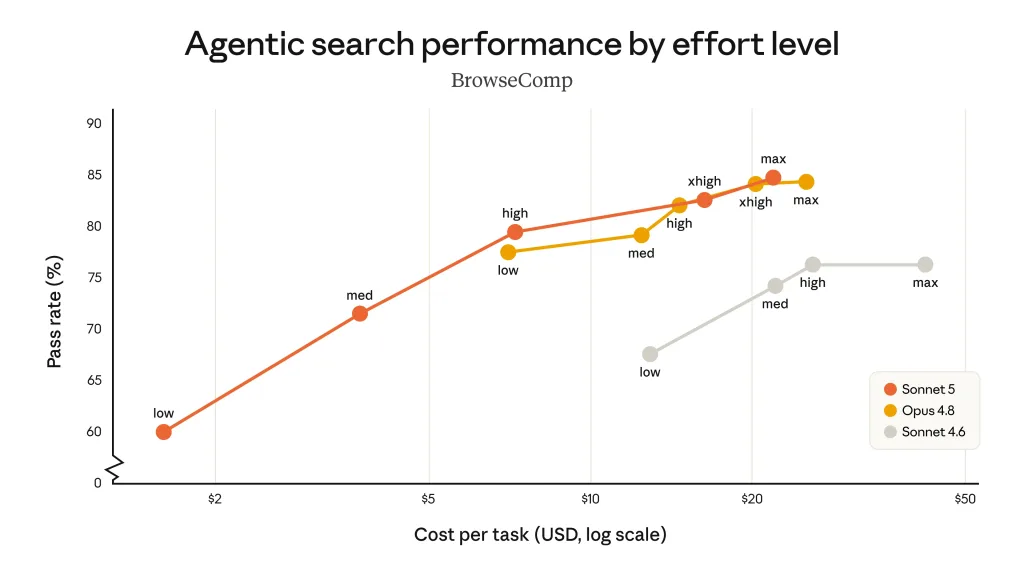
- Always-On Adaptive Thinking: Building on the architecture introduced in Fable 5, adaptive thinking is now on by default. Users can select between different reasoning effort levels (Low, Medium, High, Max, and X-High) depending on whether they need a lightning-fast reply or a deep, multi-minute step-by-step logic map.
- True Agentic Follow-Through: Anthropic calls this its “most agentic model yet.” Sonnet 5 is built to independently formulate a multi-step plan, use digital tools (like integrated web browsers and terminals), audit its own numerical outputs, and fix runtime bugs on a single pass without stalling halfway through a workflow.
- The Massive 1M Context Window: The model features a massive 1 million token context window and supports up to 128k max output tokens, enabling it to parse entire software codebases or dense financial ledgers in one go.
 [ User Prompt / Task Query ] ──► Adaptive Thinking Engine (Selectable reasoning effort)
                                               │
                                               ▼
 [ Sonnet 5 Agentic Layer    ] ──► Builds multi-step plan ──► Accesses tools (Browser, Terminal)
                                               │
                                               ▼ (Autonomous Iteration)
 [ Real-Time Self-Correction ] ──► Runs code / checks data ──► Auto-debugs failures internally
                                               │
                                               ▼
 [ Final Structured Output   ] ──► Delivers production-grade, audited code/reports
2. Performance: Narrowing the Flagship Gap
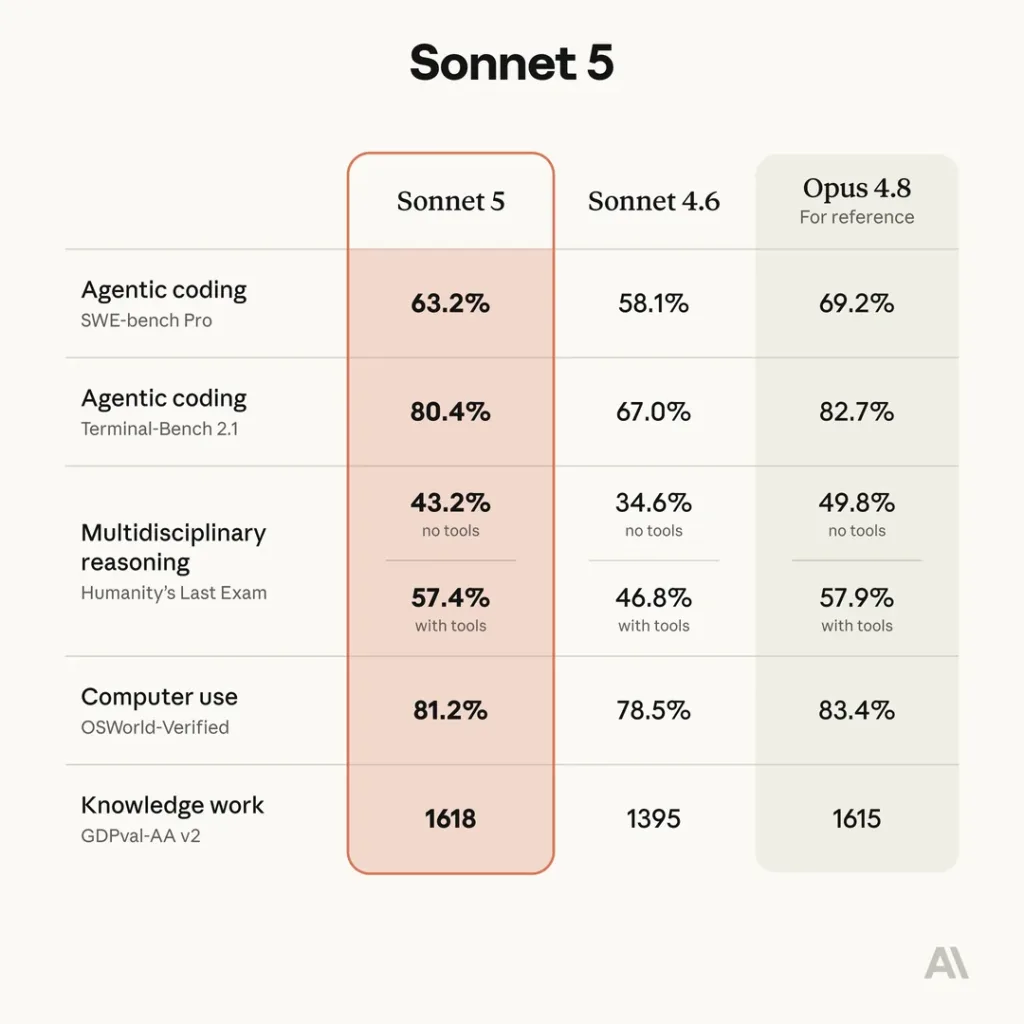
In a major win for developer budgets, benchmarks reveal that Sonnet 5 consistently beats its predecessor (Sonnet 4.6) and comes remarkably close to matching the heavily optimized Opus 4.8 on high-stakes reasoning evaluations:
| Benchmark Evaluation | Sonnet 4.6 | Sonnet 5 | Opus 4.8 (For Reference) |
| SWE-bench Pro (Agentic Coding) | 58.1% | 63.2% | 69.2% |
| Terminal-Bench 2.1 (CLI Navigation) | 67.0% | 80.4% | 82.7% |
| Humanity’s Last Exam (With Tools) | 46.8% | 57.4% | 57.9% |
| OSWorld-Verified (Computer Use) | 78.5% | 81.2% | 83.4% |
Early developer feedback highlights that the model excels at “brownfield code”—navigating messy, pre-existing legacy codebases, hunting down subtle race conditions, and writing comprehensive reproducing tests completely unprompted.
3. Two-Phase Token Pricing & Migration Watchout
To incentivize developers to migrate their API workloads away from legacy models immediately, Anthropic is launching the model with an aggressive, heavily discounted pricing structure:
- Introductory Pricing (Through August 31, 2026): $2 per million input tokens and $10 per million output tokens.
- Standard Pricing (September 1, 2026 onwards): $3 per million input tokens and $15 per million output tokens (matching the exact historical baseline of Sonnet 4.6).
- The Tokenizer Catch: Developers building production apps should note that Sonnet 5 utilizes an updated tokenizer. Depending on the language and content type, the same body of text can generate roughly 30% more tokens than it did on older versions. Anthropic deliberately priced the initial two-month introductory phase lower to make the technical transition entirely cost-neutral for existing enterprise pipelines.
On the safety front, Sonnet 5 incorporates the same real-time cyber safeguards deployed in the Opus line. These automated guardrails monitor outputs to instantly block high-risk dual-use security tasks and prompt-injection hijack attempts, making the model safe to use for consumer-facing automation and autonomous customer service agents.