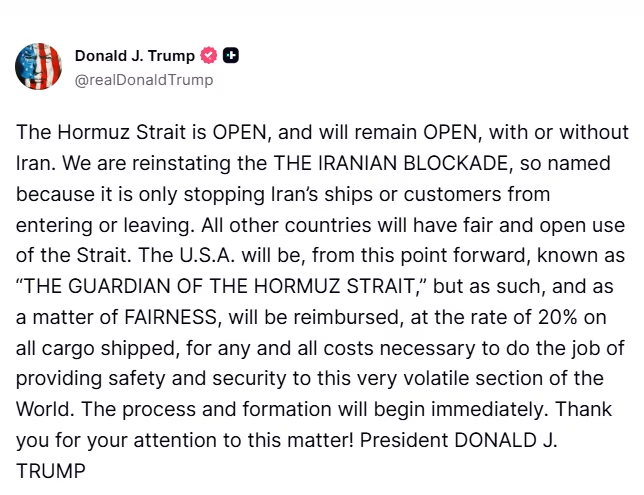
U.S. President Donald Trump announced that the United States is reinstating its naval blockade on Iran and will seek reimbursement of 20% on all cargo shipped through the Strait of Hormuz, following Iran’s declaration that it had again closed the strategic waterway. Trump said the U.S. would act as the “guardian” of the strait to ensure commercial shipping continues despite escalating military tensions in the Gulf.
The announcement marks a significant escalation in the ongoing U.S.-Iran conflict and comes after renewed missile, drone, and naval confrontations in the region. Iran has maintained that it controls access to the strait, while the U.S. says it will keep the shipping lane open for international commerce. The developments have already triggered a sharp rise in global oil prices and increased concerns over energy security and inflation.
Trump Announces New Hormuz Policy
The U.S. president outlined a new approach to securing the world’s most important oil shipping route.
| Announcement | Details |
|---|---|
| U.S. action | Reinstating naval blockade on Iran |
| Shipping policy | Strait to remain open for international traffic |
| Proposed reimbursement | 20% on all cargo shipped through the strait |
| U.S. role | “Guardian” of the Strait of Hormuz |
Trump said the policy would take effect immediately, though operational details on how the reimbursement would be collected were not provided.
Why the Strait of Hormuz Matters
The Strait of Hormuz is one of the world’s most strategically important maritime chokepoints.
Its significance includes:
- Transit route for a large share of global crude oil exports.
- Major liquefied natural gas (LNG) shipments.
- Critical energy corridor connecting Gulf producers to global markets.
- Essential supply route for Asian economies, including India, China, Japan, and South Korea.
Any disruption to traffic through the strait can quickly affect global energy prices and international trade.
Iran-U.S. Tensions Escalate
The latest announcement follows renewed military exchanges between the two countries.
Recent developments include:
- Iran declaring the strait closed.
- U.S. military operations targeting Iranian facilities.
- Missile and drone attacks across the Gulf.
- Increased naval deployments.
- Renewed threats to commercial shipping.
These developments have undermined earlier efforts to stabilize the region and restore uninterrupted maritime traffic.
Oil Markets React
Energy markets responded immediately to the renewed tensions.
| Market Impact | Potential Effect |
|---|---|
| Crude oil | Prices climbed above $80 per barrel |
| Shipping | Higher insurance and freight costs |
| Energy markets | Increased volatility |
| Inflation | Upward pressure globally |
Traders continue to monitor developments closely as any prolonged disruption could tighten global energy supplies.
Impact on Global Trade
The proposed U.S. policy could have broad implications.
Potential effects include:
- Higher shipping costs.
- Increased energy prices.
- Supply chain disruptions.
- Greater uncertainty for global trade.
- Additional costs for oil-importing nations.
Countries heavily dependent on Gulf energy supplies could face higher import bills if tensions persist.
Legal and Diplomatic Questions
Trump’s proposal also raises important international issues.
These include:
- Freedom of navigation.
- Enforcement of maritime security.
- International maritime law.
- Cost-sharing among allied nations.
- Regional diplomatic relations.
Whether a 20% reimbursement mechanism can be implemented would likely depend on military, diplomatic, and legal developments.
Outlook
The Strait of Hormuz remains at the center of one of the world’s most sensitive geopolitical flashpoints. Trump’s announcement signals a more assertive U.S. approach to securing the waterway, while Iran continues to challenge U.S. actions and assert its own authority over the strait. With military tensions intensifying and oil markets already reacting, governments, shipping companies, and energy traders are expected to closely monitor developments in the days ahead.
What It Means for Global Energy Markets
The renewed confrontation over the Strait of Hormuz highlights the vulnerability of global energy supply chains to geopolitical conflicts. Even without a prolonged closure of the waterway, heightened military activity and uncertainty can push up oil prices, increase shipping costs, and fuel inflation worldwide.
For major energy importers such as India, China, Japan, and South Korea, maintaining uninterrupted access through the Strait of Hormuz remains crucial. The evolving situation is likely to remain a key driver of commodity markets, inflation expectations, and global economic sentiment in the near term.
Get the day’s top stories in your inbox
One concise email. No spam, unsubscribe anytime.